Earth Observation Data Basics

The life cycle of Earth observation data is rich and complex, with many points of entry along the pipeline. From collection to visualization, we dive deep into the basics to demystify the incredible data in our catalog.

Remote Sensing

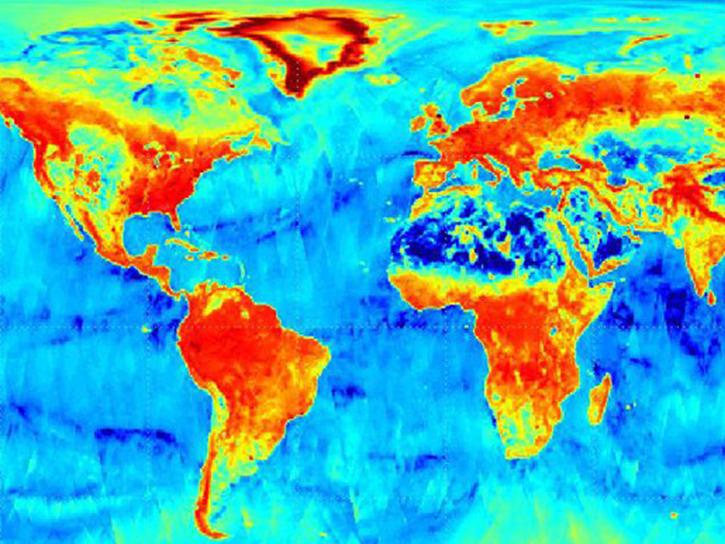
Remote sensing is the acquiring of information from a distance. NASA observes Earth and other planetary bodies via remote instruments on space-based platforms (e.g., satellites or spacecraft) and on aircraft that detect and record reflected or emitted energy. Remote instruments, which provide a global perspective and a wealth of data about Earth systems, enable data-informed decision making based on the current and future state of our planet.

For more information, check out the Fundamentals of Remote Sensing training from the Applied Remote Sensing Training (ARSET) program.

Get Data

Explore the world’s largest repository of open-access Earth science data.

Remote Sensing Data Basics

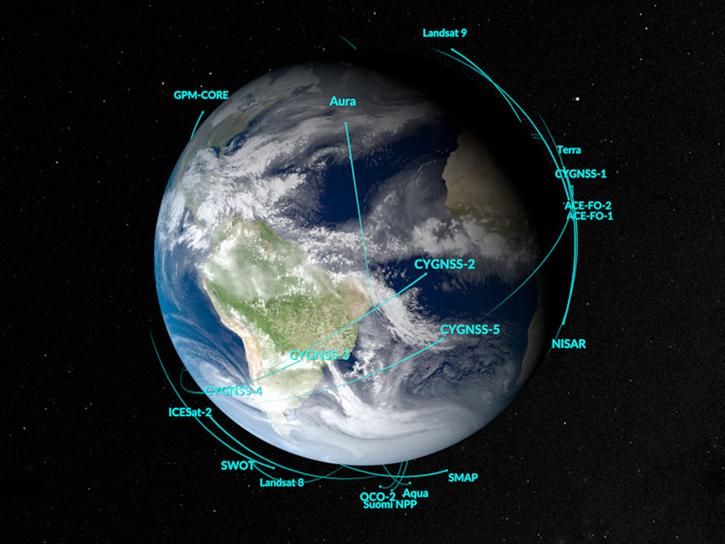
An orbit is the curved path a satellite follows around the Earth due to gravitational force.
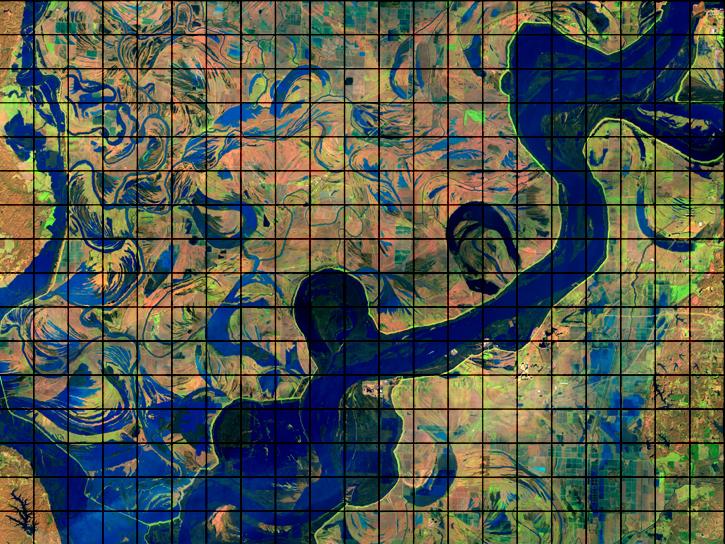
There are four types of resolution to consider for any dataset—radiometric, spatial, spectral, and temporal. Resolution plays a role in how data from a instrument can be used. Resolution can vary depending on the platform's orbit and instrument design.
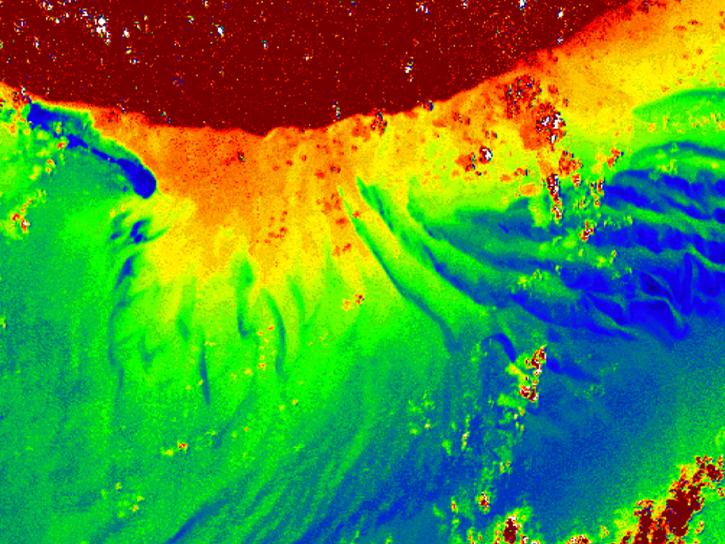
Active instruments emit energy and collect data based on changes in the return signal.
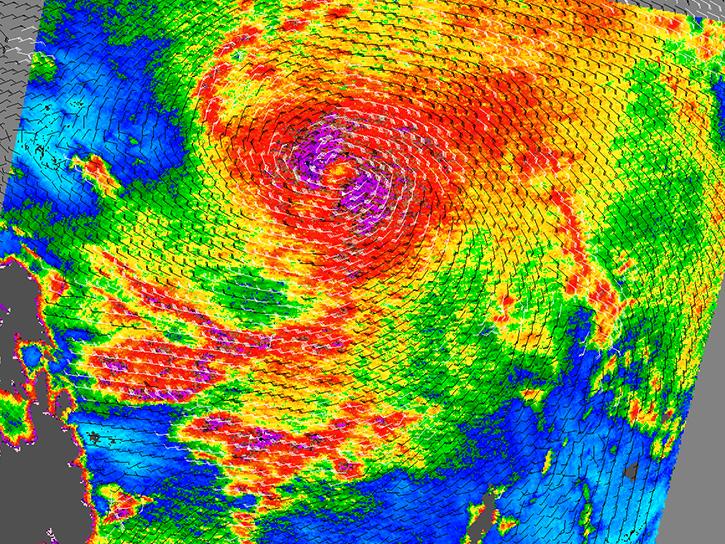
Essential variables are known to be critical for observing and monitoring a given facet of the Earth system

Understanding Metadata

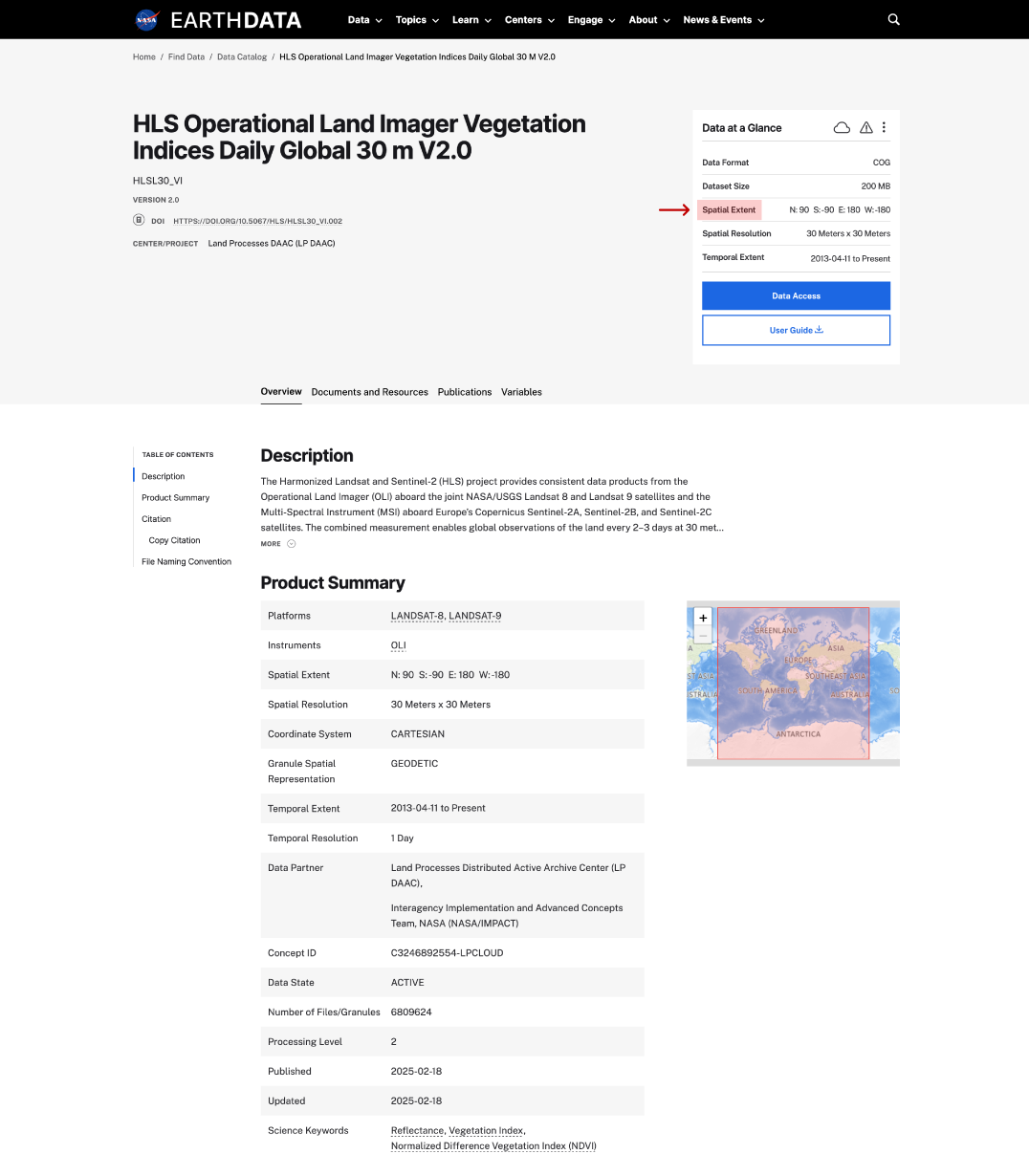
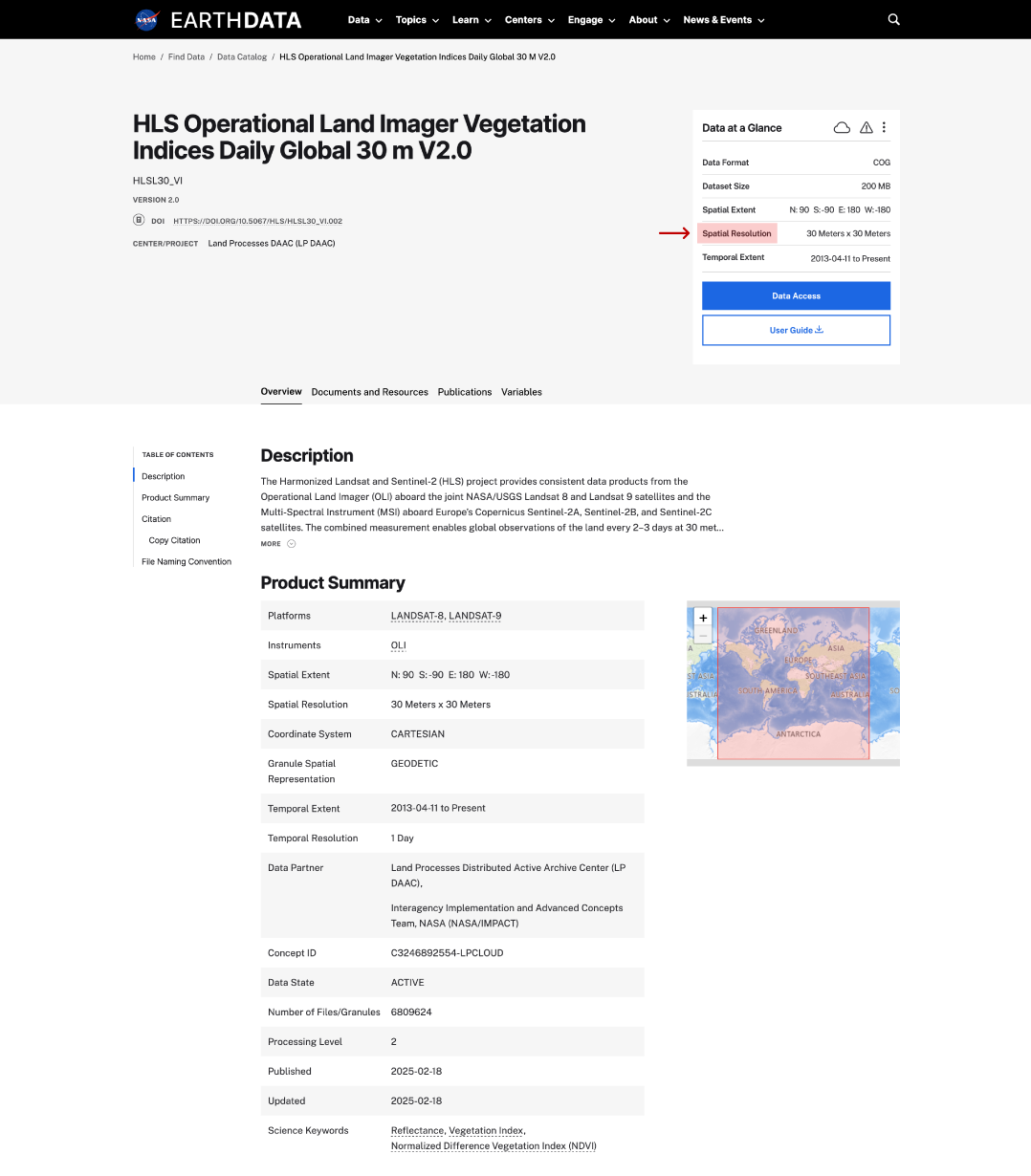
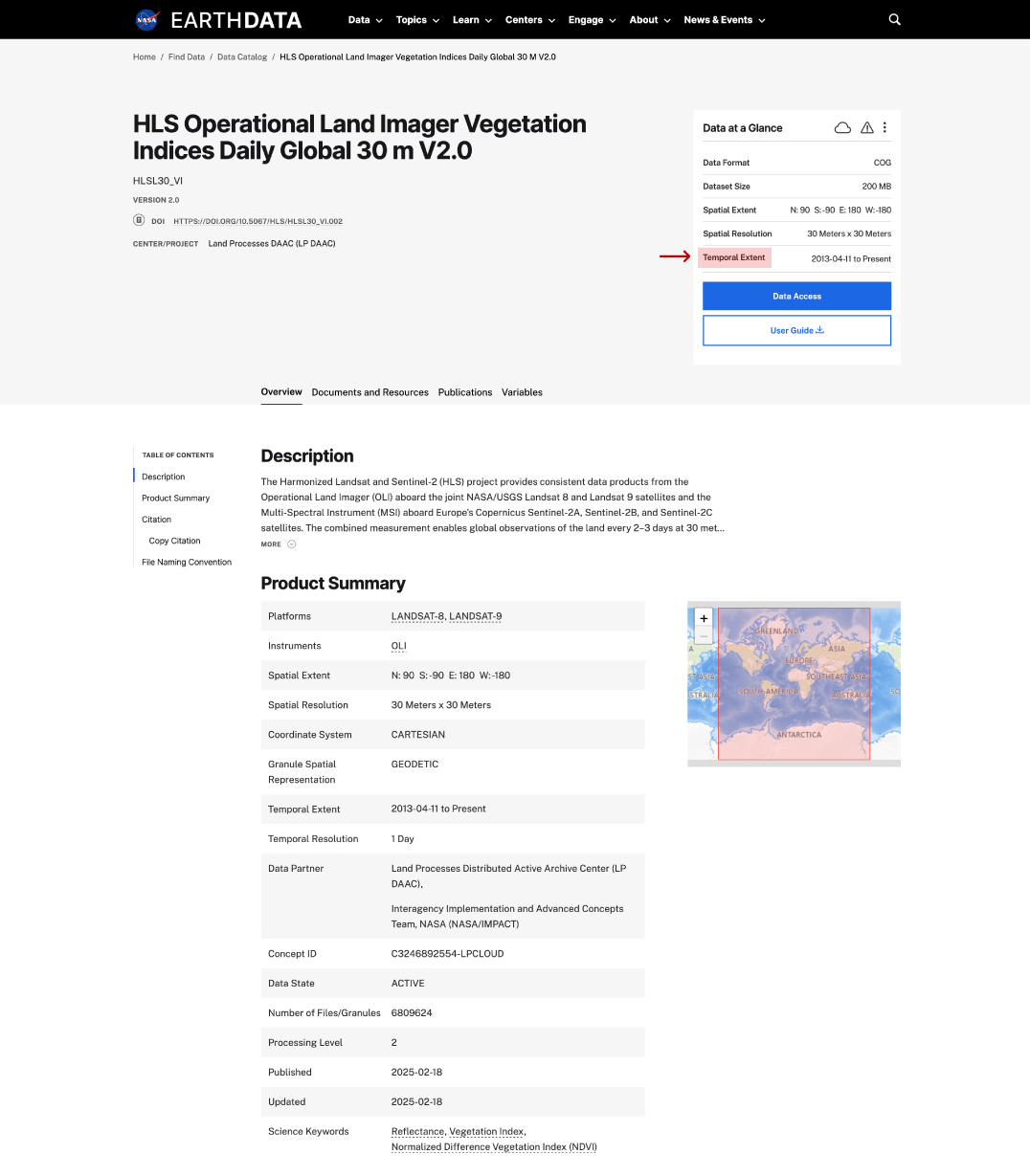
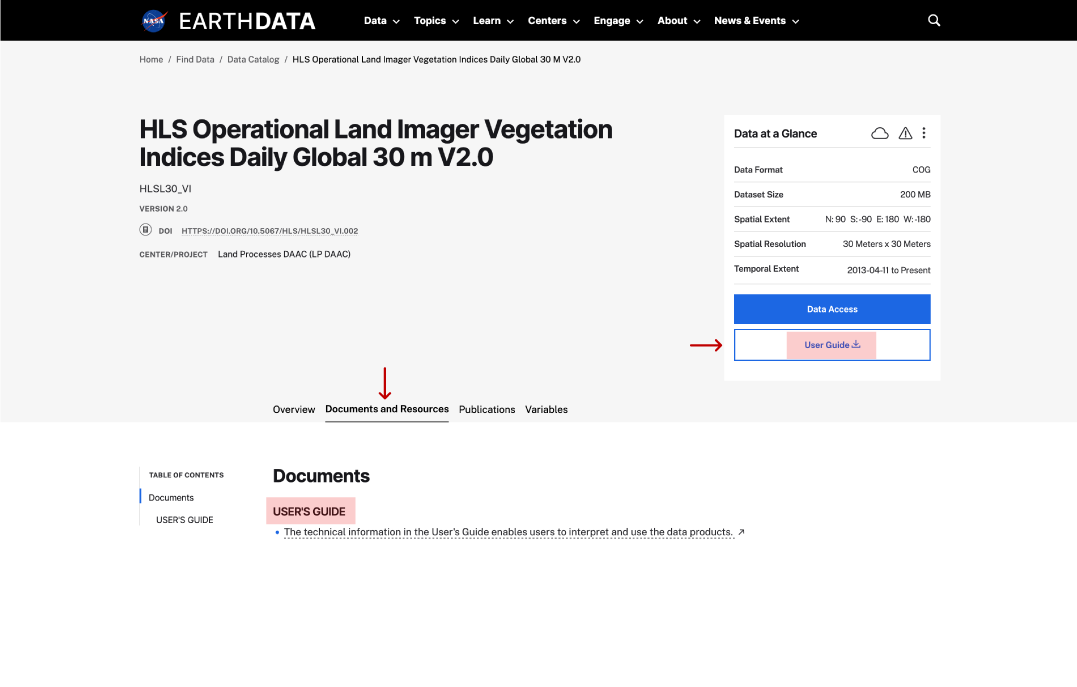
This interactive tool helps users navigate and understand essential metadata on our Earth science dataset landing pages. Through guided examples and hands-on exploration, learn critical context about our data to aid you in your own scientific discoveries.
Interactive

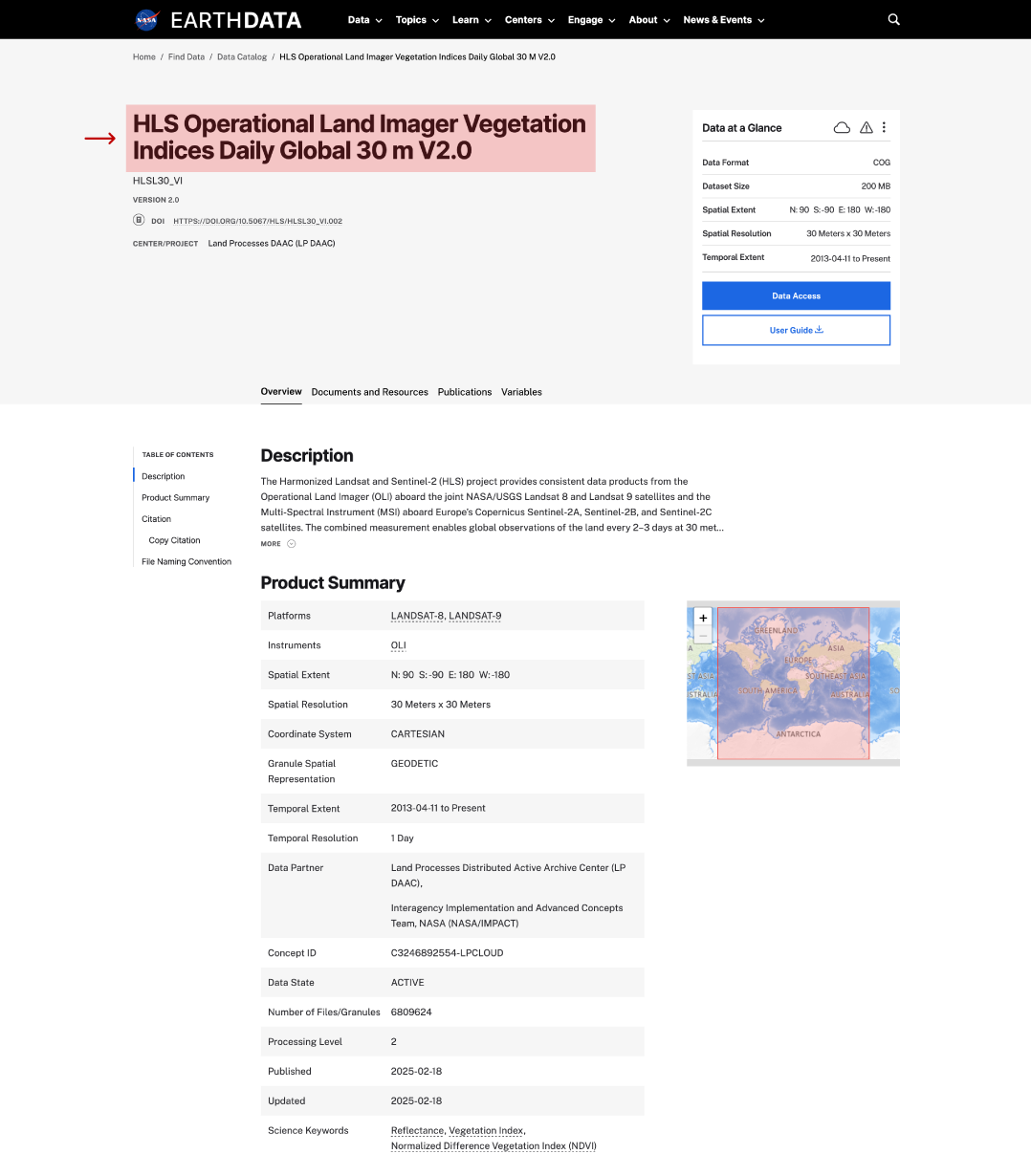
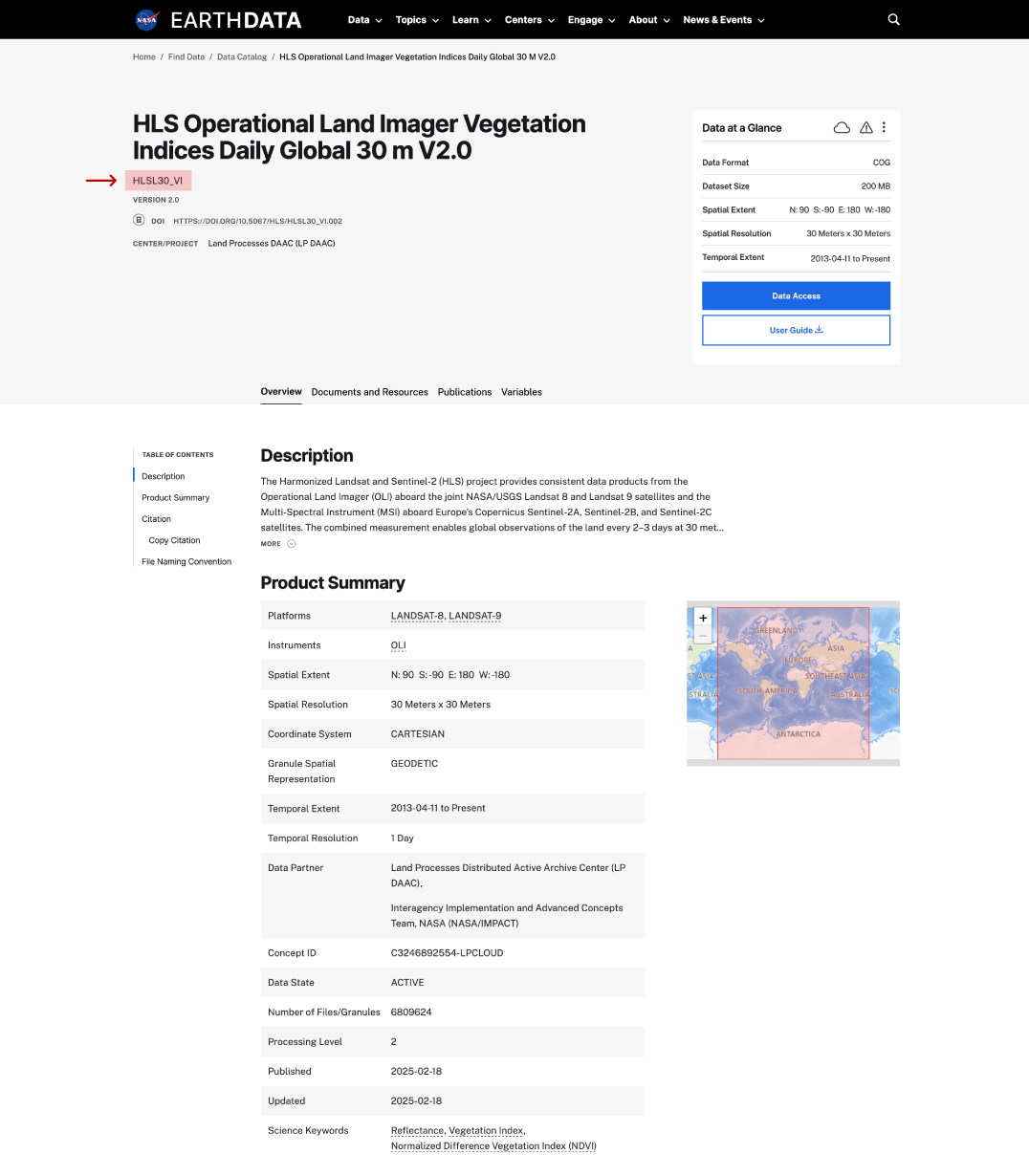
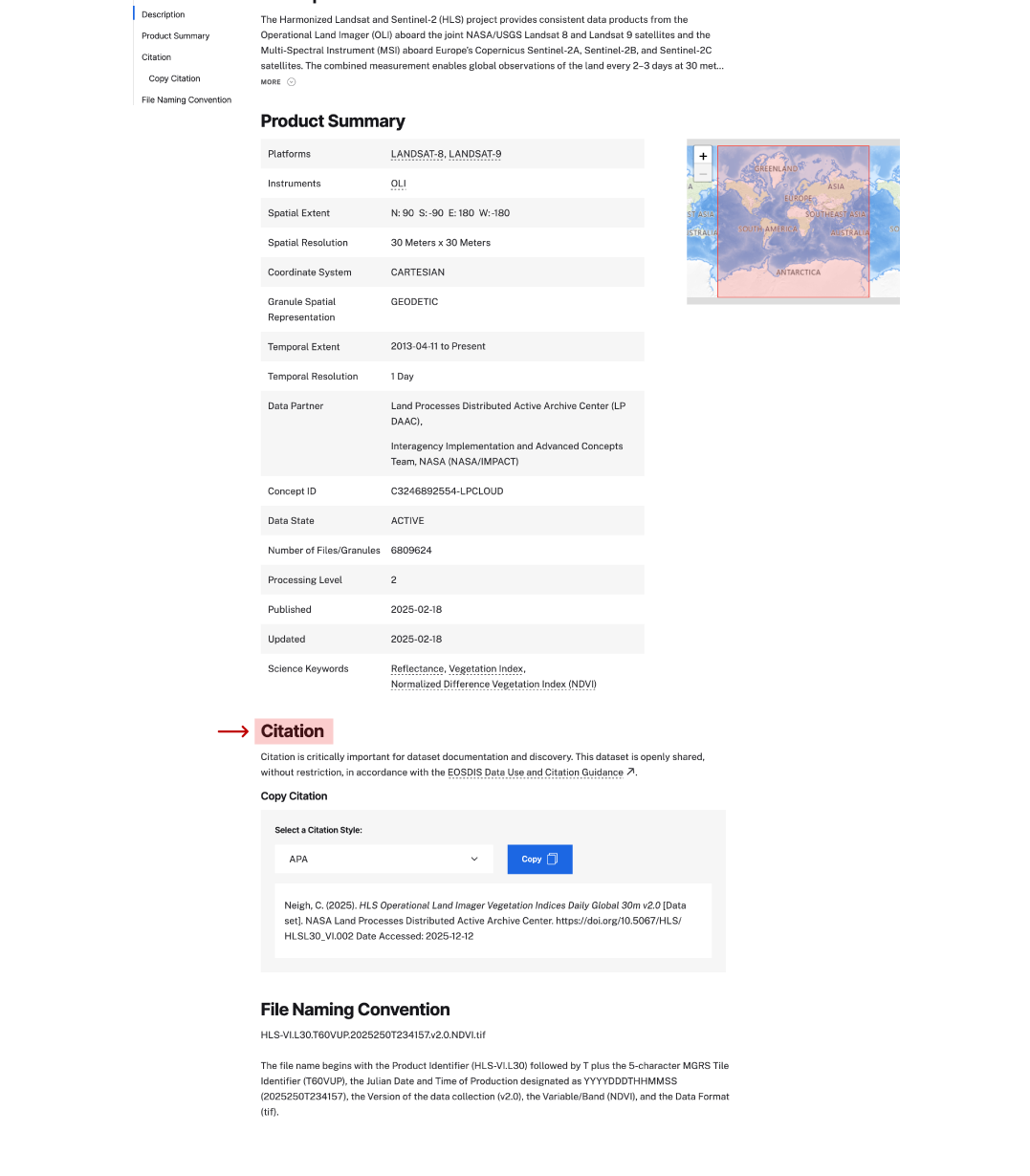
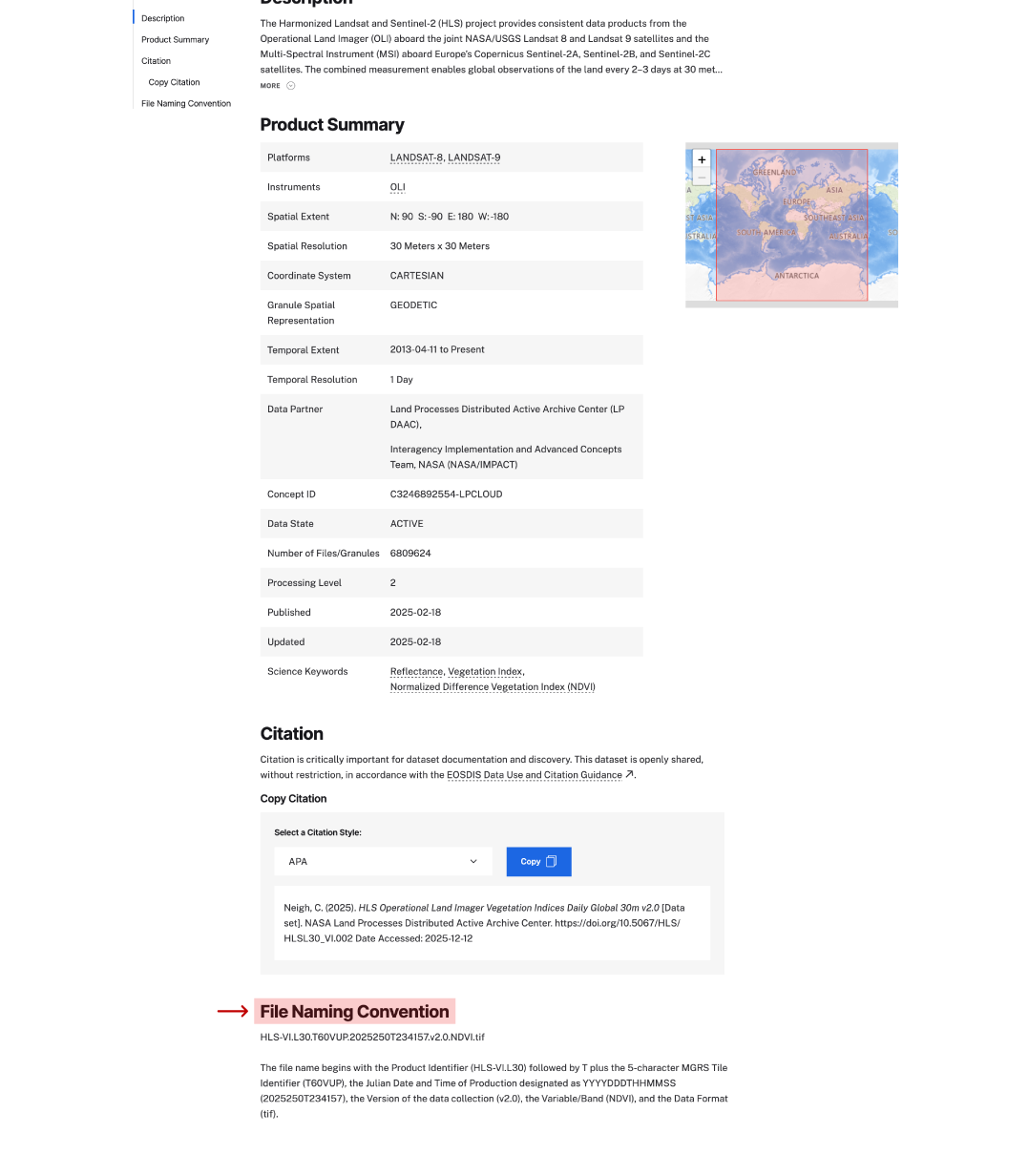
Parts of the Earthdata Dataset Landing Page

Explore
long name on dataset page
short name on dataset page
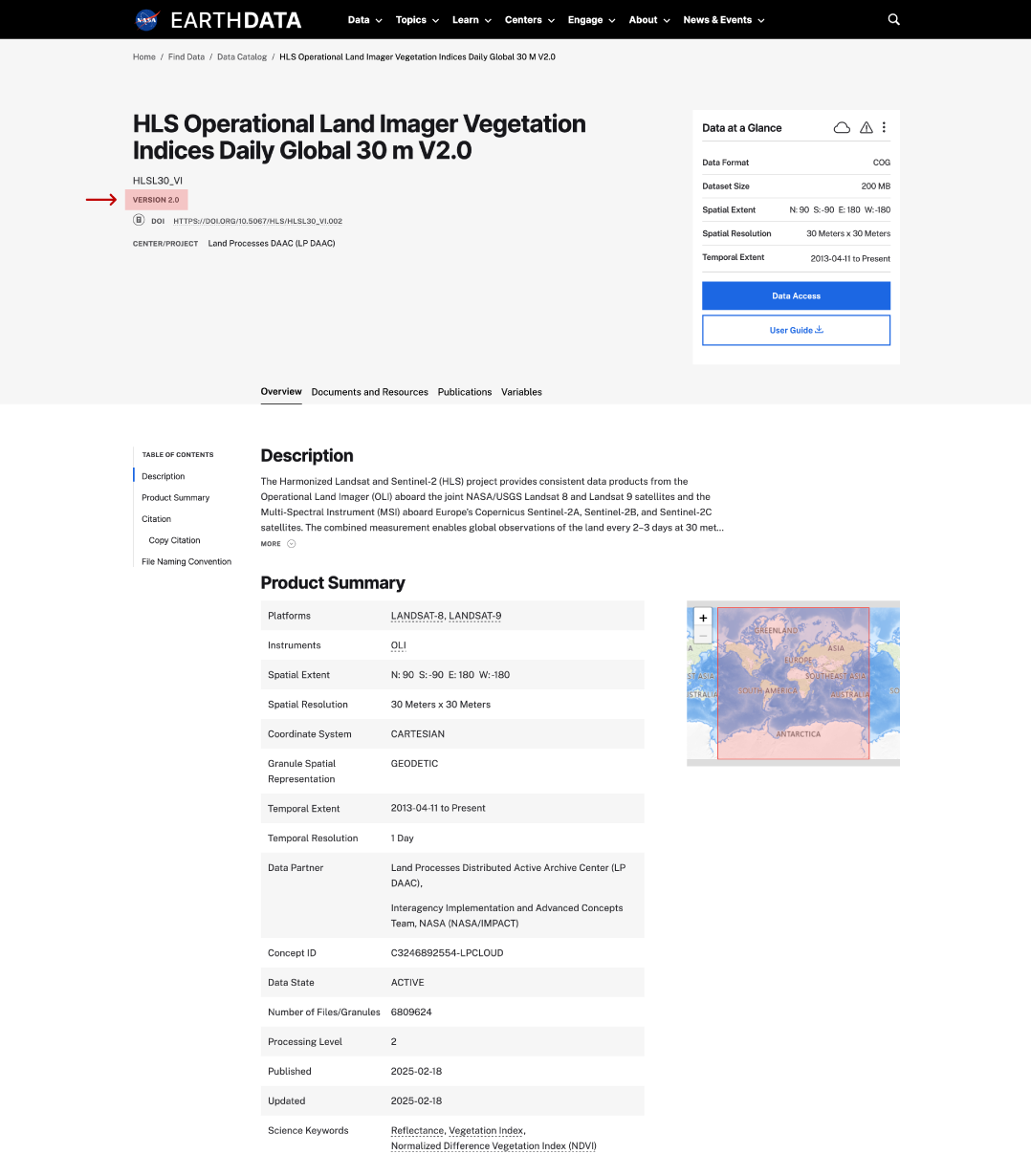
version on dataset page
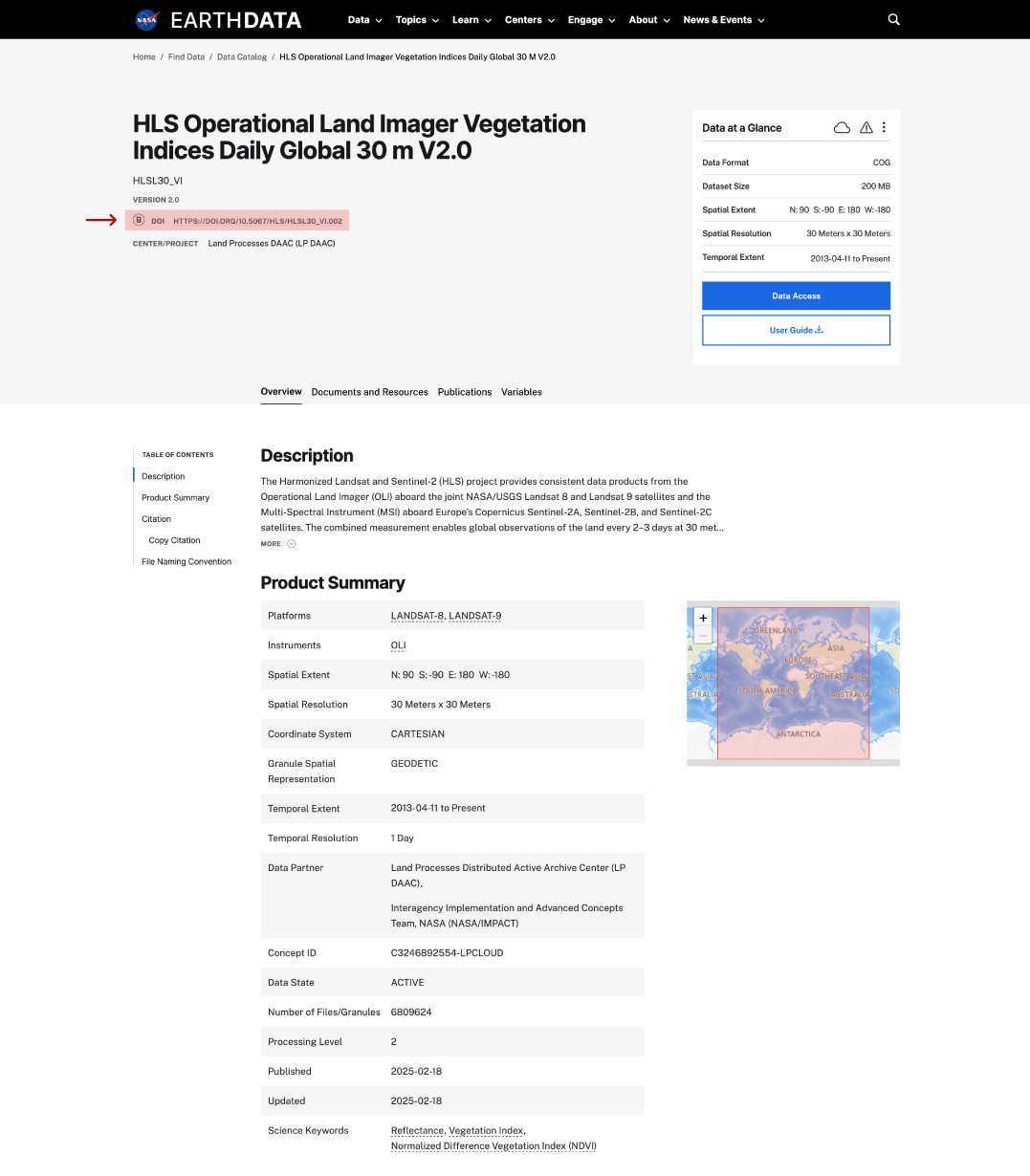
DOI on dataset page
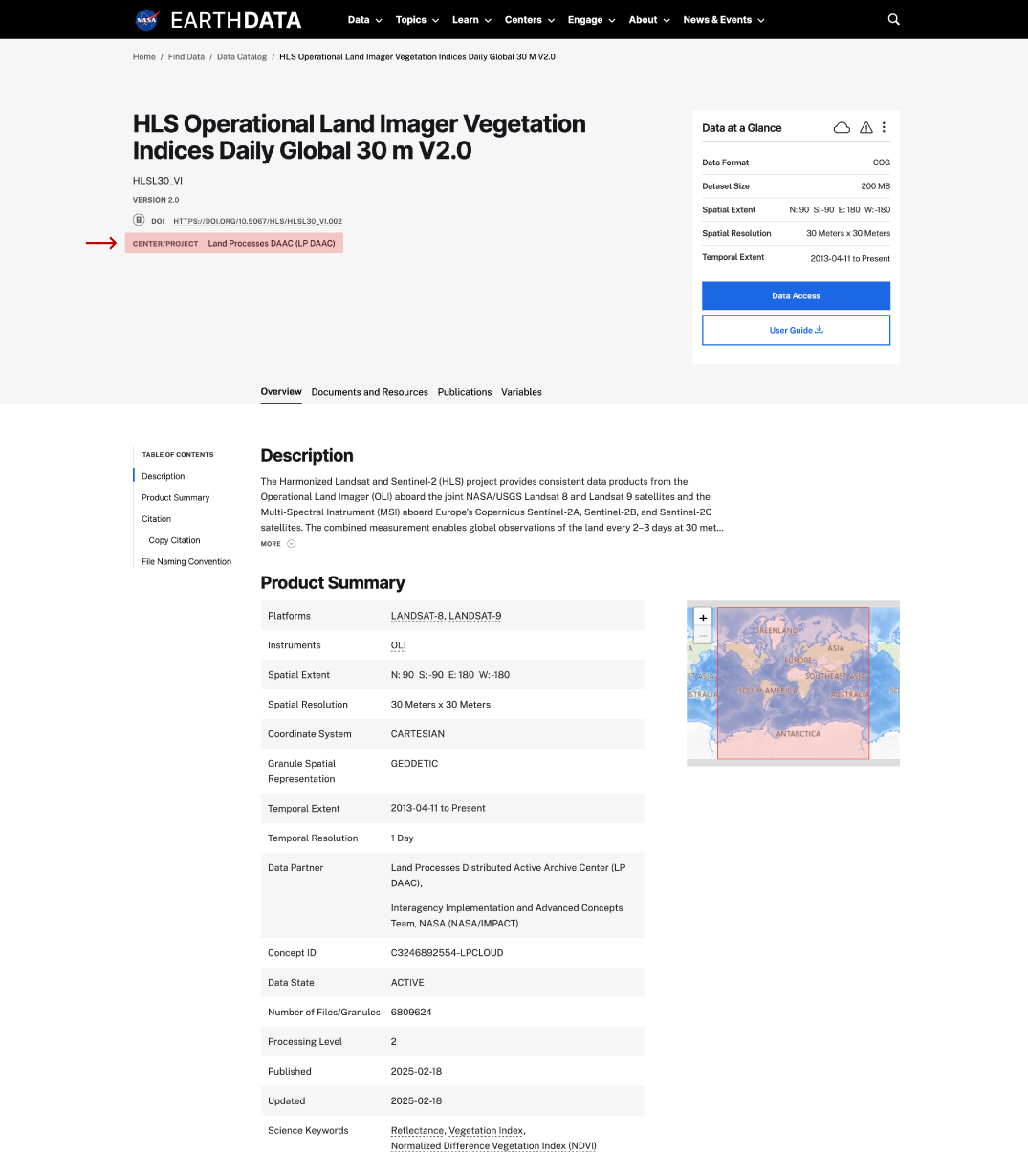
center/project on dataset page
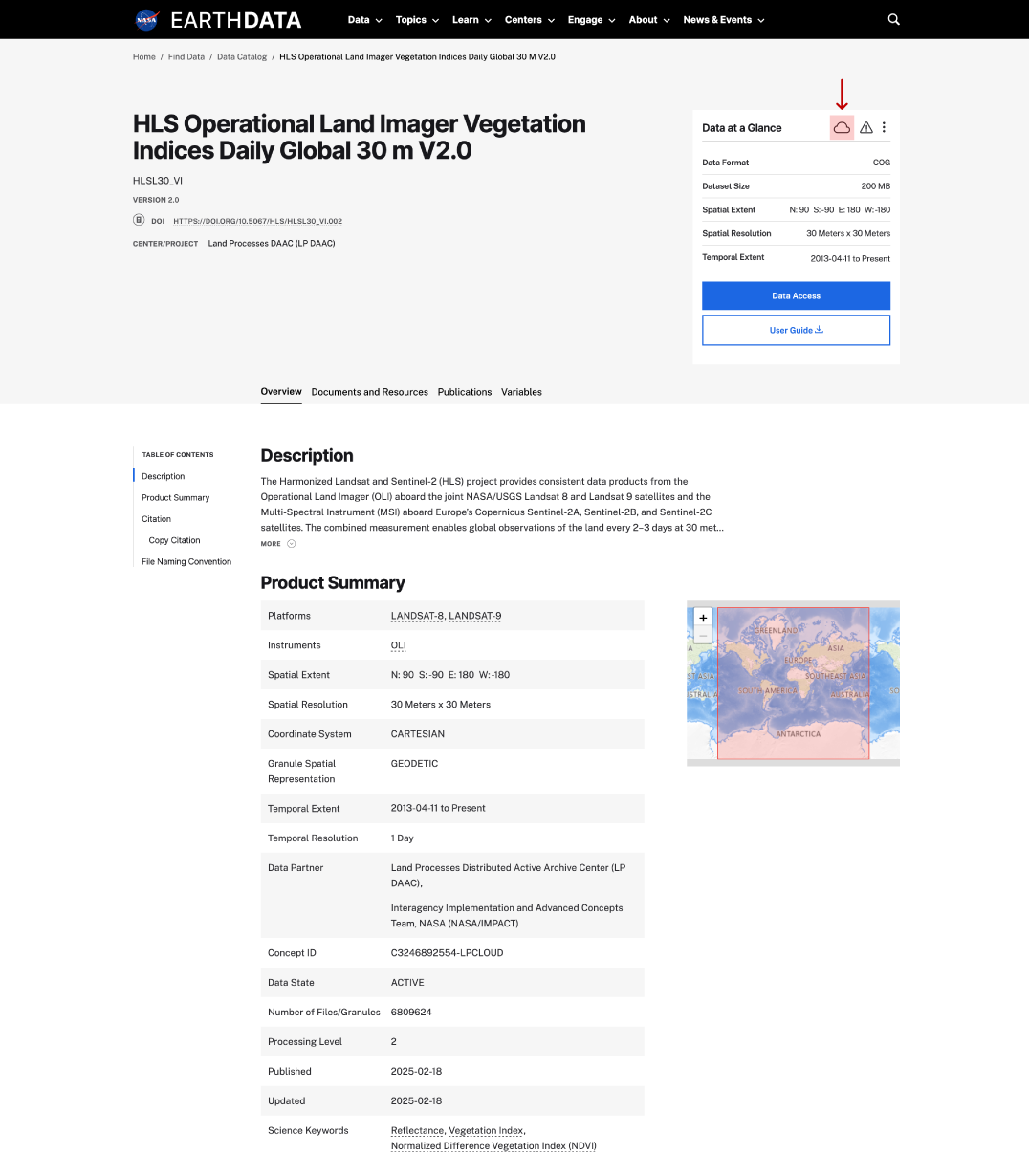
cloud icon on dataset page
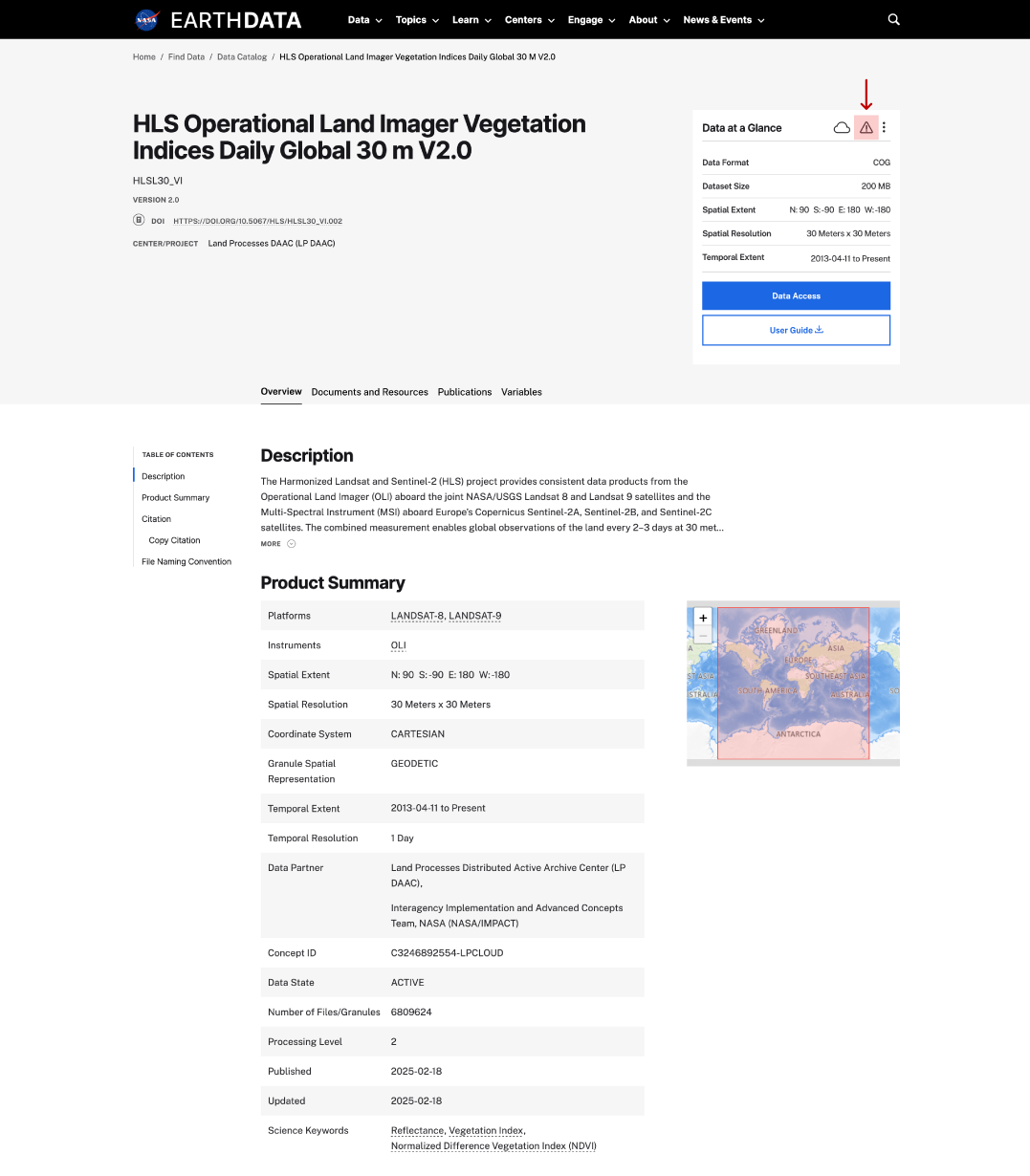
This is a screenshot of a dataset landing page showing the location of the alert icon.
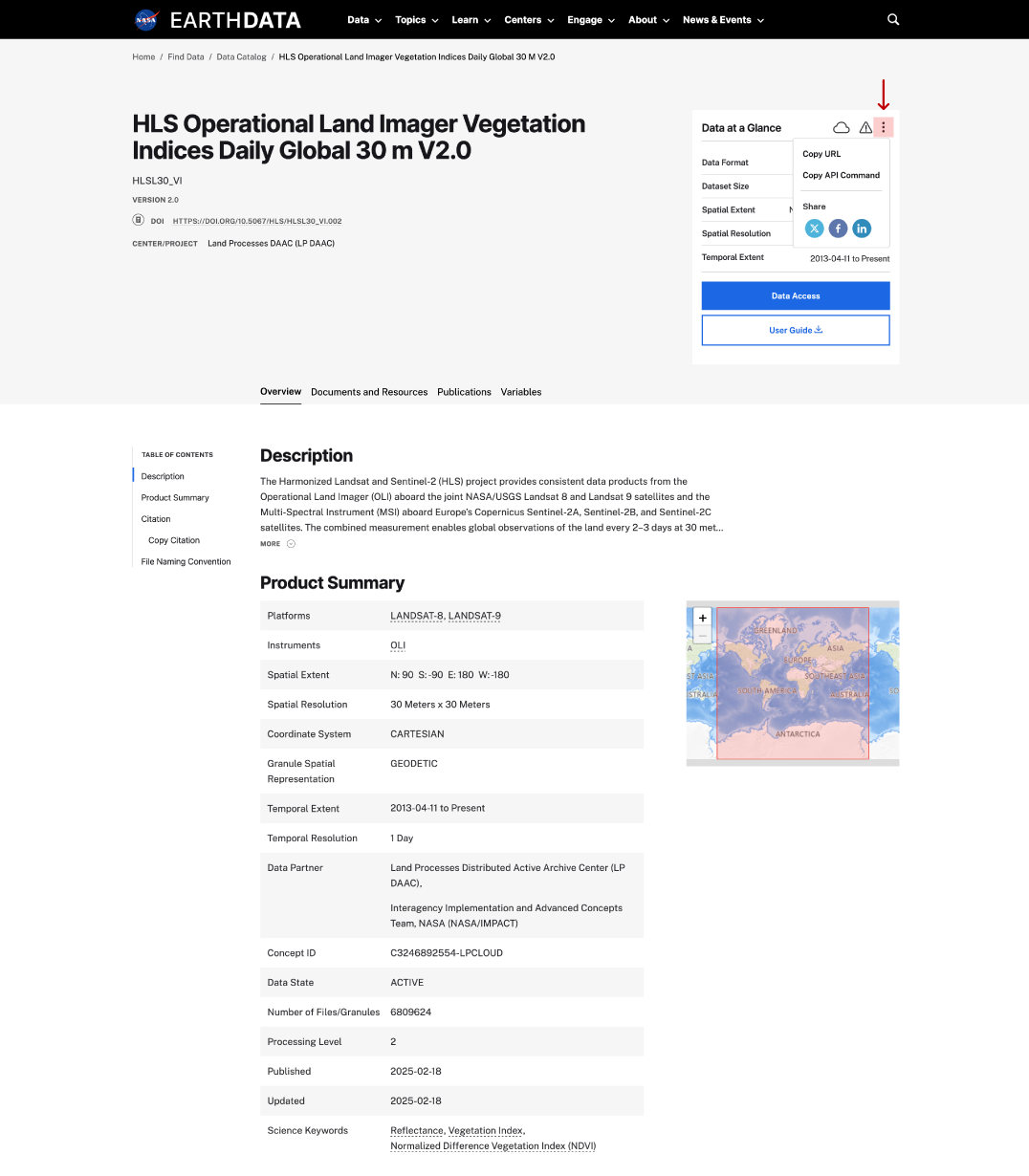
copy URL/API on dataset page
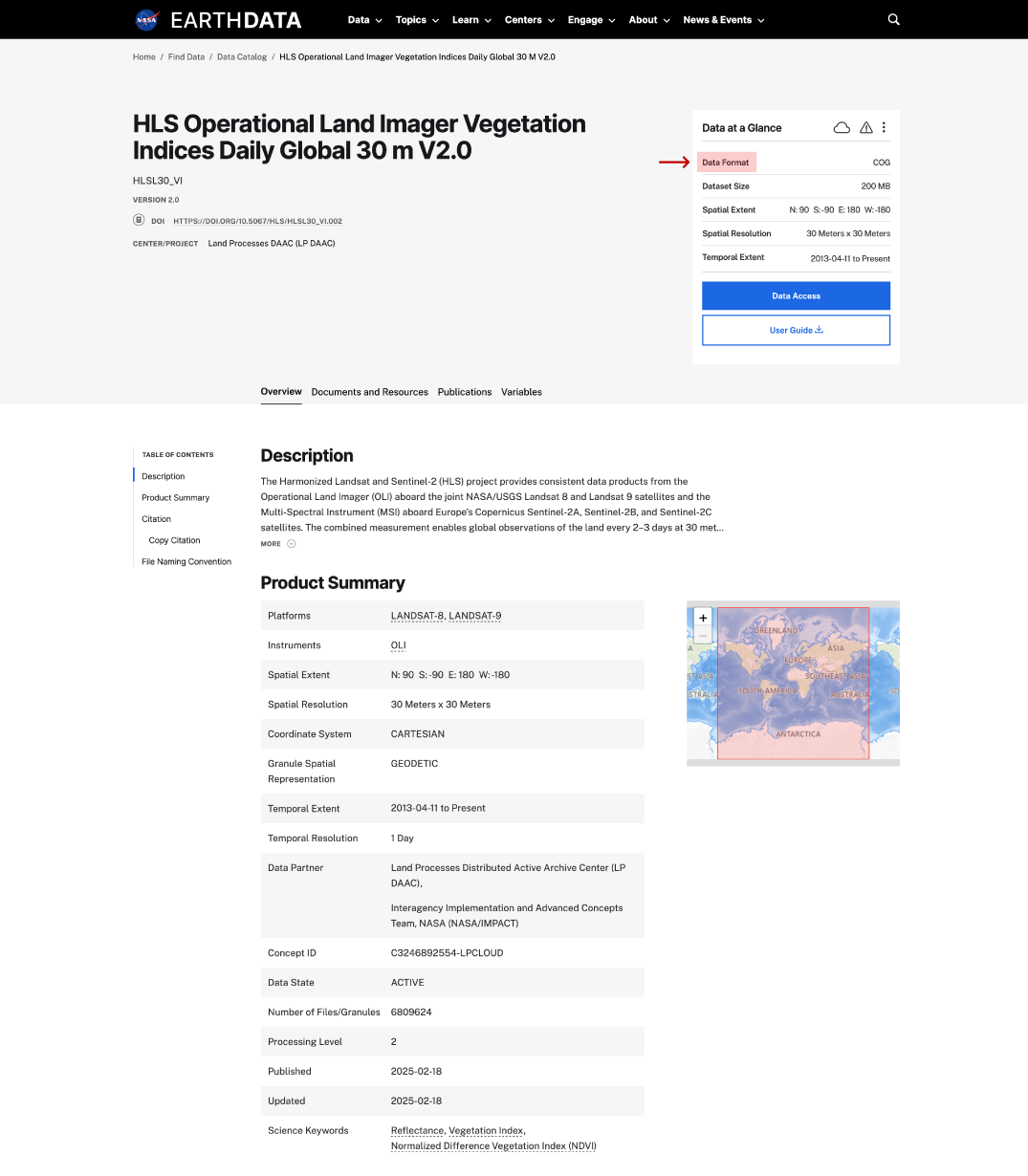
data format on dataset page
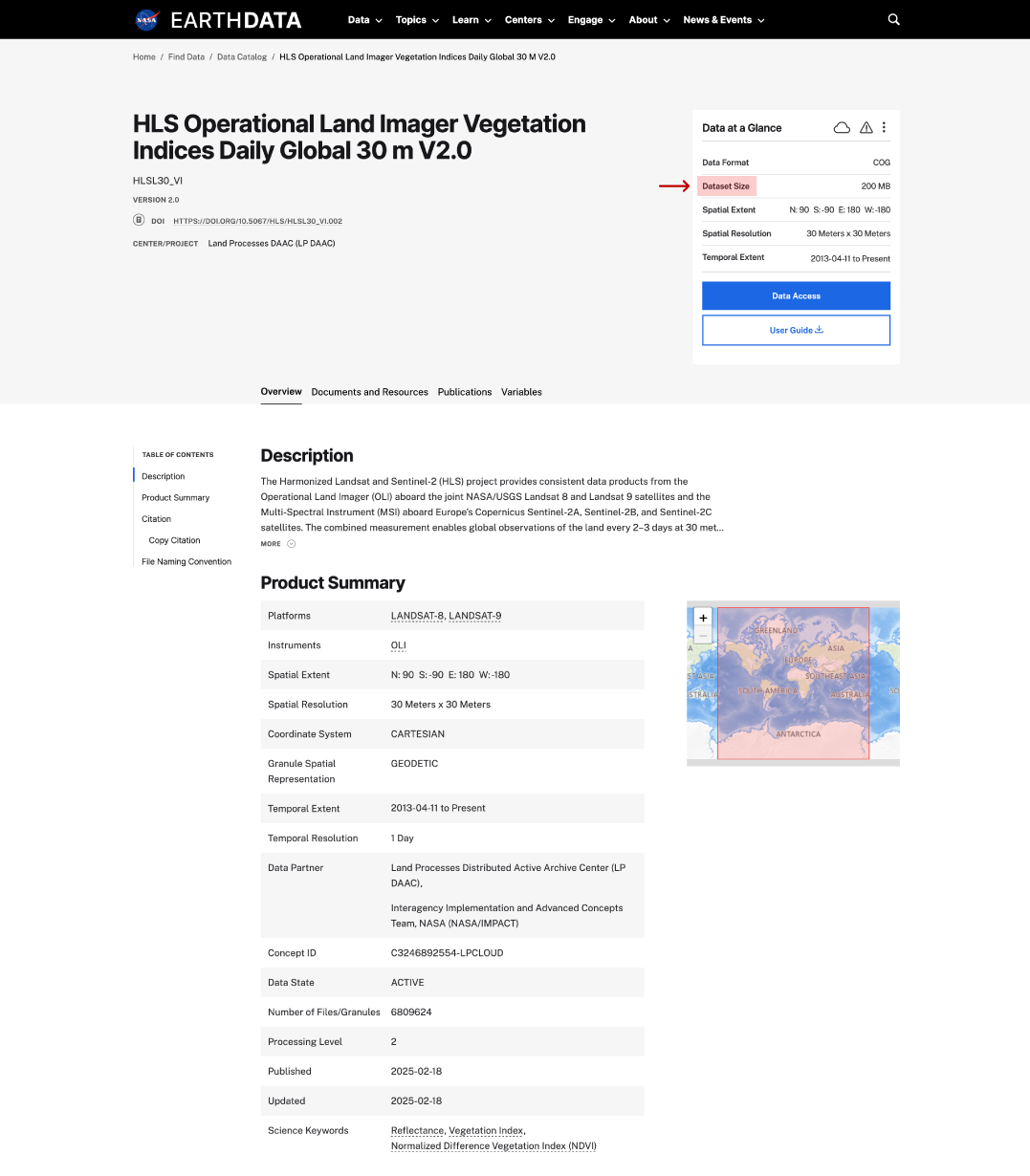
dataset size on dataset page
spatial extent on dataset page
spatial resolution on dataset page
temporal extent on dataset page
user guide on dataset page
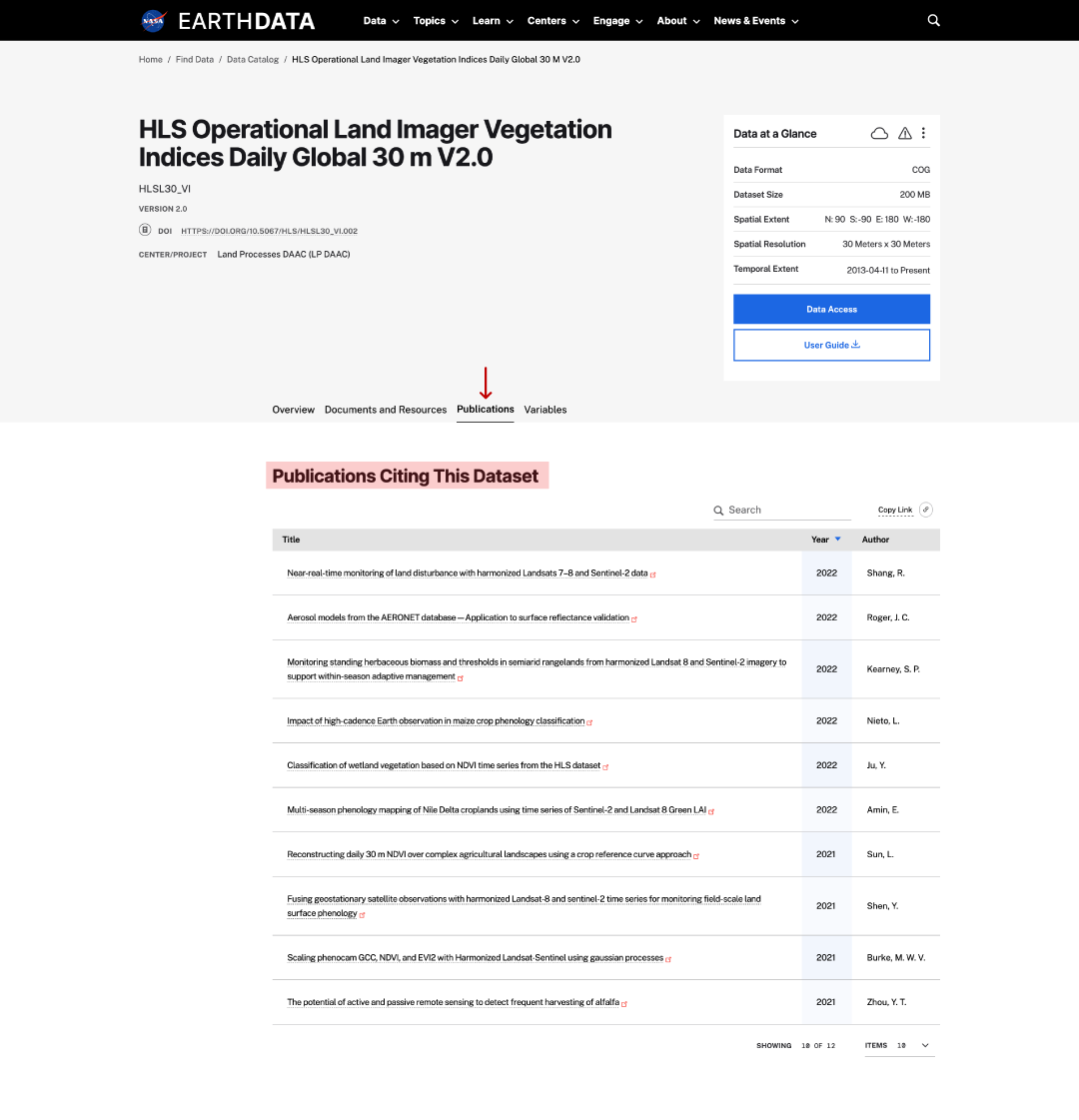
publications on dataset page
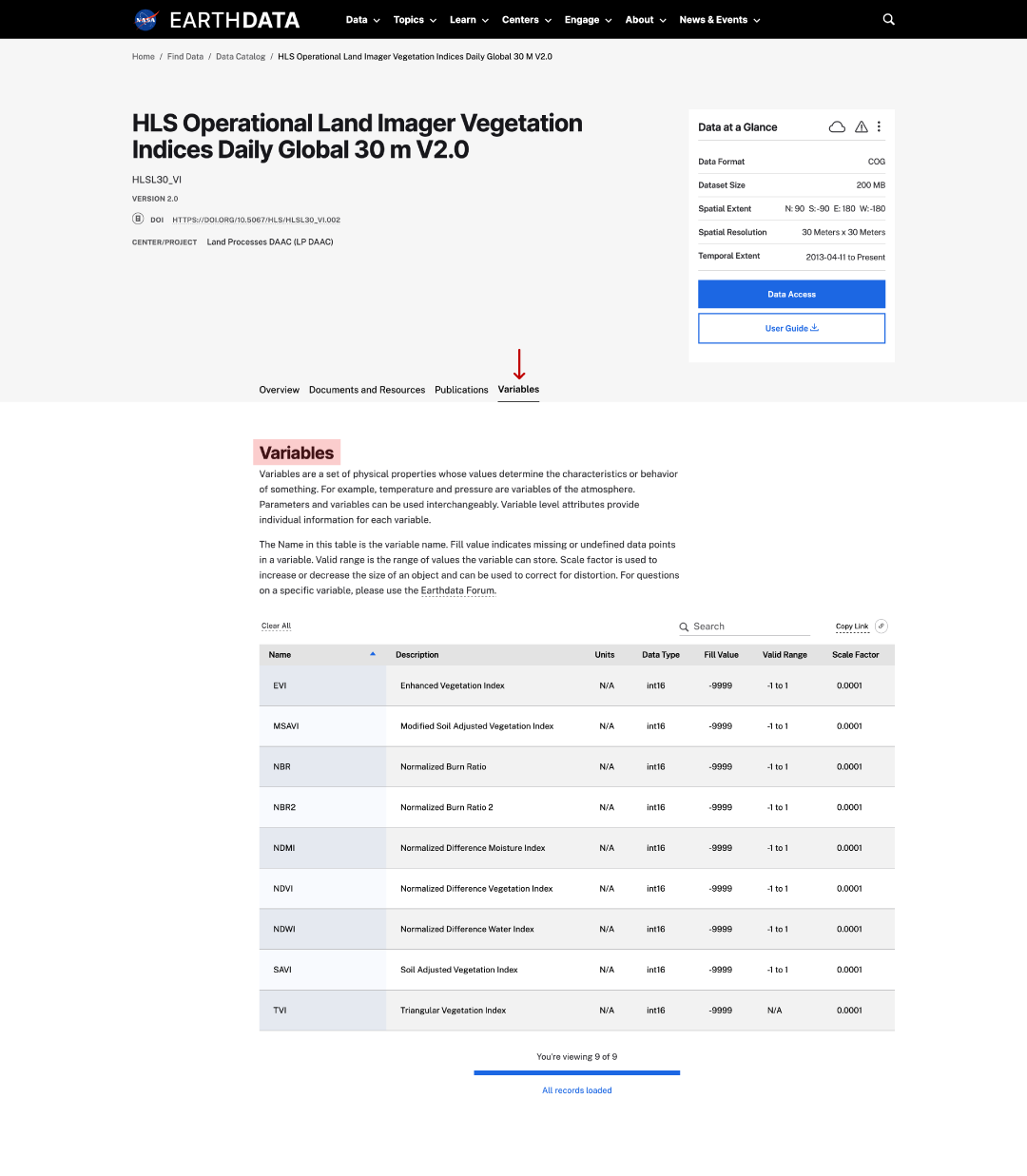
variables on dataset page
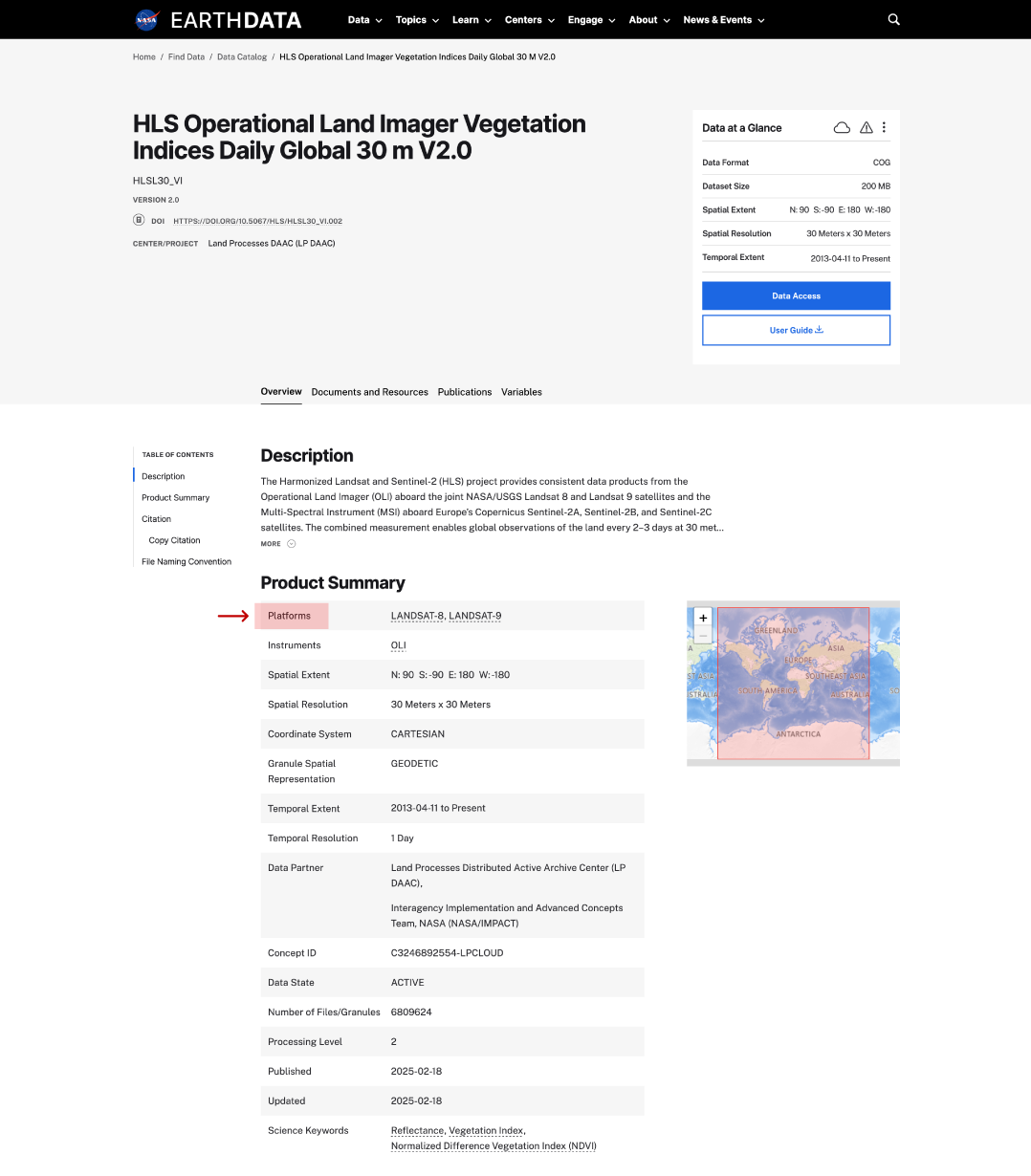
platforms on dataset page
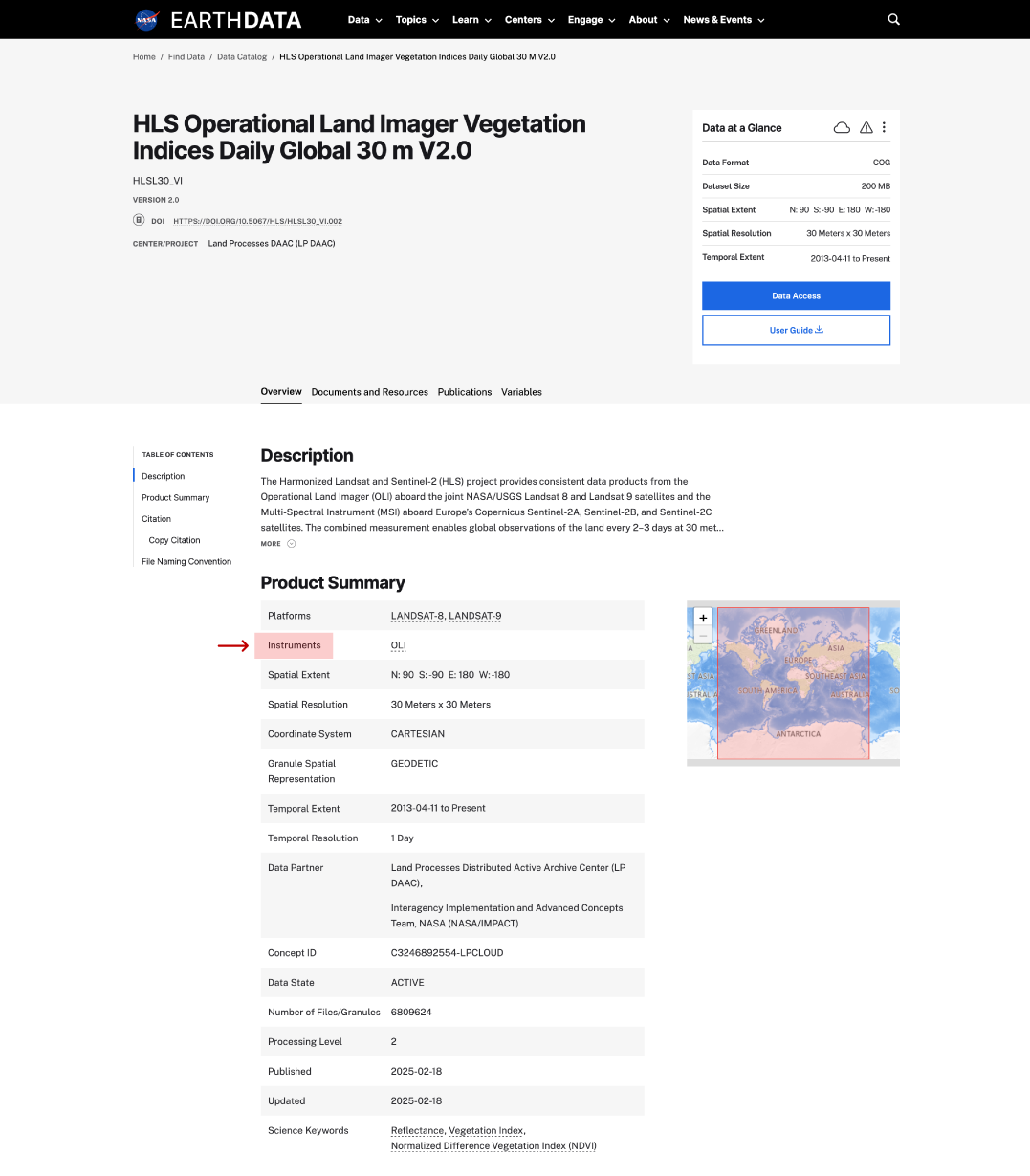
instruments on dataset page
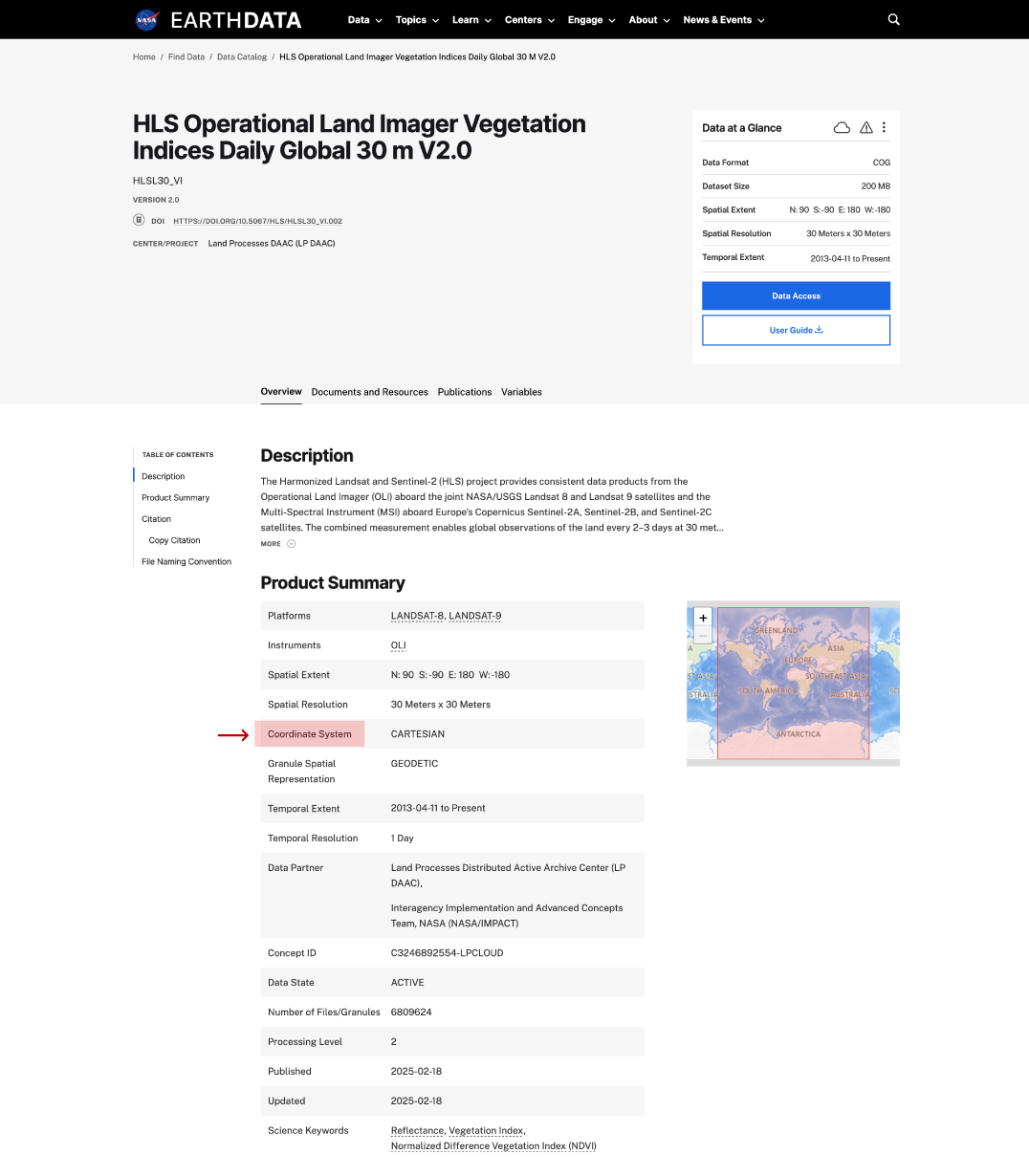
coordinate system on dataset page
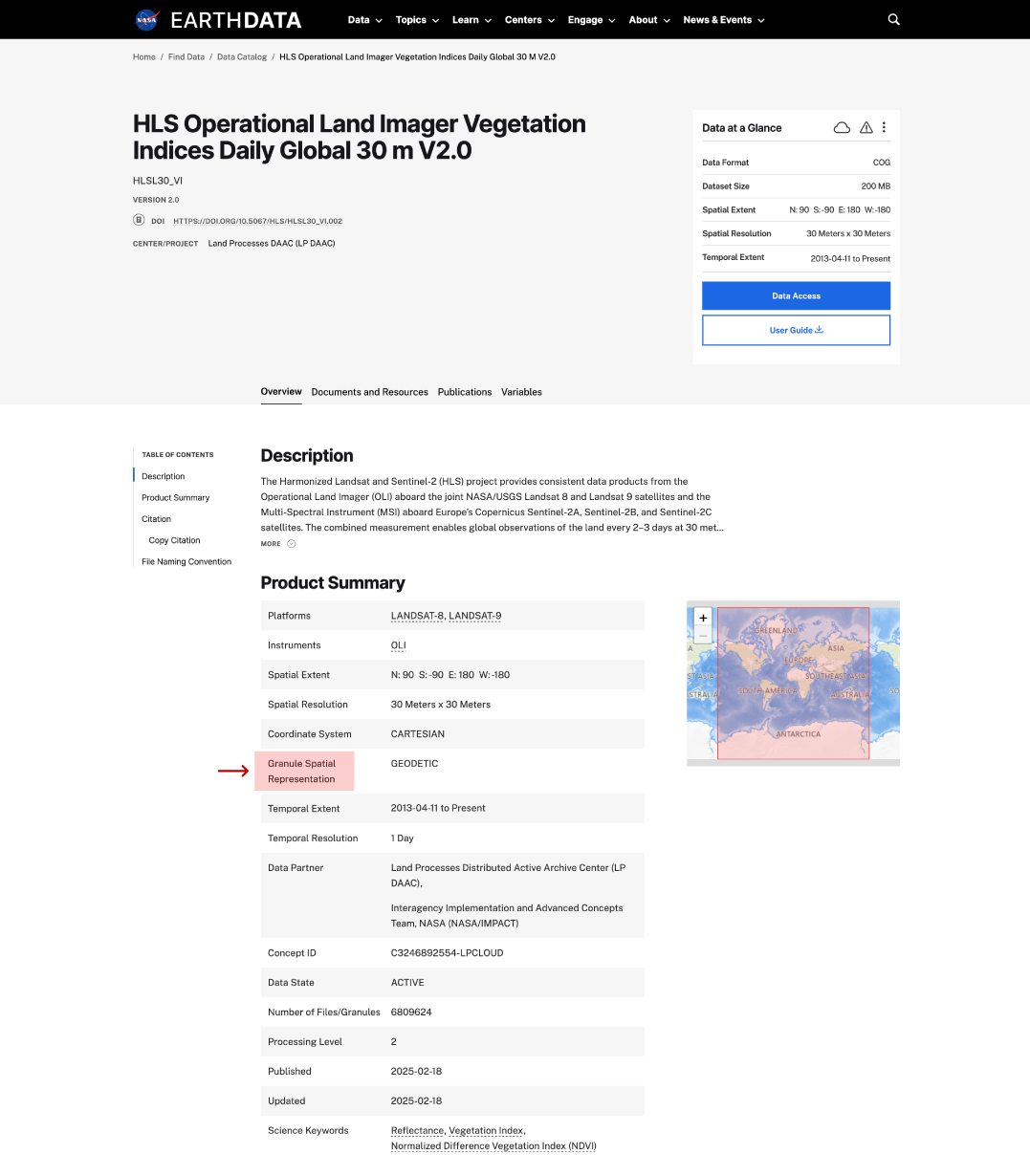
granule spatial representation on dataset page
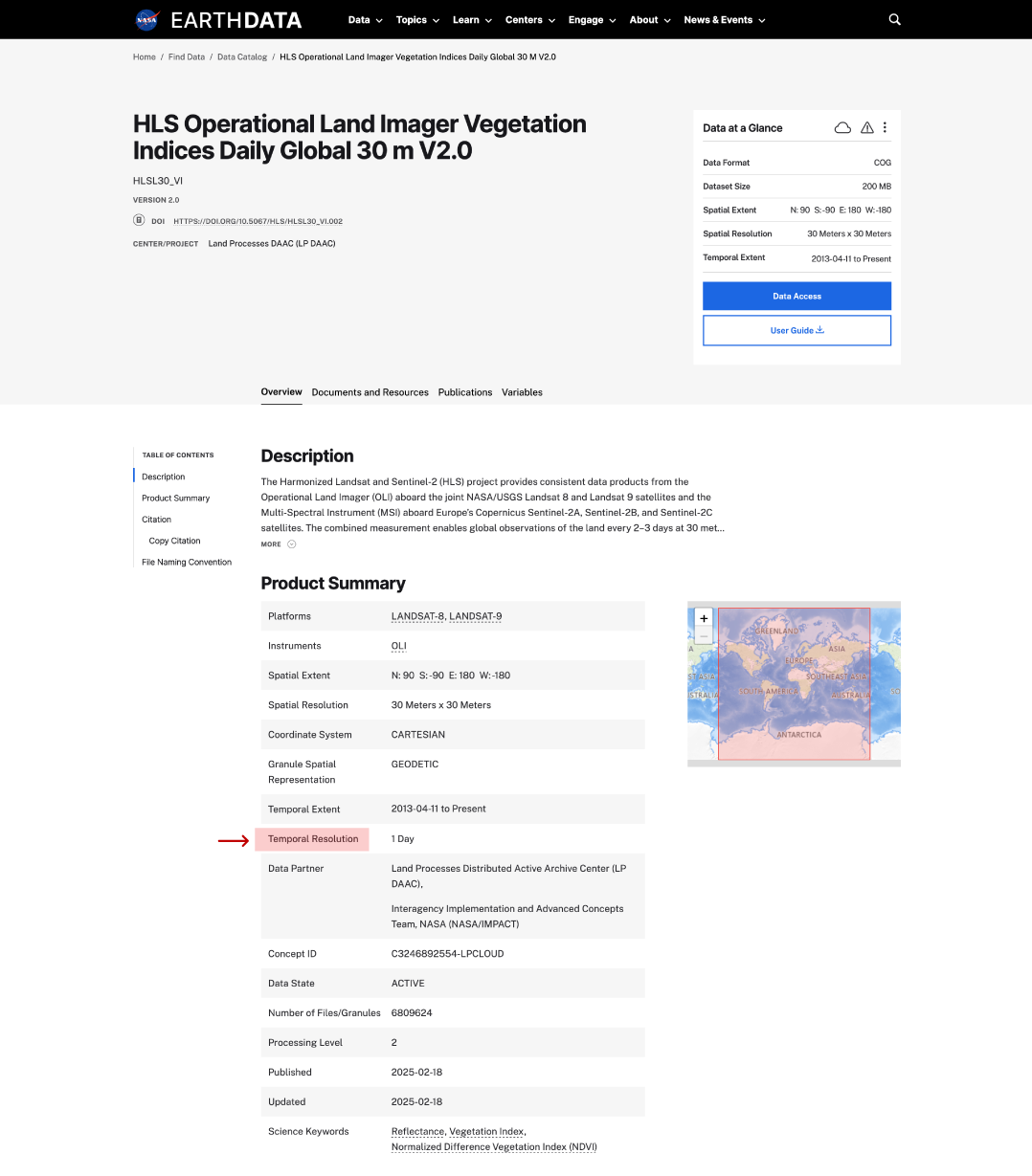
temporal resolution in dataset page
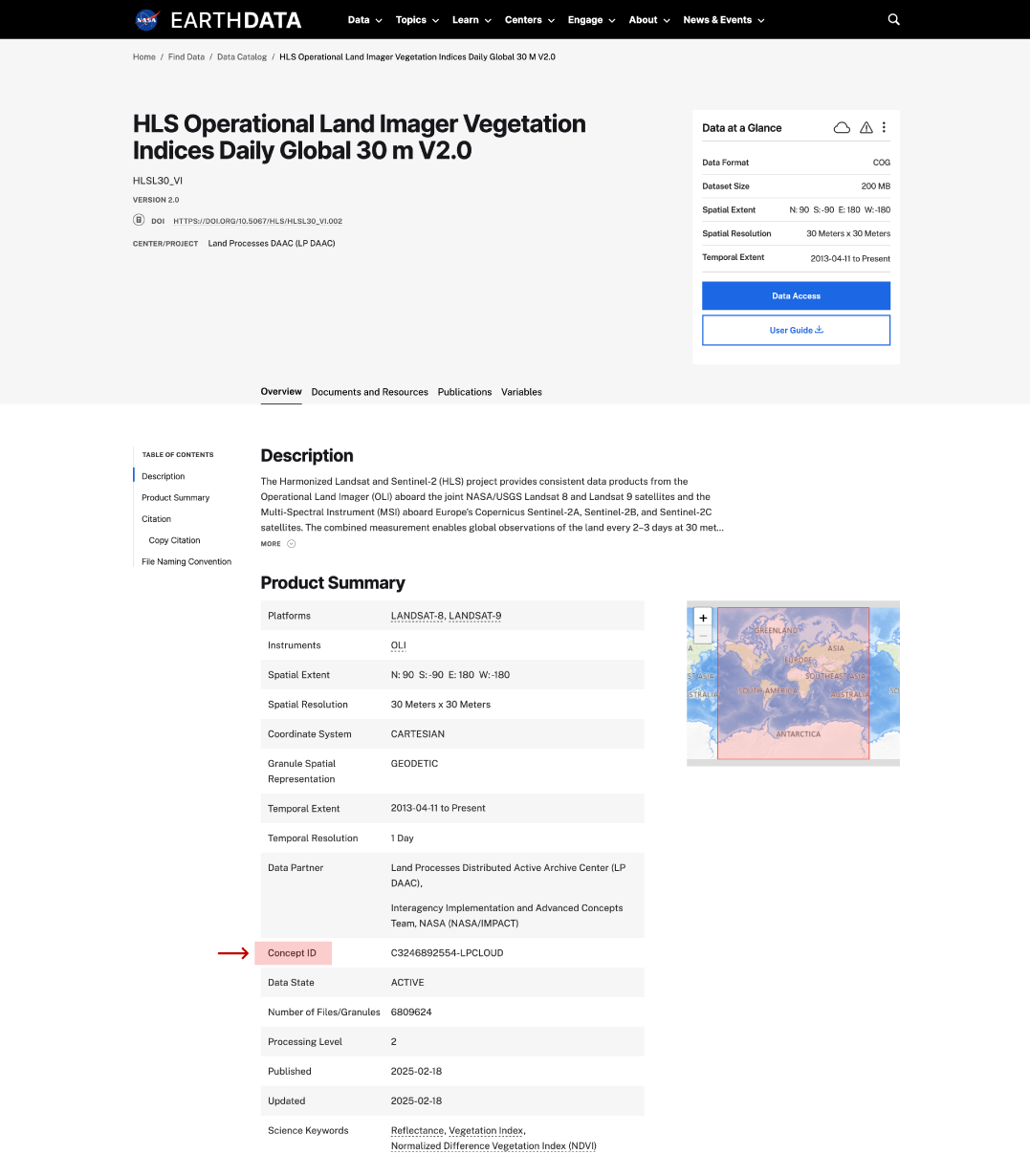
concept ID on dataset page
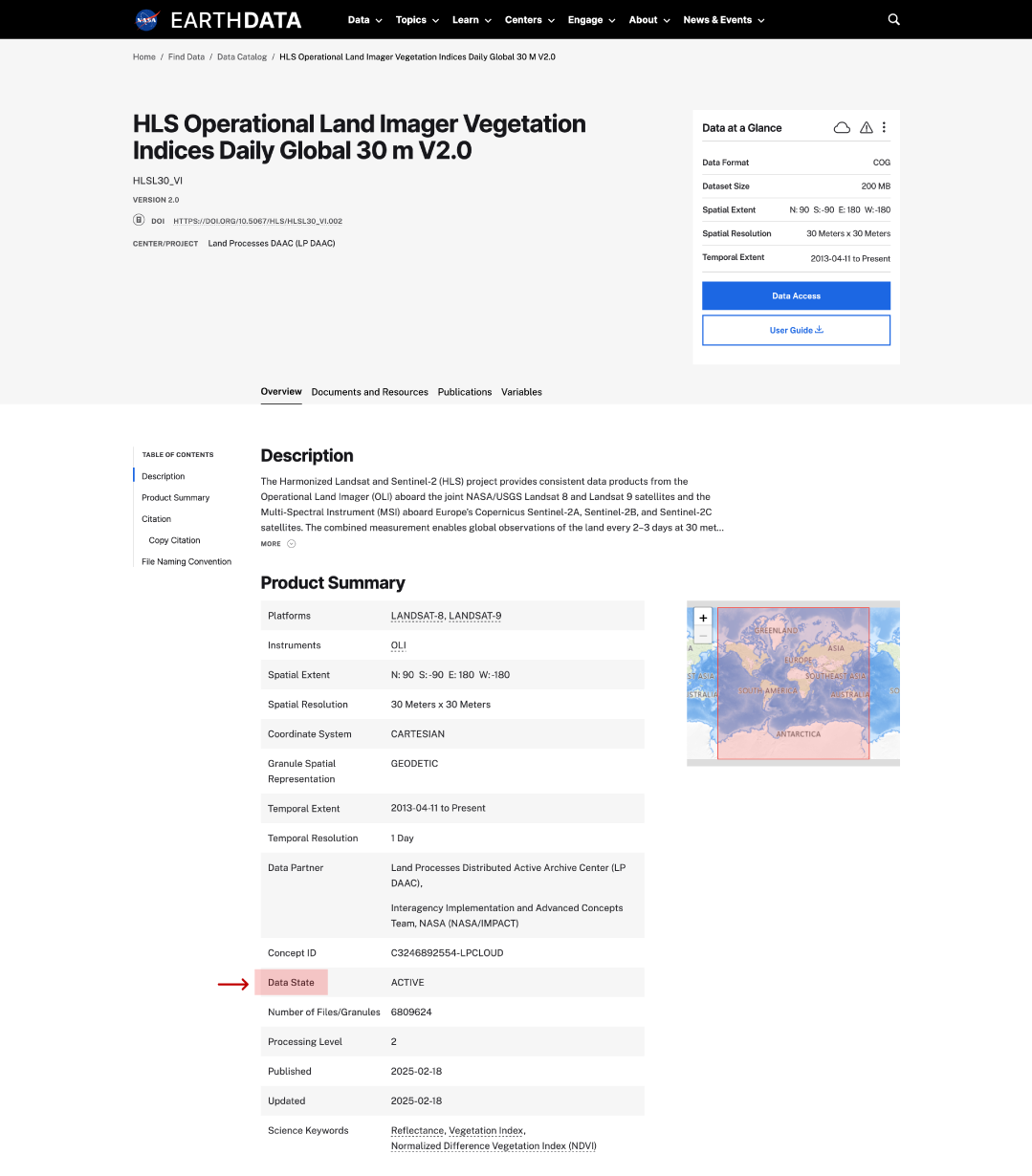
data state on dataset page
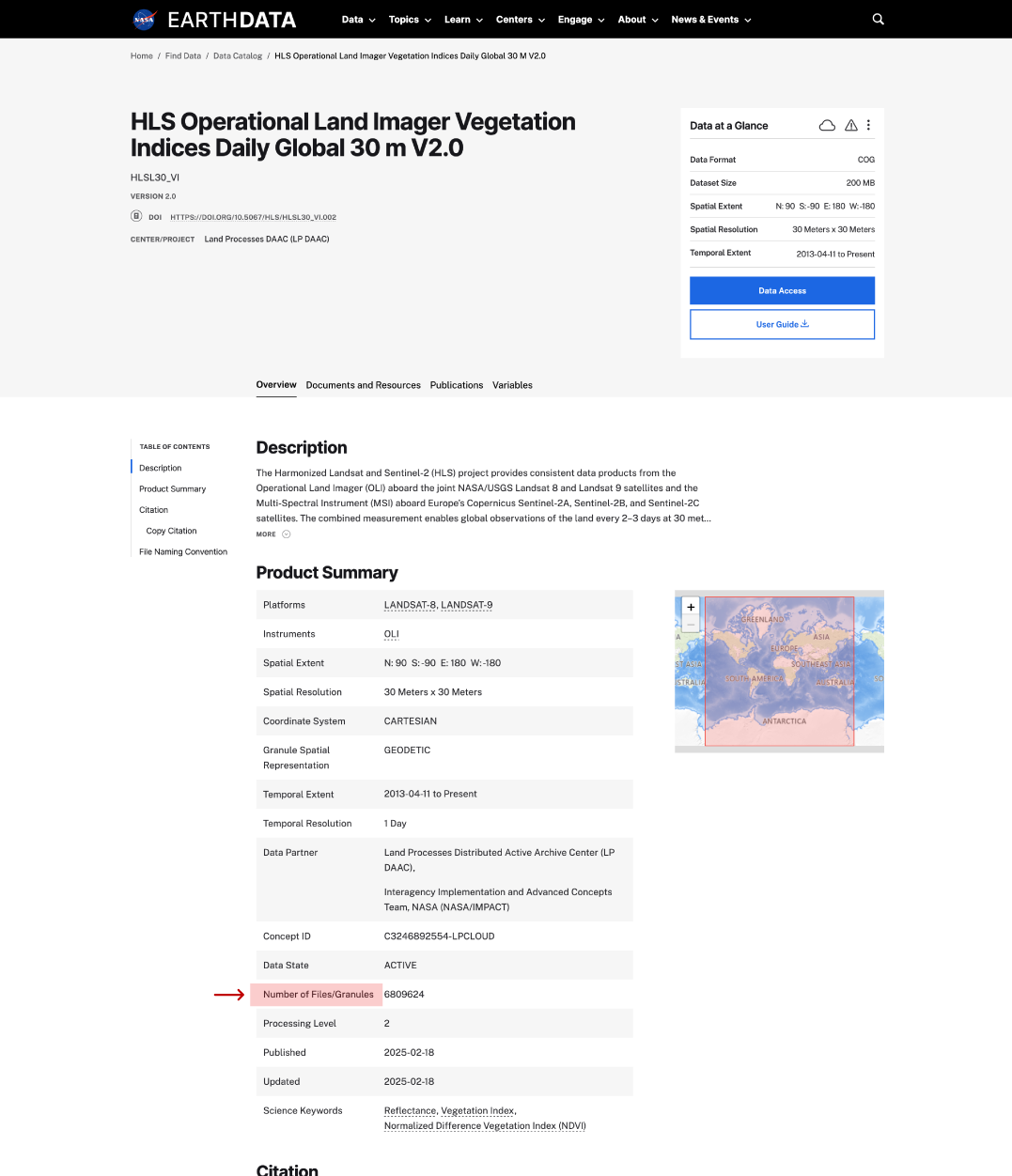
Number of files or granules
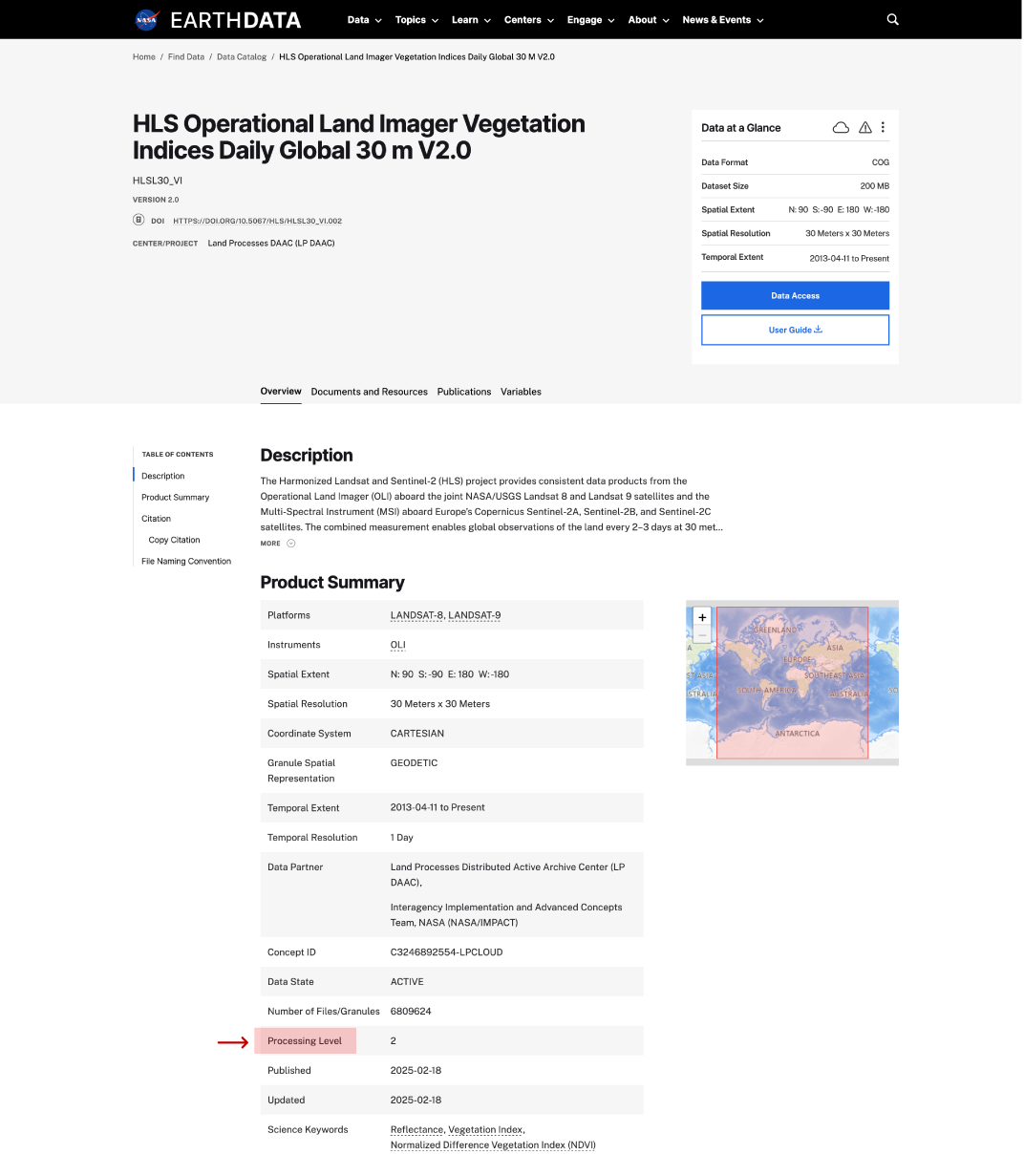
data processing level on dataset ppage
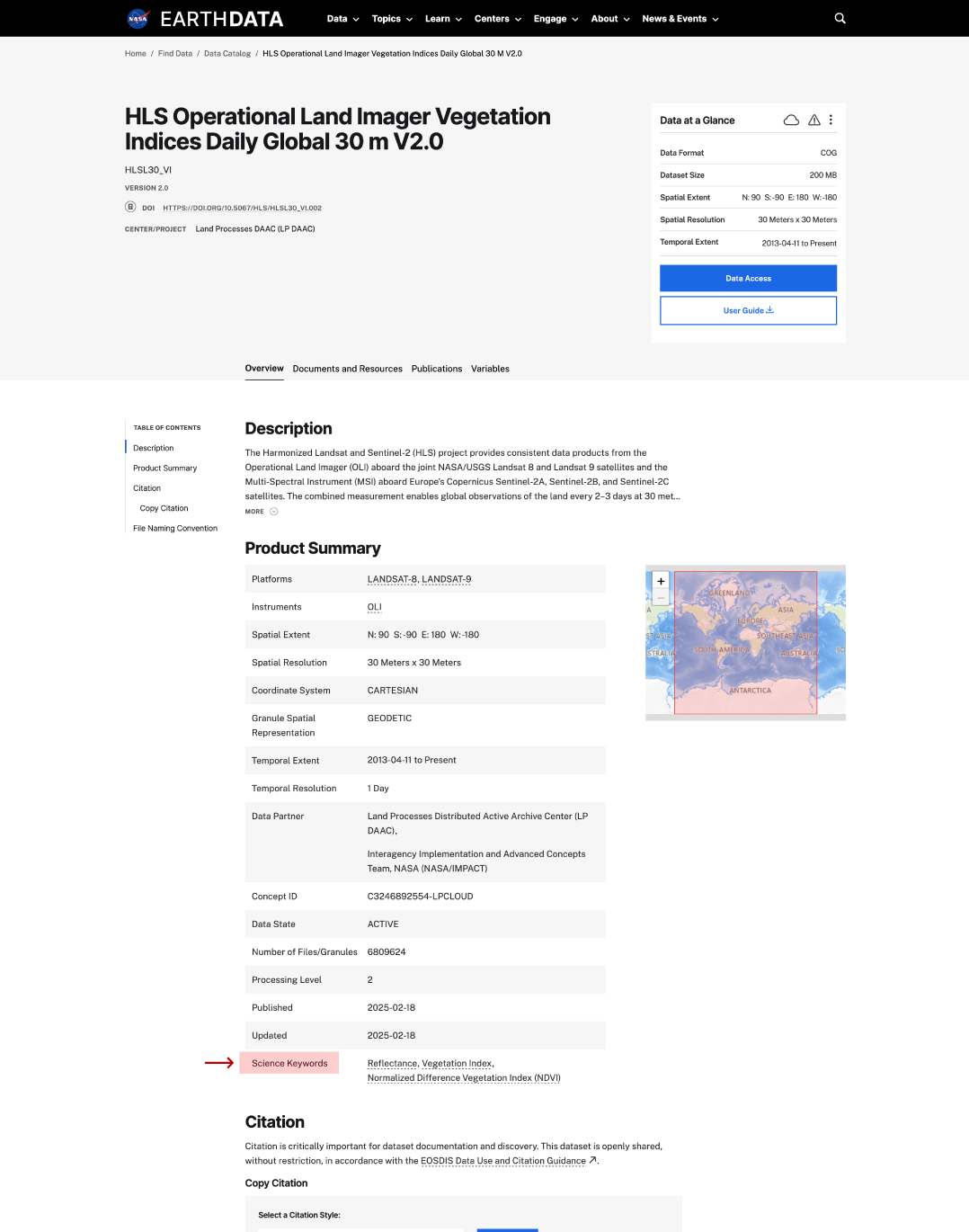
science keywords on dataset page
citation on dataset page
file naming convention on dataset page

Technology

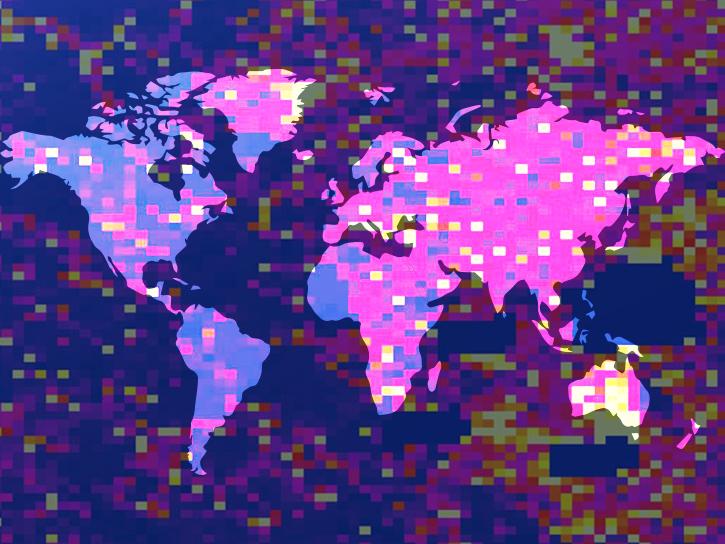
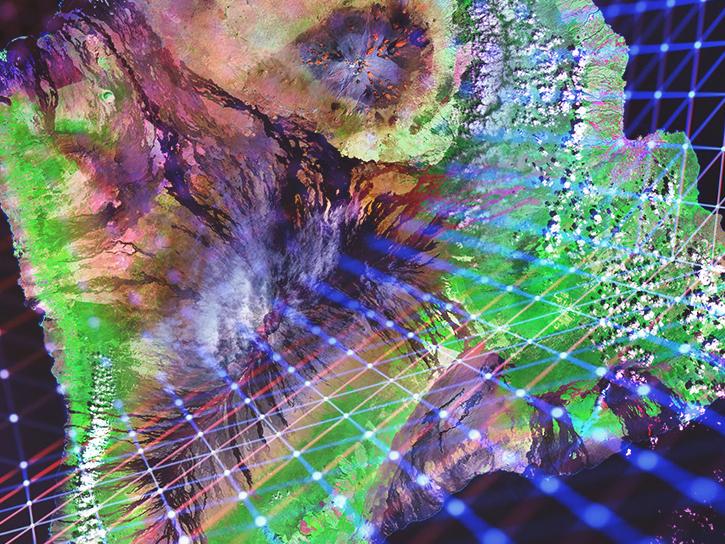
Innovations in artificial intelligence, climate models, and cloud computing are improving the ways users work with Earth science data, especially massive datasets like those expected from NISAR. NASA leverages modern computing approaches to optimize the quality of data collected and the speed at which users are able to drill down to the details they need to support on-the-ground science.

Image

Cloud Computing

Nearly all of NASA’s Earth science data is accessible through Earthdata Cloud, making access, analysis, and visualization more efficient and cost effective. We offer resources including Python libraries, tutorials, and data recipes to help users optimize working with data in the cloud.

Image

Earth Observation Data and Artificial Intelligence

The application of artificial intelligence (AI) to Earth science data makes it possible to search through large amounts of data to find relationships.

Synthetic Aperture Radar

Synthetic aperture radar (SAR) is a type of remote sensing that produces fine-resolution data using a technology that, over time, can detect even minute changes on Earth’s surface.

SAR is one of the power technologies of remote sensing, and enables high resolution imagery to be created night or day, regardless of weather conditions.
The SAR Handbook was created in 2019 as a guide for forest monitoring and biomass estimation with synthetic aperture radar (SAR).

View a table of synthetic aperture radar (SAR) products and their processing levels available through NASA's Earth Science Data Systems (ESDS) Program.
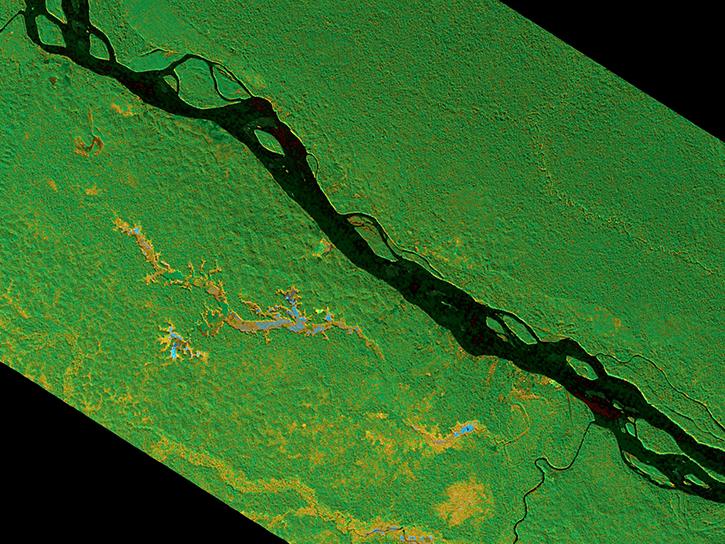
General rules of thumb for interpreting synthetic aperture radar (SAR) imagery and resources for viewing SAR imagery.

Glossary of Terms

Reference the Earth Observation Data Basics Glossary to better understand terms related to the data provided by our program.

All
A B C D E F G H I J K L M N O P Q R S T U V W X Y Z
Product Format

The specific implementation of global attributes, dimensions, groups, variables, and variable-level attributes in a data product, which is specified via the Product Format Specification (PFS) file.

Product Generation Algorithm

The Product Generation Algorithm, the version of source code used to produce the data products, need to be carefully preserved and recorded, along with version history, as well as:

  • The algorithm's theoretical (scientific and mathematical) basis,
  • How the algorithm is numerically implemented, including possible issues with computationally intensive operations,
  • A description of the outputted data products at a level of detail to determine if the product met specified product requirements,
  • A description of all assumptions that have been made concerning the algorithm performance estimates and any limitations,
  • A list of various error estimates and the error budget.
Product Quality

Description of the impact to product quality due to issues with computationally intensive operations (e.g., large matrix inversions, truncation and rounding).

Product Specification Document (PSD)

A document that provides the technical specifications relating to the formatting and content of a particular data product.

Product Team

Names of key science team leads and product team members (development, help desk and operations), roles, performing organization, contact information, sponsoring agencies or organizations and comments about the products.

Production Readiness Review (PRR)

PRRs evaluate the readiness of system developer(s) to produce the required number of systems within defined project constraints for projects developing multiple similar flight or ground support systems. PRRs also evaluate the degree to which the production plans meet the system's operational support requirements.

Project Plan

The project plan contains the technical approaches and management plans to implement the project requirements. It defines, at a high level, the scope of the project, the implementation approach, the environment within which the project operates, and the baseline commitments of the program and project. (From NPR 7120.5D)

Provenance Information

The information that documents the history of the content information. This information tells the origin or source of the content information, any changes that may have taken place since it was originated, the inputs responsible for a product, what versions of algorithms used, who has had custody of it since it was originated etc. Examples of provenance information could be the principal investigator who recorded the data, and the information concerning its storage, handling, and migration.

Quality Flag

One or more unique variables within a data file that show what data quality assessments have been performed as well as diagnostics on various aspects of quality. A quality flag can be a byte value with each bit representing a pre-defined quality verification criterion provided as a Boolean expression.

Quality Indicator
  1. A quality indicator shall provide sufficient information to allow all users to readily evaluate the “fitness for purpose” of the data or derived product. A Quality Indicator may be a number, set of numbers, graph, uncertainty budget, or a simple “flag”.
  2. One or more unique variables within a data file whose numerical value shows the overall quality of a geophysical measurement. The numerical value should be on a predefined numerical scale. For example, uncertainty per pixel (or measurement), percent cloud cover (in a scene).
Quality Information

Secondary data required to assess the primary data set’s fitness for purpose, e.g. calibration and validation data and quality control results.

Quick-Look Data

A data product, usually related to a Level 1 or higher Standard Data Product, which is generated and distributed in near-real time.

Raw Data

See: Processing Levels

Reprocessing

Reprocessing is a part of processing where a complete product collection is systematically generated to obtain a new revision using archived lower level products. Reprocessing is normally initiated after an improved processing algorithm is released. Reformatting could be considered or conducted as part of a re-processing exercise.

Requirements Documents (RQMT)

Requirements documents are detailed requirements allocated from the project to the next lower level of the project.

Safety and Mission Success Review (SMSR)

SMSRs prepare Agency safety and engineering management to participate in program final readiness reviews preceding flights or launches, including experimental/test launch vehicles or other reviews as determined by the Chief, Safety and Mission Assurance. SMSRs also provide the knowledge, visibility, and understanding necessary for senior safety and engineering management to either concur or nonconcur in program decisions to proceed with a launch or significant flight activity.

Scene

Subset of an instrument acquisition data segment, cut by time i.e. across-swath.

Science Data Management Plan (SDMP)

The SDMP describes how the program will manage the scientific data generated and captured by operational mission. The SDMP also includes descriptions of how data will be generated, processed, distributed, analyzed, and archived.

Science Data Product Software (SDPS)

Science data product generation software and software documentation. Source code used to generate products at all levels in the science data processing system.

Science Data Product Validation

Datasets and documentation. Accuracy of products, as measured by validation testing, and compared to accuracy requirements. Description of validation process, including identification of validation data sets, measurement protocols, data collection, analysis and accuracy reporting.

Science Data Products Algorithm Inputs

Identify all ancillary data or other data sets used in generation or calibration of the data or derived product at all levels

Science Data Software Tools

Product access (reader) tools. Software source code that would facilitate use of the calibration data, ancillary data and the data products at all levels.

Science Investigator-led Processing System (SIPS)

Most of the EOS standard products are produced at facilities under the direct control of the instrument Principal Investigators/Team Leaders (PIs/TLs) or their designees. These facilities are referred to as Science Investigator-led Processing Systems (SIPS). SIPS are geographically distributed across the United States and are generally, but not necessarily, collocated with the PIs/TLs’ Scientific Computing Facilities. 

Products produced at the SIPS using investigator-provided systems and software are sent to appropriate DAACs for archival and distribution. Level 0 Data Products and Ancillary Data that begin the processing sequence are stored at the DAACs and retrieved by the SIPS.

Search and Discovery

The procedure to search an archive based on specific search criteria (search) and to obtain information on available products (discovery). Data search and discovery are made possible by searchable metadata and browse image catalogues, as well as a catalogue service for making the catalogue accessible. 

During discovery, following a data search, the user finds data based on search criteria and evaluates if the data found are suitable for their application ('fit for purpose'). The user may then decide to retrieve the data.

Self-Describing File

A file that contains metadata thoroughly describing the characteristics and content of the file.

Sensor

Device which transmits an output signal as voltage in response to a physical input stimulus. In Earth observation a distinction between passives sensors, such as radiometers, and active sensors, such as radars, is common. Earth observation sensors – or instruments – are operated from different ground-/water-based, airborne, or spaceborne platforms.

Series/Collection

A grouping of science data that all come from the same source, such as a modeling group or institution. Series/collections have information that is common across all the datasets/granules they contain.

Series/Collection metadata

Metadata elements that describe an entire set of data files. Values of series/collection metadata apply to all of the files in a specific aggregate. Series/collection metadata may represent the same release of any given file, sets of data generated during an experiment, a campaign or an algorithm test.

Spatial Reference

Method by which location or coverage is designated (e.g., latitude and longitude).

Standard Product

Standard products are agency-certified key products resulting from missions or projects. They are typically acquired systematically and generated by spatially and temporally extensive systematic processing.

Standing Review Board (SRB)

The SRB is responsible for conducting independent reviews (life cycle and special) of a program/project and providing objective, expert judgments to the convening authorities. The reviews are conducted in accordance with approved Terms of Reference (ToR) and life-cycle requirements per this document and NPR 7123.1.

Stewardship

The responsibility for planning, management and certification of digital EO data sets throughout the mission phases and to ensure adequate funding. It includes curation and preservation activities. 

Data stewardship covers governance, planning, implementation and management of the sourcing, use and maintenance of space data assets. Data stewardship enables the governance of all the types and forms of space data package and the related repositories or archives.

Structured Vocabulary

An organized set of terms, headings or codes representing concepts and their inter-relationships, which can be used to support information retrieval.

Definition from ISO 25964-1:2011

Subsetting

The extraction of a multi-dimensional rectangular array of pixels from a single data granule, where consecutive pixels are extracted from each array dimension. For each dimension, the size of the pixel array is characterized by the starting pixel location and the number of pixels to extract.

Swath

A swath is defined as the area covered by the spatial samples collected during a scan of a spaceborne instrument defined by an incidence angle.

System Acceptance Review (SAR)

SARs evaluate whether a specific end item is sufficiently mature to be shipped from the supplier to its designated operational facility or launch site.

System Definition Review (SDR)

SDRs evaluate the credibility and responsiveness of the proposed program requirements/architecture to the Mission Directorate requirements and constraints, including available resources, and allocation of requirements to projects. SDRs also determine whether the maturity of the program's mission/system definition and associated plans are sufficient to begin preliminary design.

System Integration Review (SIR)

SIRs evaluate the readiness of the program, including its projects and supporting infrastructure, to begin system algorithm integration and test (AI&T) with acceptable risk and within cost and schedule constraints.

System Requirements Review (SRR)

SRRs evaluate whether the functional and performance requirements defined for the system are responsive to the Mission Directorate requirements on the program and its projects and represent achievable capabilities.

Temporal Extent or Temporal Coverage

The period during which data was collected, observations were made, or for which a model was run.

Uncertainty

Non-negative parameter characterizing the dispersion of the quantity values that are being attributed to a measure based on the information used. 

Where possible, this should be derived from an experimental evaluation but can also be an estimate based on other information, e.g. experience.

Unified Metadata Model (UMM) Profile

One of seven UMM metadata profiles: Collection (UMM-C), Granule (UMM-G), Service (UMM-S), Variable (UMM-Var), Visualization (UMM-Vis), Tools (UMM-T), and Common (UMM-Common).

User

External person, institution or system that consumes user services provided by the payload data ground segment via data access or a science and service exploitation platform.

User Support

User support is a function inside the payload data ground segment to support external users to interact with the segment, to handle user registration, inquiries, complaints. This function is usually provided by a help desk.

Validation

The process of assessing, by independent means, the quality of the data products derived from the system outputs.

Validation Stage

See: Data Maturity Levels

Variable

See: Parameter

Version/Release Number (also Collection)

Collection means the same thing as version; however, the MODIS science team uses the term Collection such as in MODIS Collection 5, but NSIDC uses Version as in MODIS Version 5. Also, Geoscience Laser Altimeter System (GLAS) refers to a release such as Release 33, which is also the same as version or collection. Thus, all three terms mean the same thing depending on which product you are using.

Visualization

Visualization—sometimes called scientific visualization—provides a window into reams of observational and simulation data by creating graphical representations that communicate to researchers and public alike. Just as a picture is worth a thousand words, visualizations are worth billions of bytes, both elucidating and simplifying big data.

Definition from NCCS

Web Object Storage

Object storage accessible through https.

Join Our Community of NASA Data Users

While NASA data are openly available without restriction, an Earthdata Login is required to download data and to use some tools with full functionality.

Learn About the Benefits of Earthdata Login

Frequently Asked Questions

Earthdata Forum

Our online forum provides a space for users to browse thousands of FAQs about research needs, data, and data applications. You can also submit new questions for our experts to answer.

Submit Questions to Earthdata Forumand View Expert Responses

Earthdata
Forum