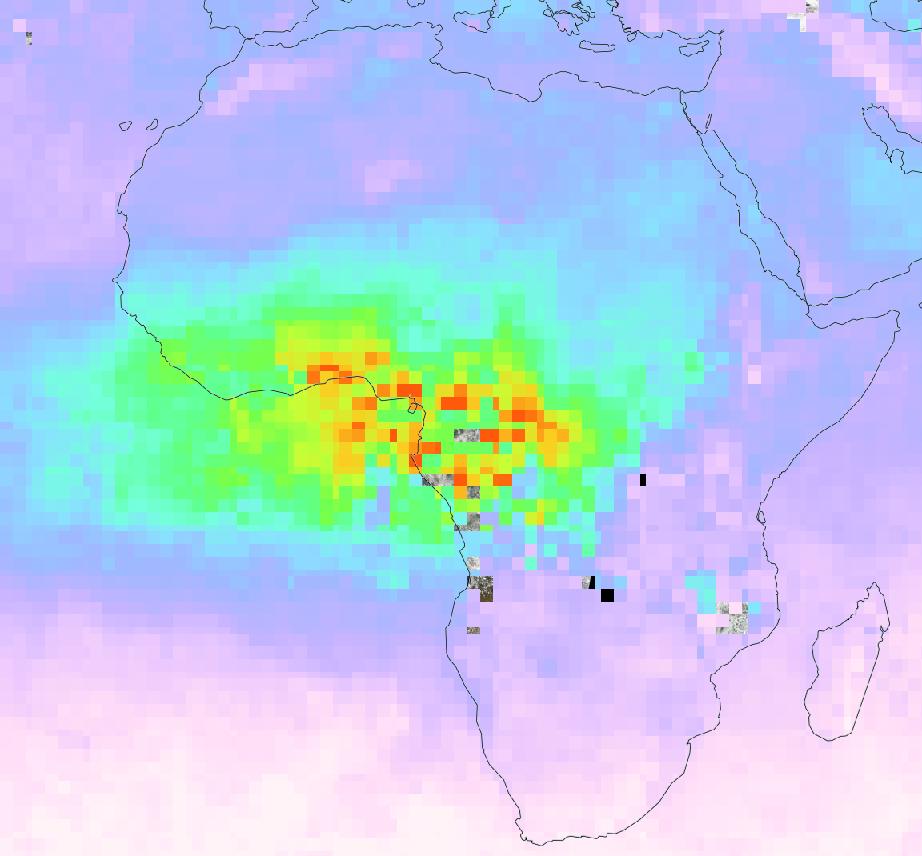
The Measurements Of Pollution In The Troposphere (MOPITT) is an instrument aboard NASA's Terra satellite, a key element of the Earth Observing System (EOS). MOPITT was successfully launched into sun-synchronous polar orbit aboard Terra, NASA's first Earth Observing System spacecraft on December 18, 1999. Terra was placed in a 705km, sun-synchronous orbit with a 10:30 a.m. equator crossing time. Although designed for a five-year mission, it collected valuable science data into 2024, creating an enduring climate record.
Current Status
Status: MOPITT was put in to safe mode on February 1, 2025, due to power constraints onboard Terra.
Mission Objectives
Measurements and Products
MOPITT measures carbon monoxide in the troposphere over the non-polar region of the globe. MOPITT measurements yield atmospheric profiles of CO volume mixing ratio and CO total column values using near-infrared radiation at 2.3 µm and thermal-infrared radiation at 4.7 µm. There are no current plans to release a MOPITT methane product.
Scientific Significance
MOPITT has observed the range of CO emissions, including agricultural sources such as biomass burning, industrial sources, and catastrophic wildfires. Most of these sources can, and indeed are, being modified by human activity on the planet.
Carbon monoxide is particularly interesting because of its potential for showing us how chemicals are transported in the troposphere, as well as giving us information about chemical reactions in the troposphere. Measurements have already shown us the production of carbon monoxide in biomass burning and its transport by atmospheric circulation systems. This needs to be understood globally and incorporated into models of tropospheric transport and chemical weather forecasting.
Technical Specifications
Measurement Method and Coverage
Measurements of carbon monoxide are made by intercepting the infrared radiation coming from the planet and then isolating the required signals. MOPITT is a nadir-sounding instrument since it maximizes the chance of avoiding cloud features, but this implies that it can 'see' the planet's surface and the desired signals must be seen against the background of the surface radiation. Each MOPITT pixel is 22 x 22km and views four pixels simultaneously using a 4 x 1 array of detector elements.
The field of view is also continuously scanned through a swath about 600km wide as the instrument moves along the orbit, increasing both the spatial coverage of the instrument and the chance of finding gaps in the cloud coverage. It takes about three days to obtain coverage at all longitudes.
Instrument Components and Cooling
The MOPITT instrument uses the principle of correlation spectroscopy whereby a cell of the gas to be measured is used as an optical filter in the infrared to measure the signal from the same gas in the atmosphere. The amount of gas in the instrument cell is modulated by varying the pressure or the length. In addition to the correlation technique, MOPITT uses mechanically cooled detectors and filters (at 100K) to enhance the overall performance.
The use of this cooling technique, which relies on Stirling Cycle coolers supplied by British Aerospace, is relatively new in satellite instrumentation, having been used on only two civilian satellite instruments before. The use of mechanical cooling rather than stored cryogen or radiative cooling permits a relatively large amount of cooling - sufficient for both the detectors and the filter systems - whilst not limiting the lifespan of the instrument as coolant is exhausted.
Collaboration and Data Management
International Consortium
The MOPITT instrument was constructed by a consortium of Canadian companies and funded by the Space Science Division of the Canadian Space Agency. The MOPITT science team is international, with members from Canada, the United States, and the United Kingdom. The instrument itself was constructed by a consortium of Canadian companies: COMDEV Atlantic of Moncton, BOMEM from Quebec City, Hughes-Leitz from Midland, and SED from Saskatoon. The instrument is funded by the Space Science Division of the Canadian Space Agency and will be tested at the University of Toronto.
Data Processing and Distribution
Data processing occurs at NCAR in Boulder, CO. The data are archived and distributed by NASA ASDC.
Further Information
For more information: