N: 90 S: -90 E: 180 W: -180
Description
The HLSL30 V1.5 data product was decommissioned on January 4, 2022. Users are encouraged to use the improved HLSL30 V2 data product.
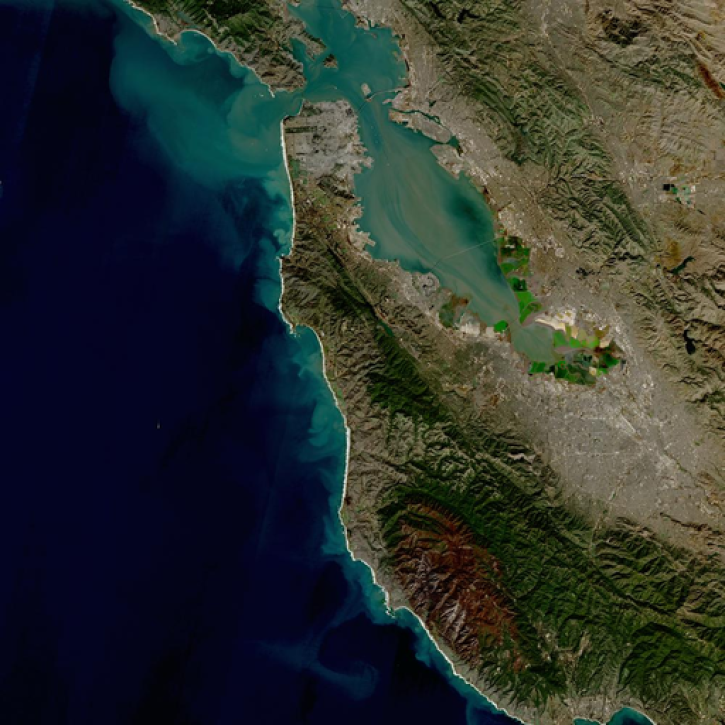
The Harmonized Landsat Sentinel-2 (HLS) project provides consistent surface reflectance (SR) and top of atmosphere (TOA) brightness data from the Operational Land Imager (OLI) aboard the joint NASA/USGS Landsat 8 satellite and the Multi-Spectral Instrument (MSI) aboard Europe’s Copernicus Sentinel-2A and Sentinel-2B satellites. The combined measurement enables global observations of the land every 1.6 days at 30-meter (m) spatial resolution. The HLS project uses a set of algorithms to obtain seamless products from OLI and MSI that include atmospheric correction, cloud and cloud-shadow masking, spatial co-registration and common gridding, illumination and view angle normalization, and spectral bandpass adjustment.
The HLSL30 product provides 30-m Nadir Bidirectional Reflectance Distribution Function (BRDF)-Adjusted Reflectance (NBAR) and is derived from Landsat 8 OLI data products. The HLSS30 and HLSL30 products are gridded to the same resolution and Military Grid Reference System (MGRS) tiling system and thus are “stackable” for time series analysis.
The HLSL30 product is provided in Cloud Optimized GeoTIFF (COG) format, and each band is distributed as a separate file. There are 10 bands included in the HLSL30 product along with one quality assessment (QA) band and four angle bands. For a more detailed description of the individual bands provided in the HLSL30 product, please see the User Guide.
The HLS project is funded by NASA’s Satellite Needs Working Group (SNWG) which provides data products developed to meet the needs of stakeholders from US government agencies.
Known Issues
-
HLSL30.015 products are based on input Landsat 8 L1TP (precision terrain corrected) products, which require identification of ground control targets for precision geometric correction. Images where ground control is not available (e.g., very cloudy images) cannot be processed to L1TP and are not included in the HLSL30 dataset.
-
Interruptions in data service occurred during a restaging of backlogged data between June 1 and June 15, 2021 for both HLSS30 and HLSL30 version 1.5 data products. During this time period increased errors in the processing workflow resulted in a significant number of data ingestion failures and thus, significant gaps in data availability. Given the pending release of the version 2.0, science quality HLS products, these missing data will not be filled for version 1.5. Users of the provisional version 1.5 products should be aware of the significant data gap in this two week window. The version 2.0 products will incorporate these data back into the archive. If you have any feedback or questions on the data please contact Customer Services or join our HLS conversion on the Earthdata Forum.
Version Description
Product Summary
Citation
Citation is critically important for dataset documentation and discovery. This dataset is openly shared, without restriction, in accordance with the EOSDIS Data Use and Citation Guidance.
Copy Citation
File Naming Convention
The file name begins with the Product Identifier (HLS.L30) followed by T plus the 5-character MGRS Tile Identifier (T55GEN), the Julian Date and Time of Production designated as YYYYDDDTHHMMSS (2025238T234638), the Version of the data collection (v2.0), the Variable/Band (B11), and the Data Format (tif).
Documents
USER'S GUIDE
ALGORITHM THEORETICAL BASIS DOCUMENT (ATBD)
Dataset Resources
Publications Citing This Dataset
Variables
The table below lists the variables contained within a single granule for this dataset. Variables often contain observed or derived geophysical measurements collected from a variety of sources, including remote sensing instruments on satellite and airborne platforms, field campaigns, in situ measurements, and model outputs. The terms variable, parameter, scientific data set, layer, and band have been used across NASA’s Earth science disciplines; however, variable is the designated nomenclature in NASA’s Common Metadata Repository (CMR). Variable metadata attributes such as Name, Description, Units, Data Type, Fill Value, Valid Range, and Scale Factor allow users to efficiently process and analyze the data. The full range of attributes may not be applicable to all variables. Additional information on variable attributes is typically available in the data, user guide, and/or other product documentation.
For questions on a specific variable, please use the Earthdata Forum.
| Name Sort descending | Description | Units | Data Type | Fill Value | Valid Range | Scale Factor | Offset |
|---|---|---|---|---|---|---|---|
| Band01 | Nadir BRDF-normalized Reflectance Band 1 | N/A | int16 | -9999 | N/A | 0.0001 | N/A |
| Band02 | Nadir BRDF-normalized Reflectance Band 2 | N/A | int16 | -9999 | N/A | 0.0001 | N/A |
| Band03 | Nadir BRDF-normalized Reflectance Band 3 | N/A | int16 | -9999 | N/A | 0.0001 | N/A |
| Band04 | Nadir BRDF-normalized Reflectance Band 4 | N/A | int16 | -9999 | N/A | 0.0001 | N/A |
| Band05 | Nadir BRDF-normalized Reflectance Band 5 | N/A | int16 | -9999 | N/A | 0.0001 | N/A |
| Band06 | Nadir BRDF-normalized Reflectance Band 6 | N/A | int16 | -9999 | N/A | 0.0001 | N/A |
| Band07 | Nadir BRDF-normalized Reflectance Band 7 | N/A | int16 | -9999 | N/A | 0.0001 | N/A |
| Band09 | Top of Atmosphere Reflectance Band 9 | N/A | int16 | -9999 | N/A | 0.0001 | N/A |
| Band10 | Top of Atmosphere Brightness Temperature Band 10 | Degree | int16 | -9999 | N/A | 0.01 | N/A |
| Band11 | Top of Atmosphere Brightness Temperature Band 11 | Degree | int16 | -9999 | N/A | 0.01 | N/A |
| FMASK | Quality Bits | Bit Field | uint8 | 255 | N/A | N/A | N/A |
| Sun azimuth | Sun azimuth angle Band | Degree | uint16 | 40000 | N/A | 0.01 | N/A |
| Sun zenith | Sun zenith angle Band | Degree | uint16 | 40000 | N/A | 0.01 | N/A |
| View azimuth | View azimuth angle Band | Degree | uint16 | 40000 | N/A | 0.01 | N/A |
| View zenith | View zenith angle Band | Degree | uint16 | 40000 | N/A | 0.01 | N/A |