Introduction
May 2011 was a record-breaking flood year in the central United States. Widespread flooding was attributed to excessive precipitation from major storm systems in combination with extensive snowmelt. The combination of the two caused the Mississippi River and many of its tributaries to swell to record levels, devastating the states of Illinois, Missouri, Tennessee, Arkansas, Mississippi, and Louisiana and their inhabitants.
The Mississippi River is the largest river in North America, draining approximately 41% of the contiguous United States. More than half of the freshwater input into the Gulf of America comes from the Mississippi River, and has implications to the general ocean circulation and ecology of the Gulf.
Capturing Freshwater Discharge into the Gulf with Aquarius/SAC-D
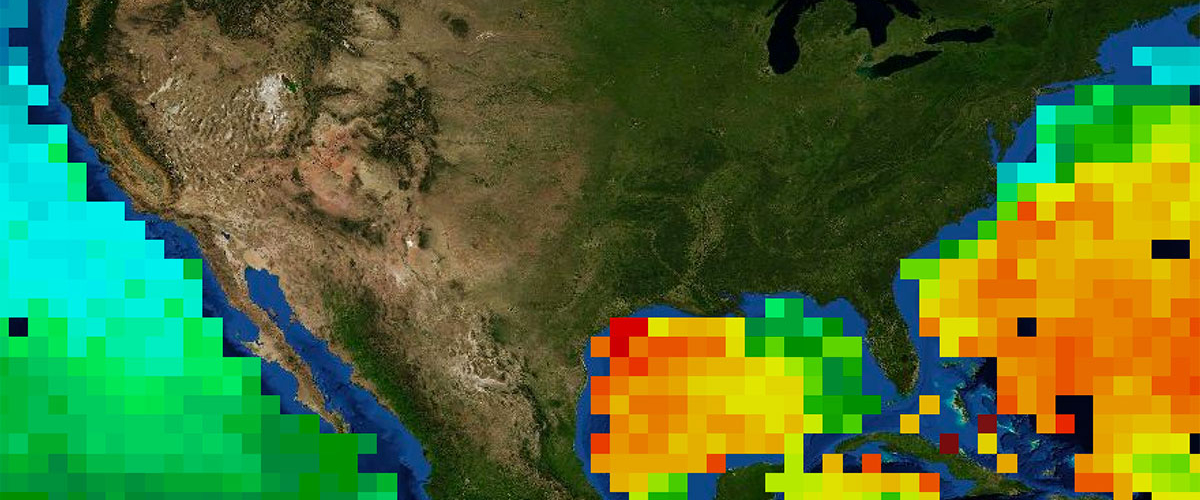
Data from the Aquarius/Satélite de Aplicaciones Científicas-D (Aquarius/SAC-D) satellite began in late August 2011 and captured part of this discharge event in the Gulf of America. Aquarius data showed low sea surface salinity (SSS) values (< 34 psu) in the northeastern Gulf of America from August to September 2011 (three to four months after peak discharge), with peak freshening and maximum intrusion in the open Gulf of America in August 2011. By October 2011 (five months after peak discharge), the effect of the discharge was no longer visible in the Aquarius data.
Reference
- Gierach, M. M., J. Vazquez, T. Lee, V. Tsontos, 2013: Aquarius and SMOS detect effects on an extreme Mississippi River flooding event in the Gulf of Mexico, Geophys. Res. Lett., 40(19), 5188-5193. doi:10.1002/grl.50995