Introduction
El Chichón volcano located in northwestern Mexico (17.3N, 95.2W) erupted from March 28 to April 4, 1982, and spewed a large amount of ash and gaseous products into the atmosphere. The large ash particles fell off within a few days, but the gaseous products, particularly SO2, were converted into sulfuric acid and resided in the stratosphere for a few years (Kruger, 1983). Airborne lidar data showed that by July 1982 the aerosol cloud had spread up to 30N and by October 1982 the El Chichón cloud boundaries were from 10S to 35N (Bandeen and Fraser, 1982; Robock and Matson, 1983).
Soon after the eruption, the aerosol optical thickness measured at the Mauna Loa Observatory was the largest in the 25-year history of observations (Deluisi et al, 1983, King et al., 1984). The effect of volcanic eruption was observed in satellite-measurements of geophysical parameters including sea-surface temperature by the Advanced Very High Resolution Radiometer (AVHRR) and ozone measurements by the Solar Backscatter Ultraviolet (SBUV) instrument and the Total Ozone Mapping Spectrometer (TOMS).
The sea surface temperature was biased by as much as 2.5° C for many months (Bandeen and Fraser, 1982), and column ozone amount derived with the operational algorithm was much greater than previously observed (Bandeen and Fraser, 1982, Kruger, 1983).
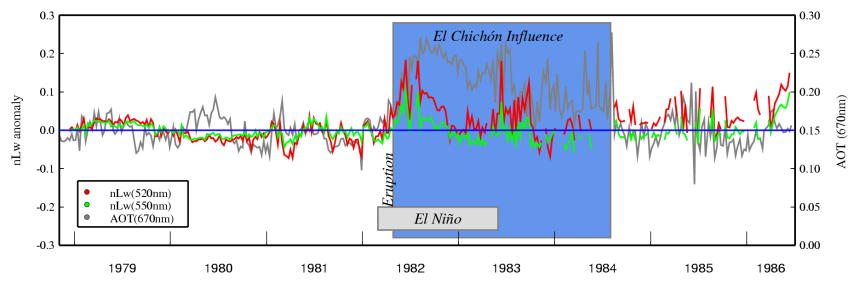
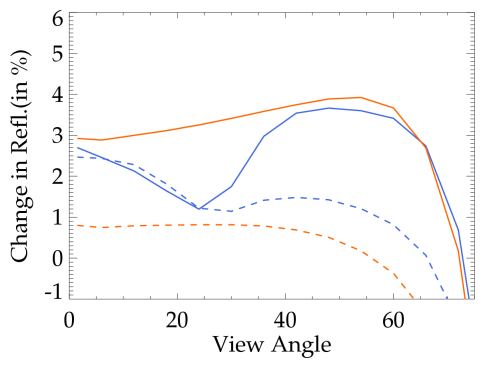
Based on a simulation study, Howard and Castano (1988) had concluded that the El Chichón aerosols would not have any appreciable effect on the determination of water-leaving radiances from the Coastal Zone Color Scanner Experiment (CZCS) instrument. However, recent reprocessing of the CZCS data clearly show significant increase in the retrieved water-leaving radiances in 520 and 550-nm bands during the El Chichón period. This prompted researchers at NASA's Ocean Biology Distributed Active Archive Center (OB.DAAC) to re-examine the effect of El Chichón aerosols on water-leaving radiances by the CZCS instrument.