Introduction
Off the coast of Florida, the Gulf Stream sheds swirls of water only a few kilometers wide that spin off, drift, and disappear within days in the Atlantic Ocean. Oceanographers call these short-lived whirlpools submesoscale eddies, and for decades they were dismissed as background noise—too small to matter for understanding big ocean currents like the Gulf Stream.
That view has changed, thanks to numerical ocean models and a small number of challenging field campaigns through which scientists discovered that these small eddies (generally less than 10 km across) actually play a vital role in the global ocean circulation. They help move energy between large- and small-scales, pull carbon out of the atmosphere and down into the deep ocean, and mix the upper ocean. These small scales are also where the ocean’s microscopic plant-like organisms, called phytoplankton, are sustained by nutrient-rich water pulled up from the depths. Phytoplankton form the center of the marine food web and, through photosynthesis, produce a significant amount of the oxygen we breathe.
Submesoscale ocean dynamics have long been situated in an observational blind spot – too small to see from space, too big and quick to record by ship. Conventional satellite altimeters, which measure sea surface height from space, cannot resolve submesoscales. Ocean color satellites take a different approach, detecting subtle shifts in the sea surface's color—greener where chlorophyll, the pigment phytoplankton use to capture sunlight, is more concentrated—to estimate how much chlorophyll is present in submesoscale eddies, though not which phytoplankton species produced it.
Frontal eddies, which form along the edges of western boundary currents like the Gulf Stream, are particularly difficult to observe because they occur intermittently and are pulled along quickly by the fast currents that spawned them.
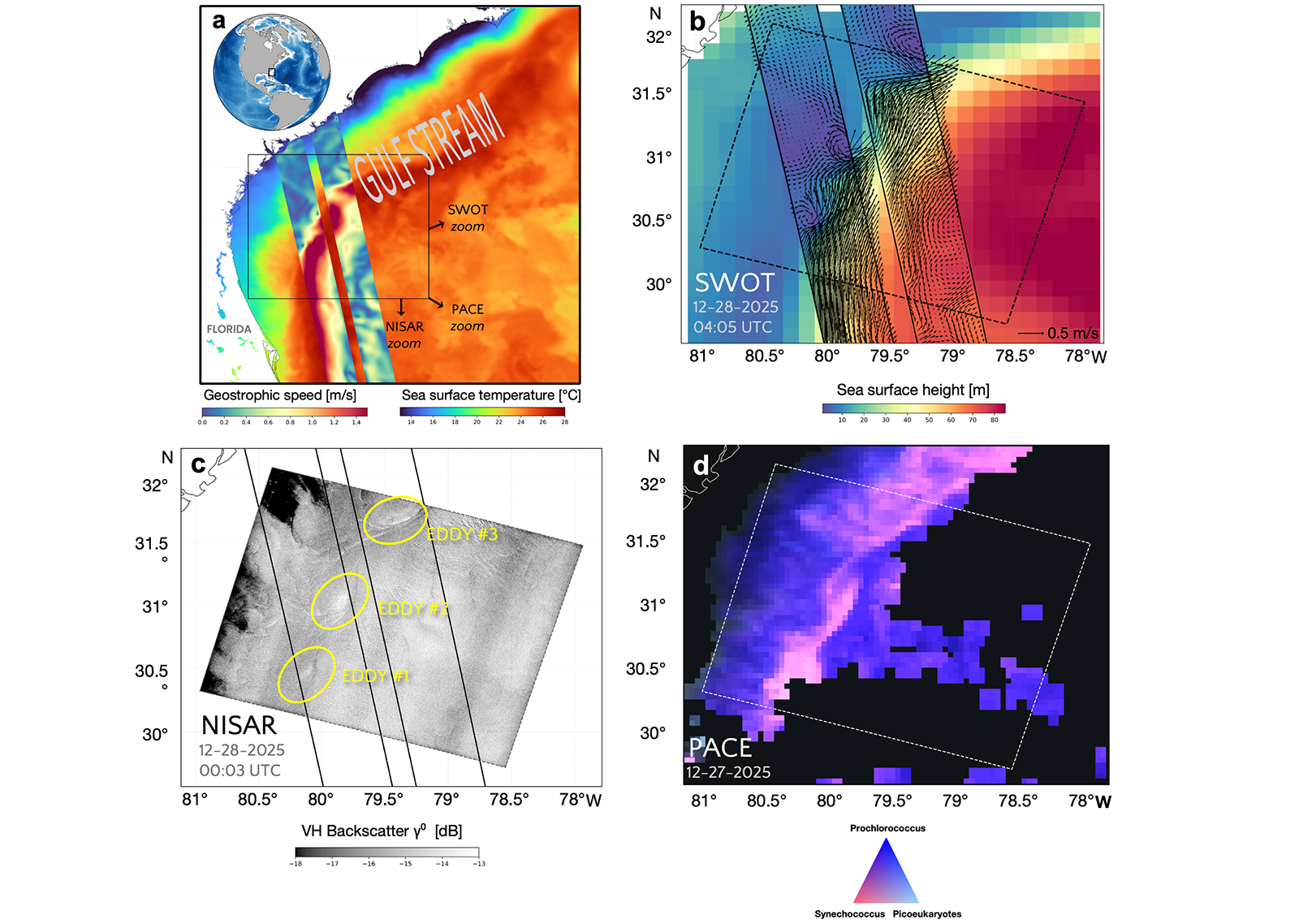
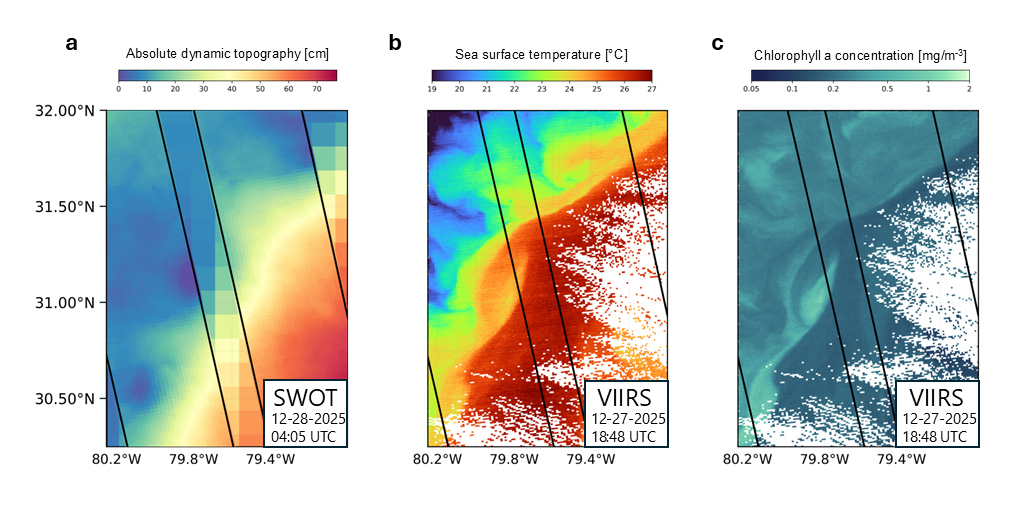
Now, a new generation of NASA satellite missions is closing these observational gaps, and, for the first time, several satellites can look at the same patch of ocean on the same day in high spatial resolution.