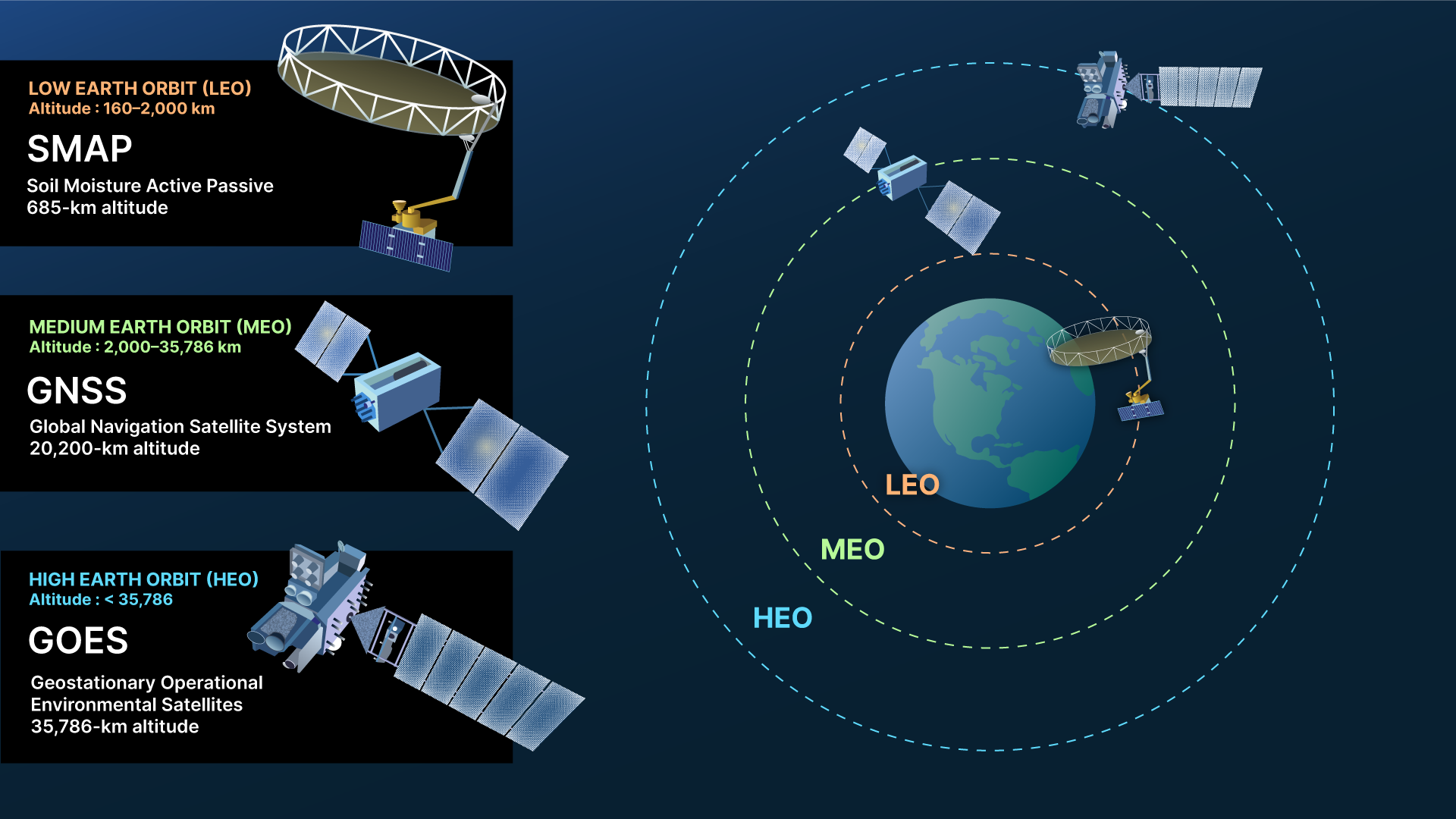
Low-Earth orbit is a commonly used orbit since platforms can follow several orbital tracks around the planet. Polar-orbiting platforms, for example, are inclined nearly 90 degrees to the equatorial plane and travel from pole to pole as Earth rotates. This enables instruments aboard these platforms to acquire data for the entire globe rapidly, including the polar regions. Many polar-orbiting platforms are considered Sun-synchronous, meaning that the platform passes over the same location at the same solar time each cycle. One example of a Sun-synchronous, polar-orbiting platform is NASA’s Aqua, which orbits approximately 705 km above Earth’s surface.
Non-polar low-Earth orbit platforms, on the other hand, do not provide global coverage but instead cover only a partial range of latitudes. The joint NASA/JAXA (Japan Aerospace Exploration Agency) Global Precipitation Measurement (GPM) Core Observatory is an example of a non-Sun-synchronous low-Earth orbit platform. Its orbital track acquires data between 65 degrees north and south latitude from 407 km above the planet.
A medium-Earth orbit platform takes approximately 12 hours to complete an orbit. In 24-hours, the platform crosses over the same two spots on the equator every day. This orbit is consistent and highly predictable. As a result, this is an orbit used by many telecommunications and GPS platforms. One example of a medium-Earth orbit platform constellation is the ESA (European Space Agency) Galileo global navigation satellite system (GNSS), which orbits 23,222 km above Earth.
While both geosynchronous and geostationary platforms orbit at 35,786 km above Earth, geosynchronous platforms have orbits that can be tilted above or below the equator. Geostationary platforms, on the other hand, orbit Earth on the same plane as the equator. These platforms capture identical views of Earth with each observation and provide almost continuous coverage of one area. The joint NASA/NOAA Geostationary Operational Environmental Satellite (GOES) series of weather platforms are in geostationary orbits above the equator.