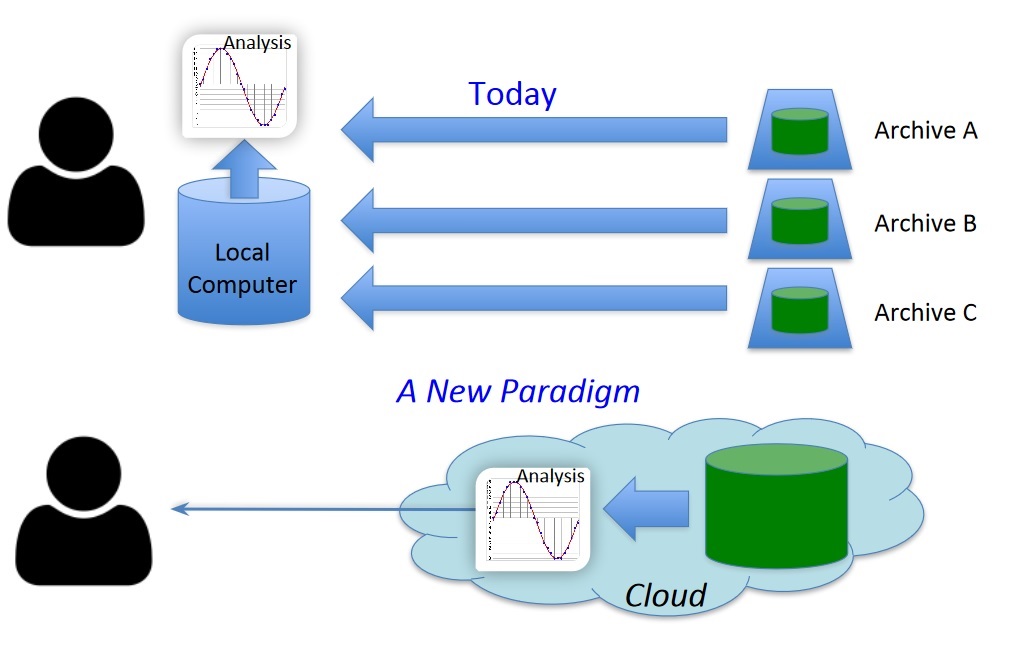
Cloud computing refers to storing data in the cloud and accessing it through a virtual, cloud-based environment. This approach allows users to perform analyses and manipulate data directly where it's stored in the cloud, rather than downloading entire datasets to a local machine. Only the final analysis results need to be downloaded, which saves significant time and bandwidth—especially when working with large datasets. This method eliminates the need to transfer massive files back and forth while still providing access to powerful computing resources for data processing and analysis.

Since 1994, NASA has made all Earth science data freely available to everyone. NASA's Earth Science Data Systems (ESDS) Program aims to maximize the value of this data by deploying cloud-enabled tools and storage solutions.

By moving NASA Earth science data to Amazon Web Services (AWS), users gain significant advantages. They can work with larger datasets and collaborate more effectively on in-depth research projects with:

  • improved operations that make free and open data access even easier.
  • investment in open-source tools that benefit the entire scientific community.
  • enhanced capabilities for accessing and managing data.
  • stronger partnerships with both commercial providers and the open-source community.

This comprehensive approach streamlines how researchers access and use NASA's Earth science data while maintaining the agency's commitment to free and open data sharing.

Delivering Efficiencies

Cloud computing improves the efficiency of NASA's data systems operations and furthers the free and open access to NASA data.

As the volume of data in NASA's Earth Science Data and Information System (ESDIS) archive grows, so does the need for more flexible and scalable data access and management technologies.

Cumulus is an ESDIS Project effort to prototype and test how ESDIS data collections can be archived collectively and disseminated in the commercial cloud. A primary feature of Cumulus is a cloud-based framework for data ingest, archive, distribution, and management, which are the primary activities of the discipline-specific Distributed Active Archive Centers (DAACs). ESDS is migrating high-value datasets into commercial cloud archives, and NASA DAACs are in the process of moving the data they archive and distribute to the AWS commercial cloud. Additional datasets are being prioritized for migration based on user demand. 

Facilitating Open Science

Having data in the cloud enables efficient use of Big Data collections and the collaborative work with these data.

The ESDS Program defines open science as a collaborative culture enabled by technology that empowers the open sharing of data, information, and knowledge within the scientific community and the wider public to accelerate scientific research and understanding. The launch of high-data-volume missions such as the Surface Water and Ocean Topography (SWOT) mission and the NASA-Indian Space Research Organisation Synthetic Aperture Radar (NISAR) mission increase the volume of data to around 600 petabytes by 2030. Having these data in the cloud enables users to work next to the data and then download the results of their analysis, significantly reducing computing time and cost. The cloud also enables teams of researchers in different locations to work collaboratively in real time with these data.

Learn more about open science at NASA.

Simplified Analysis and Management

Cloud-based data enable researchers and other users to access and process petabytes of open data quickly without the need for complex data management capabilities.

Enabling the analysis of cloud-based open data allows the next generation of data systems to scale to the magnitude of the data archives holding these data. Building capacity to access and process these data provides faster time to delivery of new tools and services and the opening up of technological advances to new communities of data users.

Image
Image Caption

The evolution of data in NASA's Earth science data collection leads to a new paradigm in how data are used. Rather than individual data users downloading data from multiple sources for analysis on their local machines (top image), Big Data will be most efficiently used by working close to the data and conducting analyses in the cloud, then downloading only the results (bottom image). This also will facilitate more communal use of data in the cloud by teams of researchers.

Innovation and Strategic Partnerships

The ESDS Program supports evolving technology development programs to foster a cloud-based portfolio with innovations from strategic partners and the open-source community.

NASA works closely with technology partners such as AWS and Google as well as organizations like Esri, ESA (European Space Agency), USGS, and NOAA to develop tools, services, and applications that drive cloud-based innovation.

All software and tools developed for use with NASA data comply with NASA's Open Data, Services, and Software policies.

Get Started in the Cloud