NASA's Surface Water and Ocean Topography (SWOT) platform monitors Earth’s surface water, collecting data to contribute to the first global survey of Earth's oceans and its terrestrial surface water. SWOT observes the fine details of surface topography and measures how water bodies change over time.

SWOT uses interferometry to achieve 2D mapping, and its observations can be used to better understand ocean currents and processes happening at spatial scales on the order of 15-150 km. SWOT enables high resolution monitoring of coastal regions, including coastal currents, storm surges, and regional sea level change. On land, SWOT provides measurements of water storage changes (surface water area and water depth) of major lakes, reservoirs, rivers, and wetlands, and supports derived estimates of river discharge, which aid in assessing water resources.

Type

Earth Observation Satellite

Data Center

PO.DAAC

Launch

December 16, 2022

Objective

Track how bodies of water change over time
Remote video URL
In this video, Dr. Hind Oubanas, the SWOT Hydrology Science Lead at CNES, gives an overview of SWOT river discharge data products and algorithm development. Specifically, the Dr. Oubanas describes the work of the SWOT Discharge Algorithms Working Group, detailing how river discharge is derived from SWOT observations and what products are being developed and validated. Credit: PO.DAAC
SWOT Partners
SWOT is jointly developed by NASA and Centre National D'Etudes Spatiales (CNES), with contributions from the Canadian Space Agency (CSA) and United Kingdom Space Agency.
Four logos are arranged in a square: NASA, Centre National D'Etudes Spatiales (CNES), Canadian Space Agency (CSA), and United Kingdom Space Agency.

SWOT aims to provide valuable data and information about the world's oceans and its terrestrial surface water such as lakes, rivers, and wetlands. Its instruments measure ocean surface topography and land surface water elevation with great accuracy, using interferometry to achieve 2D mapping. Observations from SWOT can be used to better understand ocean currents and processes happening at spatial scales on the order of 15-150 km, something that has not been done before. 

SWOT enables high resolution (within 1 km from land) monitoring of coastal regions, including coastal currents, storm surges, and regional sea level change. On land, SWOT provides measurements of water storage changes (surface water area and water depth) of major lakes, reservoirs, rivers, and wetlands, and supports derived estimates of river discharge, which aid in assessing water resources. SWOT can observe rivers wider than 100 m and lakes with a surface area of 15 acres or more.
SWOT Spatial Coverage for Beta Pre-Validated Products v1.1

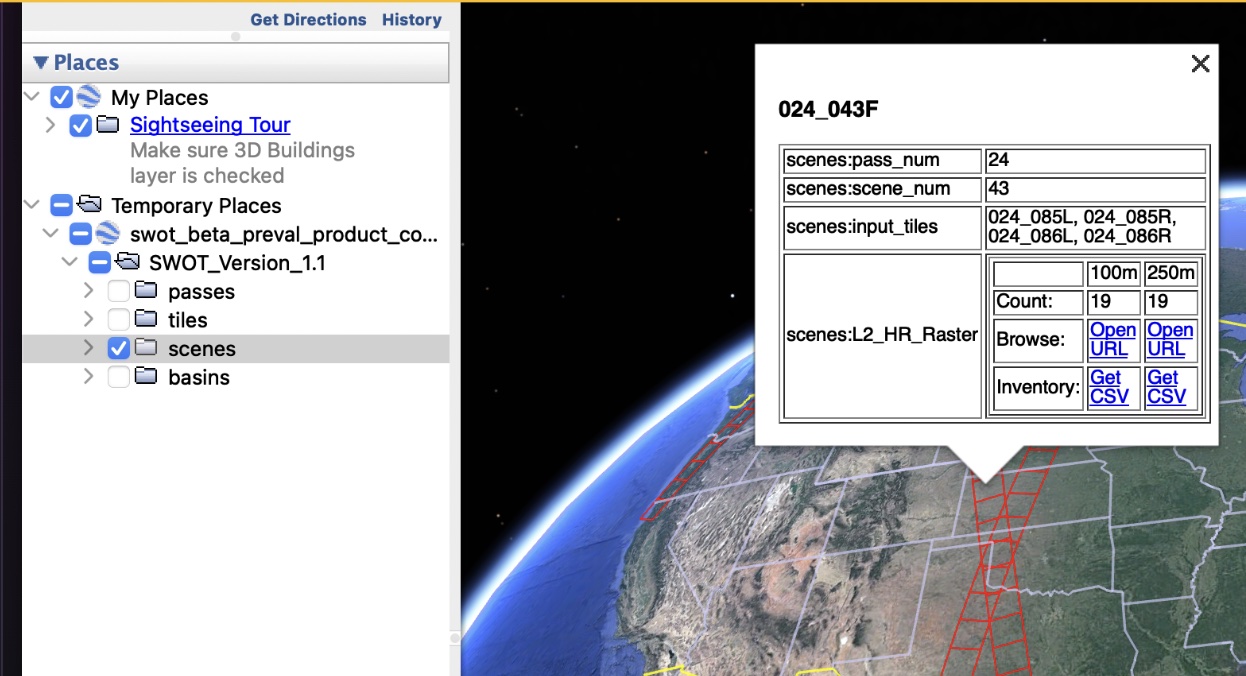
To identify spatial coverage/search terms for the Beta Pre-Validated products (v1.1), PO.DAAC has created a KMZ file that has layers of the SWOT passes, tiles, scenes, and basins covered in this product release. Spatial coverage will expand for the pre-validated product release. Each layer has direct links to Earthdata Search (the ‘Open URL’ link) and CMR (the ‘Get CSV’ link) results for the corresponding files. The passes layer has useful information for all SWOT products, the tiles layer is useful for the L1B_HR_SLC, L2_HR_PIXC, and L2_HR_PIXCVec products, the scenes layer is useful for the L2_HR_Raster product (screenshot below), and the basins layer gives the L2_HR_RiverSP and L2_HR_LakeSP product coverages for each continent/pass combination.

Download the Beta Pre-Validated HR Product KMZ file (1.6 MB). The file can be opened in the Google Earth desktop application and viewed as follows:

Image
Image Caption

SWOT beta pre-validated data viewed in the Google Earth desktop application.

SWOT will provide Low Rate (LR) data with low spatial resolution globally, and High Rate (HR) data with high spatial resolution for the terrestrial and coastal environments.

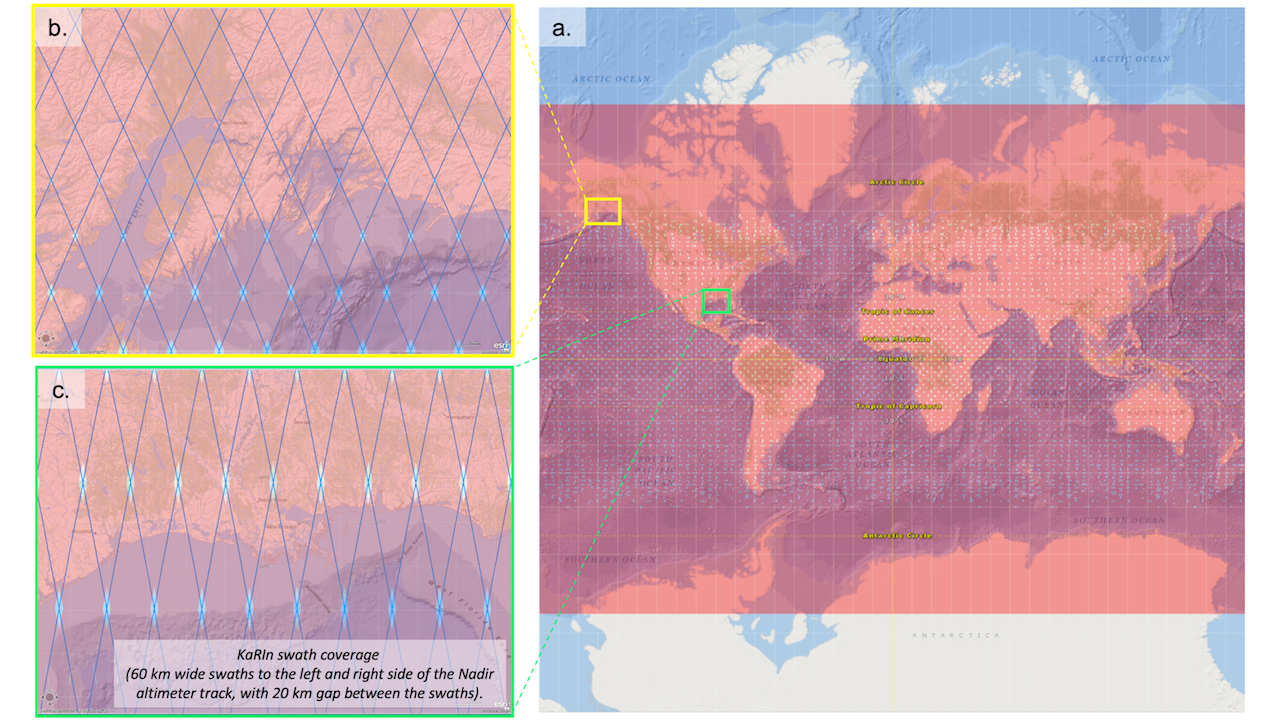
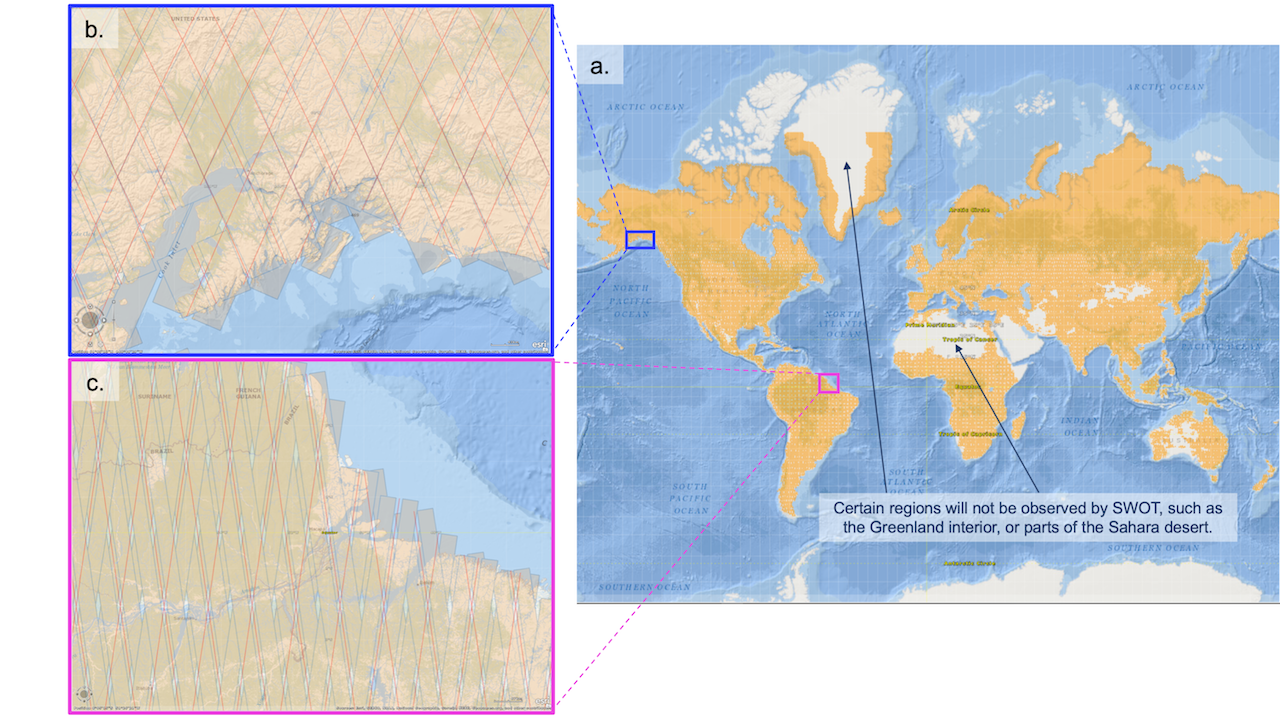
HR measurements will not be taken everywhere, due to bandwidth issues of downlinking the data. To resolve that, an HR mask will be used. Figure 1 below shows, in yellow, where the HR data will be made available. The areas not covered by the mask will be preprocessed to LR data. Figure 2 below shows the coverage and swath geometry of LR data at high and low latitudes. HR data will have terrestrial corrections applied, whereas LR data will only have oceanic corrections applied.

Image
Image Caption

Figure 1. SWOT High Rate (HR) spatial coverage mask. Areas in yellow will have HR measurements. The HR mask extends a few kilometers off the coast. a) Spatial coverage for terrestrial water features and coastal areas. b) Cook Inlet, AK. c) Amazon River Delta.

Image
Image Caption

Figure 2. This illustrates SWOT satellite spatial coverage, including the KaRIn swaths and the Nadir altimeter track. It depicts (a) global coverage, (b) coverage and swath geometry over high latitudes (here Yukon Peninsula is shown), and (c) coverage and swath geometry over lower latitudes (here Mississippi Delta). Note the coverage difference between (b) and (c). SWOT has a 21-day cycle. Note: this image is for illustration purposes only. Check out the SWOT Visualizer to see how your geographic region of interest might be cover by SWOT observations. KMZ and SHP files of nadir and swath will be provided here (coming soon).

Recommended User Documentation


  1.     "Version C" KaRIn products are distributed in the "Version 2.0" SWOT collections at PO.DAAC
  2. "Version D" KaRIn products are distributed in the "Version D" SWOT collections at PO.DAAC


Altitude890.582 km
Inclination77.6°
Mean Eccentricity0.00105
Number of Orbits per Cycle292
Number of Passes per Cycle584
Nodal Period6173.62 sec
Duration of one pass3086.81 sec
Exact repeat cycle duration20.86455 days
Longitude gap between tracks at the Equator1.233°
Repeat orbit parameters (N+P/Q)13+19/21
Mean semi-major axis7268.72 km

Please refer to the list of SWOT significant events for relevant information about spacecraft events that impact data quality and availability. This page includes links to the downlink masks for the KaRIn high-rate data.

Instruments Aboard SWOT

Instrument Name Operational Date(s) Spectral Resolution Type of Instrument
Advanced Microwave Radiometer (AMR) 2023 - present

18.7 GHz, 23.8 GHz and 34.0 GHz

Spectrometer/Radiometer
Jason-Class Altimeter 2023 - present

13.6 GHz in the Ku band and 5.3 GHz in the C band

Altimeter
Ka-band Radar Interferometer (KaRIn) Radar Interferometer
Laser Reflector Assembly (LRA) 2023 - present Positioning/Navigation

Frequently Asked Questions

Earthdata Forum

Our online forum provides a space for users to browse thousands of FAQs about research needs, data, and data applications. You can also submit new questions for our experts to answer.

Submit Questions to Earthdata Forumand View Expert Responses

Earthdata
Forum