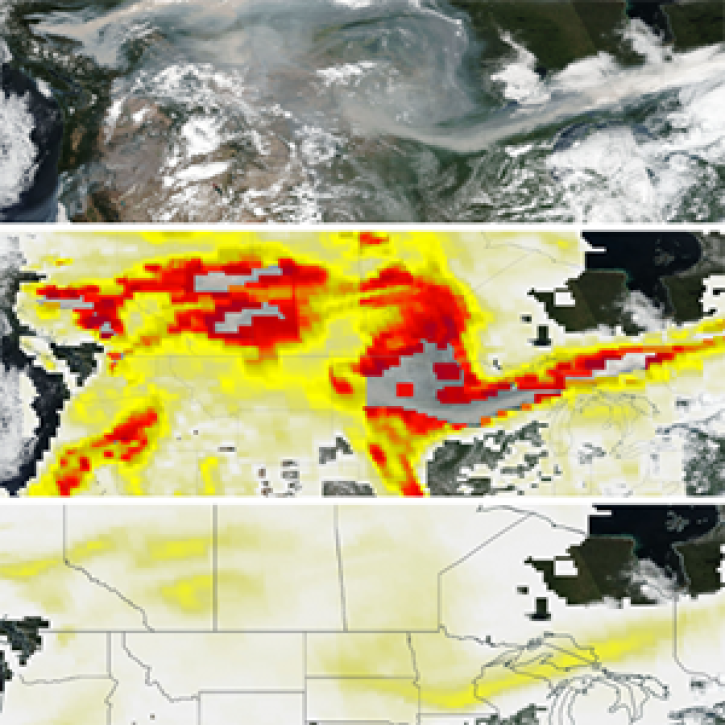
Access a range of datasets and data tools to further your UV aerosol index research.
Aerosol index (AI) is a measurement related to Aerosol Optical Depth (AOD) that indicates an increased concentration of tiny particles called aerosols suspended in the atmosphere. In general, a lower AI value indicates clearer skies due to a lower concentration of aerosols.
Aerosol index is an ideal metric for tracking the evolution of episodic aerosol plumes from dust outbreaks, volcanic ash, significant fire events, and biomass burning. Those plumes can harm human and ecosystem health, disrupt the work of important industries, and pose significant hazards to transportation.
The calculation of the aerosol index is based on wavelength-dependent changes in Rayleigh scattering in the ultraviolet (UV) spectral range, where ozone absorption is very small. The aerosol index is derived from normalized radiances using two wavelength pairs at 340 and 378.5 nanometers.
UV aerosol index can be calculated even if clouds are present, enabling daily global coverage. Instruments aboard NASA’s Earth-observing satellites provide worldwide aerosol index data, including near real-time data.
Learn How to Use UV Aerosol Index Data
Join Our Community of NASA Data Users
While NASA data are openly available without restriction, an Earthdata Login is required to download data and to use some tools with full functionality.
Learn About the Benefits of Earthdata LoginGet Help
QUESTIONS & SUPPORT
Get help with NASA Earth science data, datasets, tools, services, and metadata on the Earthdata Forum. Experienced staff in the data user community review and answer questions.
Get help on Earthdata ForumForum