Delivery of Suomi National Polar-orbiting Partnership (Suomi NPP) satellite data products will cease on November 1, 2026. Data users should transition now to alternative products from NOAA-21 and NOAA-20.
Suomi NPP data announcement
Tropical Storm Cristobal in the Gulf of Mexico
Image captured on 7 June 2020, by the VIIRS instrument, aboard the joint NASA/NOAA Suomi NPP satellite.
Image
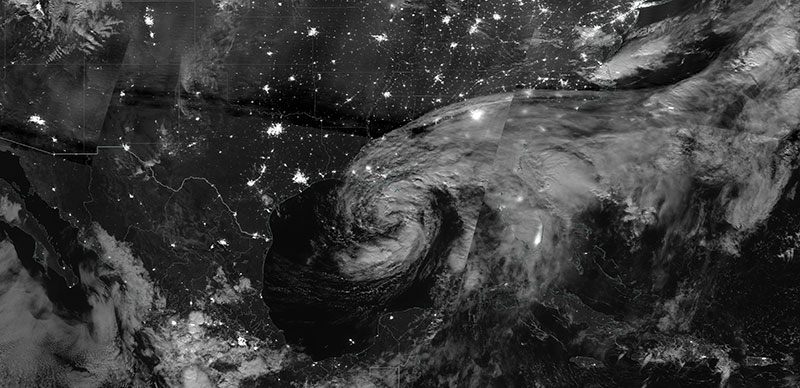
Night time image of Tropical Storm Cristobal in the Gulf of Mexico. The image was acquired on 7 June 2020 by the Visible Infrared Imaging Radiometer Suite (VIIRS) instrument, aboard the joint NASA/NOAA Suomi National Polar orbiting Partnership (Suomi NPP) satellite.
The VIIRS Nighttime Imagery (Day/Night Band, Enhanced Near Constant Contrast) layer shows the Earth’s surface and atmosphere using a sensor designed to capture low-light emission sources, under varying illumination conditions. It is displayed as a grey-scale image. Sources of illumination include both natural and anthropogenic sources of light emissions. Lunar reflection can be used to highlight the location and features of clouds and other terrestrial features such as sea ice and snow cover when there is partial to full moon conditions.
When there is no moonlight, natural and anthropogenic night time light emissions are highlighted such as city lights, lightning, auroras, fires, gas flares, and fishing fleets. This layer is useful for showing patterns of human activity and energy behaviors such as cities and highways, the holiday periods, the tracking of shipping and fishing fleets at night and, the burning of waste natural gas (gas flares) from on and offshore oil/gas production sites.
Visit Worldview to visualize near real-time imagery from NASA's EOSDIS, and check out more Worldview weekly images in our archive.
Details
Last Updated
Published on
Sept. 11, 2020