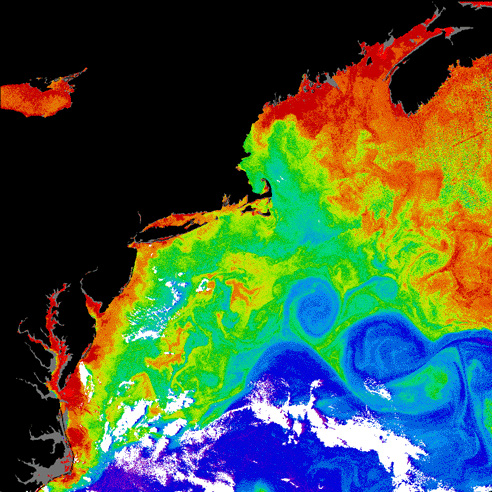
The Gulf Stream is a western boundary current, indicating that if flows along the west side of a major ocean basin (in this case the North Atlantic Ocean). The corresponding current in the Pacific Ocean is called the Kuroshio, which flows north to about the center of the Japanese archipelago and then turns eastward into the central Pacific basin. In the Southern Hemisphere, the most noteworthy western boundary current is the Agulhas Current in the Indian Ocean. Note that the Agulhas flows southward instead of northward like the Gulf Stream and the Kuroshio.
Western boundary currents result from the interaction of ocean basin topography, the general direction of the prevailing winds, and the general motion of oceanic waters induced by Earth's rotation. This type of circulation pattern can be derived mathematically. Of interest here are the general characteristics of western boundary currents, and why they are such striking features in ocean color imagery.
The primary characteristics of western boundary currents are their velocity and volume of flow. Western boundary currents are very strong, quite narrow, and due to the amount of water transported, they exert a considerable influence on the dynamics of the entire ocean basin and the regional climate. The climate of the United Kingdom and continental Europe is considerably moderated by the influence of the warm water transported by the Gulf Stream.
The Gulf Stream marks the dividing line between warm, low-productivity waters to the south and colder, more productive waters near the North American continental shelf. Just as in the image of Tasmania, the characteristics of the water and the associated biological communities can change dramatically over a very small area. CZCS images clearly show the fluctuating boundary between the nearshore productive waters and the offshore waters with lower concentrations of phytoplankton chlorophyll and associated pigments. The eddies and meanders of the Gulf Stream are also visible.
Another feature of interest are large circular features that appear to both the north and south of the Gulf Stream front. The generation of these features, and their interesting physical and biological characteristics, are the subjects of the next chapter.