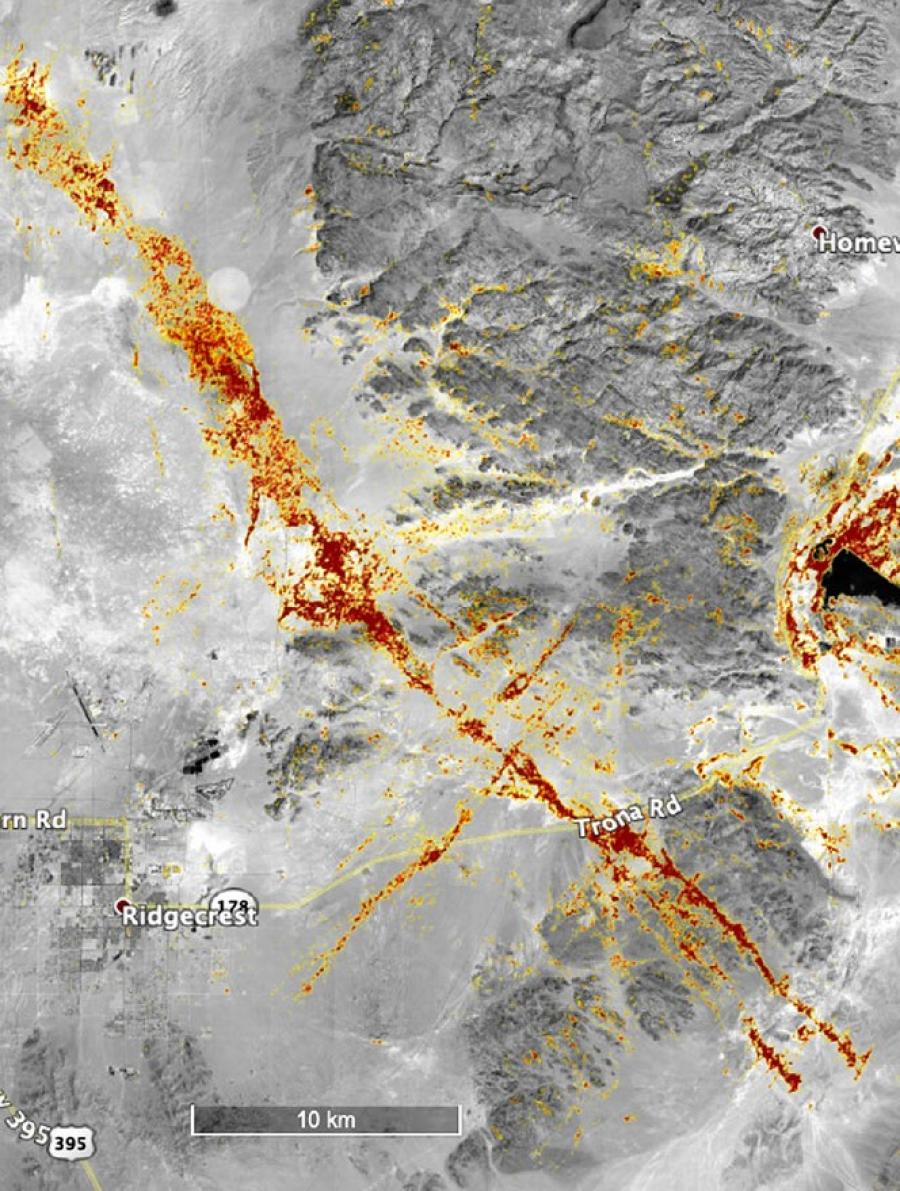
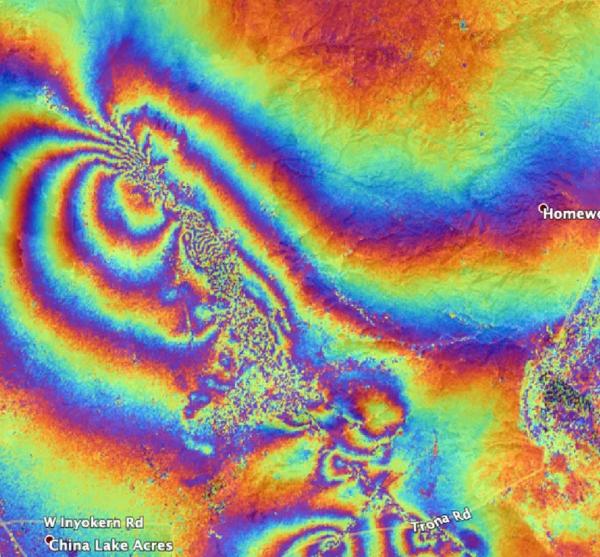
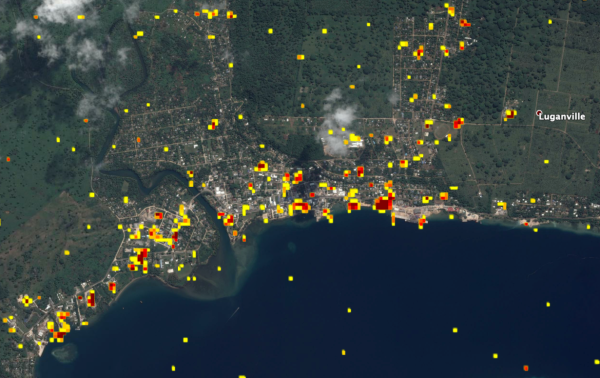
ARIA GUNW product
ARIA GUNW derived product

ARIA

Advanced Rapid Imaging and Analysis

The Advanced Rapid Imaging and Analysis (ARIA) Project, a collaboration between NASA's Jet Propulsion Laboratory (JPL) and the California Institute of Technology, utilizes synthetic aperture radar (SAR) data and Global Positioning System (GPS) for detecting and measuring ground deformation and creating predictive models.

Partners

Data Centers

ASF DAAC

ARIA-S1-GUNW products are a standardized interferometric SAR (InSAR) dataset produced at JPL, enabling rapid analysis of surface deformation using Sentinel-1 SAR data. They provide Climate and Forecast (CF)-compliant NetCDF files at 90-m pixel spacing, containing unwrapped interferometric phase measurements, imaging geometry, various correction layers, and metadata, and are available for VV polarization only. ARIA-S1-GUNW products use a custom framing convention to ensure consistent geospatial extents through time, making them high-quality inputs for time-series analysis.

The products are designed to support a range of geophysical and hazard applications, including monitoring earthquakes, volcanoes, land subsidence, and other sources of surface deformation. There are currently more than one million ARIA-S1-GUNW products archived by ASF DAAC, covering areas worldwide that have been identified for natural hazard monitoring and response. This archive is continually growing as new products are produced at JPL from newly acquired Sentinel-1 data and from products generated by the ASF On Demand S1-GUNW processing service.

More information on the ARIA-S1-GUNW Standard Products is available from JPL's ARIA Project website and in ASF DAAC's ARIA ARIA Sentinel-1 GUNW Product Guide.

The ASF On Demand service now offers the option to produce custom ARIA-S1-GUNW products from user-selected Sentinel-1 SLC pairs. This allows the creation of ARIA-S1-GUNW products with different spatial or temporal pairings than what is already available in the ARIA-S1-GUNW archive.

On Demand ARIA-S1-GUNW products are generated using the same code used by the ARIA project, and have been validated to ensure that products generated On Demand and those generated by the ARIA team at JPL are fully interoperable. Products generated On Demand are automatically added to the ASF ARIA-S1-GUNW archive once processing is complete, where they can be found by anyone searching for ARIA-S1-GUNW products.

Information on using the On Demand ARIA-S1-GUNW custom processing service is available in ASF DAAC's ARIA Sentinel-1 GUNW Product Guide.

ARIA-S1-GUNW Products are accessible using the ASF Discovery Services and through Earthdata Search. Downloading data from ASF requires a NASA Earthdata Login account.

Browser Search Tools

ASF Command Line Search Tools

Working with ARIA-S1-GUNW Products

  • ARIA-tools is an open-source Python package that contains tools for manipulating ARIA standard InSAR products. The ARIA-tools package includes functionality to crop/merge data and metadata layers for multiple standard products, extract data and metadata layers from these products, and set up and prepare time series. Time-series processing is not supported in ARIA-tools. However, outputs are compatible with third-party time-series InSAR packages, such as the open-source Miami InSAR Time-series in Python (MintPy) software.

The ARIA team provides Jupyter notebook examples and YouTube tutorials for using ARIA-tools with ARIA-S1-GUNW products:

When using ARIA-S1-GUNW data in publications such as journal papers, articles, presentations, posters, and websites, please cite:

Buzzanga, Brett, et al. "Toward sustained monitoring of subsidence at the coast using InSAR and GPS: An application in Hampton Roads, Virginia." Geophysical Research Letters 47.18 (2020): e2020GL090013

When using an ARIA-S1-GUNW image in publications such as journal papers, articles, presentations, posters, and websites, please include the following credit with the image:

Credit: ARIA S1 GUNW, NASA [year of data acquisition]. Contains modified Copernicus Sentinel data