N: 90 S: -90 E: 180 W: -180
Description
The MOD13A1 Version 6 data product was decommissioned on July 31, 2023. Users are encouraged to use the MOD13A1 Version 6.1 data product.
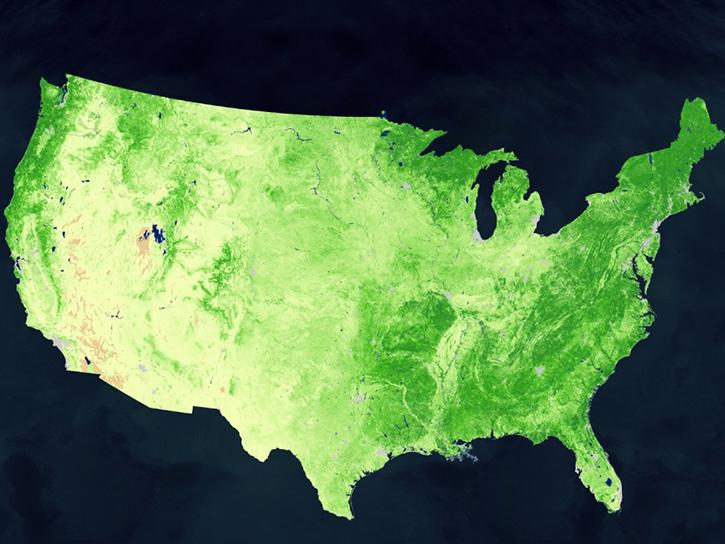
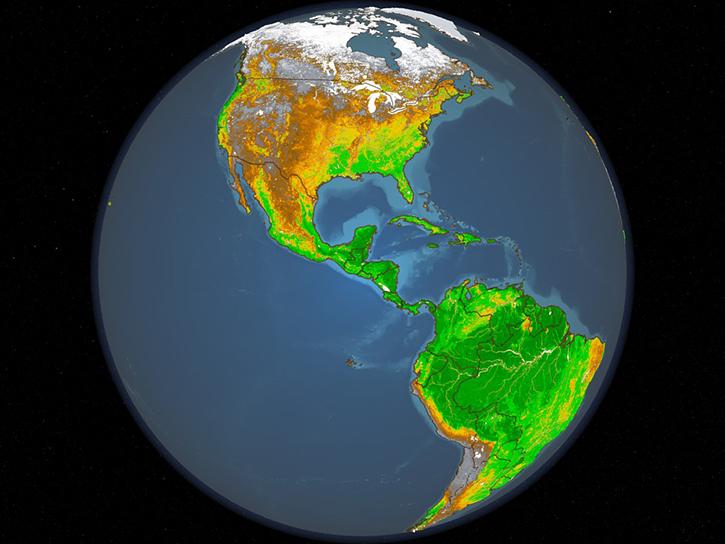
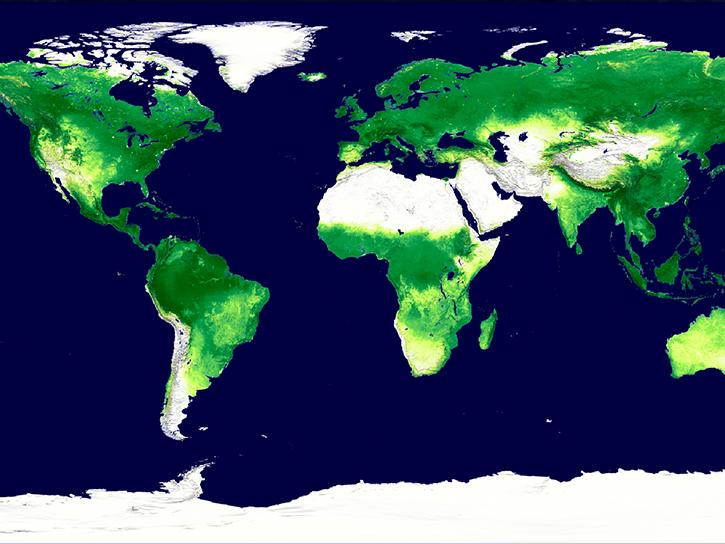
The MOD13A1 Version 6 product provides Vegetation Index (VI) values at a per pixel basis at 500 meter (m) spatial resolution. There are two primary vegetation layers. The first is the Normalized Difference Vegetation Index (NDVI), which is referred to as the continuity index to the existing National Oceanic and Atmospheric Administration-Advanced Very High Resolution Radiometer (NOAA-AVHRR) derived NDVI. The second vegetation layer is the Enhanced Vegetation Index (EVI), which has improved sensitivity over high biomass regions. The algorithm for this product chooses the best available pixel value from all the acquisitions from the 16 day period. The criteria used is low clouds, low view angle, and the highest NDVI/EVI value.
Provided along with the vegetation layers and two quality assurance (QA) layers are reflectance bands 1 (red), 2 (near-infrared), 3 (blue), and 7 (mid-infrared), as well as four observation layers.
Known Issues
-
The following issues have been detected:
- Unexpected missing data in the last cycles of each year.
- Incorrect instances of "NoData" and spikes in NDVI values.
- VI Usefulness Bits are not correctly assigned.
- For instances where the VI Quality (bits 0-1) is flagged as good and the VI Usefulness (bits 2-5) indicates the same pixels have the lowest usefulness score, users are advised to disregard the usefulness score.
- The incorrect representation of the aerosol quantities (low, average, high) in the Collection 6 MOD09 surface reflectance products may have impacted MOD13 Vegetation Index data products particularly over arid bright surfaces.
- Corrections were implemented in Collection 6.1 reprocessing.
- For complete information about known issues please refer to the MODIS/VIIRS Land Quality Assessment website.
Version Description
Product Summary
Citation
Citation is critically important for dataset documentation and discovery. This dataset is openly shared, without restriction, in accordance with the EOSDIS Data Use and Citation Guidance.
Copy Citation
File Naming Convention
The file name begins with the Product Short Name (MOD13A1) followed by the Julian Date of Acquisition formatted as AYYYYDDD (A2002257), the Tile Identifier which is horizontal tile and vertical tile provided as hXXvYY (h21v13), the Version of the data collection (006), the Julian Date and Time of Production designated as YYYYDDDHHMMSS (2015151084135), and the Data Format (hdf).
Documents
USER'S GUIDE
ALGORITHM THEORETICAL BASIS DOCUMENT (ATBD)
PRODUCT QUALITY ASSESSMENT
Dataset Resources
Publications Citing This Dataset
| Title | Year Sort ascending | Author | Topic |
|---|---|---|---|
| Identifying vegetation dynamics and sensitivities in response to water resources management in the Heihe River Basin in China | Yin, Dongqin, Li, Xiang, Huang, Yuefei, Si, Yuan, Bai, Rui | Vegetation Index, Normalized Difference Vegetation Index (NDVI), Enhanced Vegetation Index (EVI) | |
| Inferring anthropogenic trends from satellite data for water-sustainability of US cities near artificial reservoirs | Yigzaw, Wondmagegn, Hossain, Faisal | Land Use/Land Cover Classification, Land Surface Temperature, Emissivity, Vegetation Index, Normalized Difference Vegetation Index (NDVI), Enhanced Vegetation Index (EVI) | |
| National forest aboveground biomass mapping from ICESat/GLAS data and MODIS imagery in China | Chi, Hong, Sun, Guoqing, Huang, Jinliang, Guo, Zhifeng, Ni, Wenjian, Fu, Anmin | Land Use/Land Cover Classification, Canopy Characteristics, Evergreen Vegetation, Crown, Deciduous Vegetation, Leaf Characteristics, Vegetation Cover, Vegetation Index, Normalized Difference Vegetation Index (NDVI), Enhanced Vegetation Index (EVI) | |
| Land cover mapping of a tropical region by integrating multi-year data into an annual time series | Anaya, Jesus, Colditz, Rene, Valencia, German | Vegetation Index, Normalized Difference Vegetation Index (NDVI), Enhanced Vegetation Index (EVI) | |
| Lidar with multi-temporal MODIS provide a means to upscale predictions of forest biomass | Li, Le, Guo, Qinghua, Tao, Shengli, Kelly, Maggi, Xu, Guangcai | Leaf Area Index (LAI), Fraction Of Absorbed Photosynthetically Active Radiation (fapar), Vegetation Index, Normalized Difference Vegetation Index (NDVI), Enhanced Vegetation Index (EVI) | |
| Water allocation and water consumption of irrigated agriculture and natural vegetation in the Aksu-Tarim river basin, Xinjiang, China | Thevs, Niels, Peng, Haiyan, Rozi, Ahmedjan, Zerbe, Stefan, Abdusalih, Nurbay | Land Surface Temperature, Emissivity, Vegetation Index, Normalized Difference Vegetation Index (NDVI), Enhanced Vegetation Index (EVI), Albedo, Anisotropy | |
| Modifying SEBAL model based on the trapezoidal relationship between land surface temperature and vegetation index for actual evapotranspiration estimation | Wang, Xiao-Gang, Wang, Wen, Huang, Dui, Yong, Bin, Chen, Xi | Land Use/Land Cover Classification, Land Surface Temperature, Emissivity, Vegetation Index, Normalized Difference Vegetation Index (NDVI), Enhanced Vegetation Index (EVI), Albedo, Anisotropy | |
| Multi-scale influence of vapor pressure deficit on fire ignition and spread in boreal forest ecosystems | Sedano, F., Randerson, J. T. | Vegetation Index, Normalized Difference Vegetation Index (NDVI), Enhanced Vegetation Index (EVI) | |
| Spatio-temporal patterns of precipitation-use efficiency of vegetation and their controlling factors in Inner Mongolia | Shao-Jie, MU, Ke-Xin, ZHOU, Yang, QI, Yi-Zhao, CHEN, Ying, FANG, ZHU Chao, and | Vegetation Index, Normalized Difference Vegetation Index (NDVI), Enhanced Vegetation Index (EVI) | |
| Rice equivalent crop yield assessment using MODIS Sensors' Based MOD13A1-NDVI Data | Tomar, Vandana, Mandal, Vinay Prasad, Srivastava, Pragati, Patairiya, Shashikanta, Singh, Kartar, Ravisankar, Natesan, Subash, Natraj, Kumar, Pavan | Vegetation Index, Normalized Difference Vegetation Index (NDVI), Enhanced Vegetation Index (EVI) |