
Introduction

Ocean salinity can change in response to rainfall, evaporation, and river discharge; other processes such as changing ocean currents and mixing also can redistribute salt within the ocean. Across the past decade, extensive research has established ocean salinity as a robust indicator of changes in the global water cycle–the continuous movement of water between the ocean, land, atmosphere, and cryosphere. Ocean salinity patterns and trends have revealed an amplification of the water cycle in a warming climate, with wet regions becoming wetter and dry regions becoming drier. Understanding the mechanisms that drive long-term variations in salinity is therefore essential for diagnosing climate change and its impacts on the Earth system.

Image
Image Caption

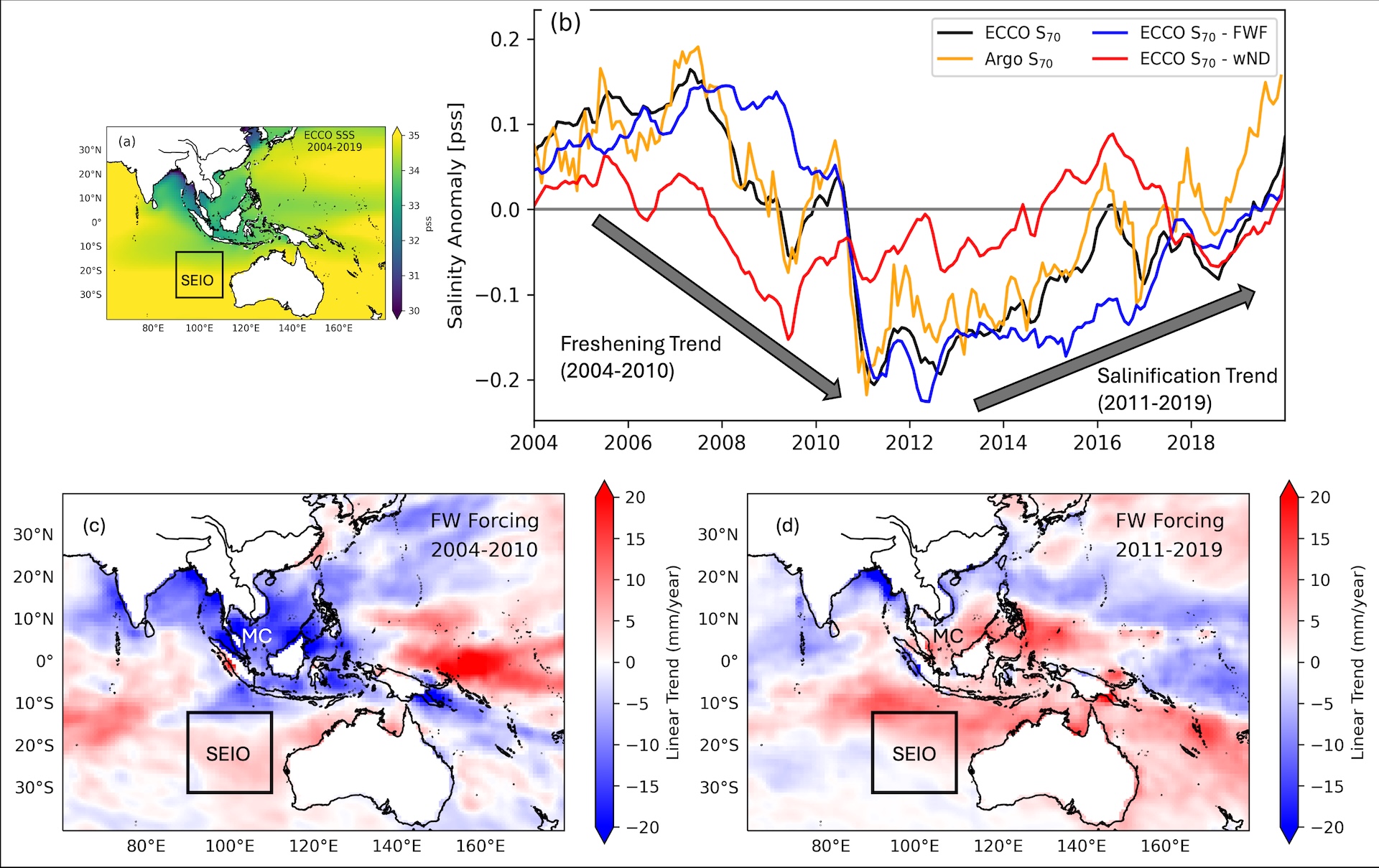
Figure: (a) Average sea surface salinity (pss) from the ECCO model with Southeast Indian Ocean (SEIO) box region marked. (b) Freshening event during 2004-2010 and salinification eventduring 2011–2019 in SEIO are observed by Argo (yellow) and two ECCO simulations: CTL (black), which includes varying surface freshwater fluxes (evaporation and precipitation) and wind forcing globally and FWF (blue), which includes varying surface freshwater fluxes and climatological wind forcing. The ECCO simulation WND (red), which includes varying wind forcing and climatological freshwater fluxes, is not capturing the events. Maps of the freshening event (blue) during 2004-2010 (c) and the salinification (red) event during 2011-2019 (d) in the ECCO freshwater forcing over Indonesia

Using ECCO to Understand Long-term Changes in Salinity in the Southeast Indian Ocean 

Salinity is an important factor in the Southeast Indian Ocean (SEIO) because it influences the health of marine ecosystems and the interactions between the ocean and atmosphere, which in turn influence weather patterns. Salinity also affects the density of seawater, driving ocean currents that distribute heat, nutrients, and salt across the ocean, further shaping regional climate and monsoon systems. 

In situ observations from Argo floats reveal pronounced long-term variability in upper-ocean salinity in the Southeast Indian Ocean (Figure a). These observations show a clear freshening of the upper 70 meters from 2004 to 2010, followed by a period of sustained salinification from 2011 to 2019 (Fig. b; yellow curve). Previous studies suggested several possible factors causing this salinity signal: SEIO local winds affecting the advection of local waters; remote winds in the tropical Pacific forcing the advection of fresher or more saline waters into the SEIO; local evaporation and precipitation; and remote evaporation and precipitation over Indonesia being advected to the SEIO. However, these studies did not agree on the key forcing mechanism that leads to decadal variability of SEIO salinity.

Major Findings

A recent study bridged this knowledge gap by leveraging NASA’s multidecadal global ocean state estimate from the ECCO framework. ECCO is a physically consistent, data-constrained reconstruction of the global ocean state and its changes, and it faithfully reproduces the observed freshening and salinification phases seen in Argo data (Fig. b; black curve). 

The effect of evaporation, precipitation, and wind on SEIO salinity has been disentangled using ECCO global model sensitivity experiments. The model experiment that was forced with interannual evaporation and precipitation variability and climatological winds successfully captured the observed long-term freshening (2004–2010) and salinification (2011–2019) of the SEIO upper-ocean (Fig. b; blue curve). In contrast, the model experiment that was forced with interannual wind variability and climatological evaporation and precipitation failed to reproduce these trends (Fig. b; red curve), indicating that neither local nor remote wind forcing plays a primary role in driving long-term variability in SEIO salinity.

ECCO evaporation minus precipitation fields reveal strong long-term variability over Indonesia, with negative trends during 2004–2010 indicating excessive precipitation (Fig. c), followed by positive trends during 2011–2019 indicating excessive evaporation (Fig. d). This points to a corresponding long-term change in the regional water cycle. 

Further analysis⁸ based on ECCO suggests that anomalously fresh or salty waters formed near Indonesia (due to long-term changes in runoff and precipitation) are advected into the SEIO, driving the observed freshening and salinification trends. This demonstrates that the water cycle around the Indonesian region is the key driver of SEIO decadal salinity variability, helping to reconcile longstanding disagreements among previous studies. These findings fill a critical knowledge gap and provide an important benchmark for evaluating Earth system models, in which long-term variability is not directly constrained by observations.

References

Du, Y., Zhang, Y., Feng, M., Wang, T., Zhang, N., & Wijffels, S. (2015). Decadal trends of the upper ocean salinity in the tropical Indo‐Pacific since mid‐1990s. Scientific Reports, 5(1), 16050. doi:10.1038/srep16050

Durack, P. J., Wijffels, S. E., & Matear, R. J. (2012). Ocean salinities reveal strong global water cycle intensification during 1950 to 2000. Science, 336(6080), 455-458. doi:10.1126/science.1212222

ECCO Consortium, Fukumori, I., Wang, O., Fenty, I., Forget, G., Heimbach, P., & Ponte, R. M. (2021, February 10). Synopsis of the ECCO Central Production Global Ocean and Sea-Ice State Estimate (Version 4 Release 4). doi:10.5281/zenodo.4533349

Hu, S., Zhang, Y., Feng, M., Du, Y., Sprintall, J., Wang, F., et al. (2019). Interannual to decadal variability of upper‐ocean salinity in the southern Indian Ocean and the role of the Indonesian throughflow. Journal of Climate, 32(19), 6403-6421. doi:10.1175/JCLI‐D‐19‐0056.1

Huang, J., Zhuang, W., Yan, X. H., & Wu, Z. (2020). Impacts of the upper‐ocean salinity variations on the decadal sea level change in the southeast Indian Ocean during the Argo era. Acta Oceanologica Sinica, 39(7), 1-10. doi:10.1007/s13131‐020‐1574‐4

Jarugula, S., Lee, T., Wang, O., & Fournier, S. (2025). Maritime continent water cycle as a key forcing for decadal variation of upper-ocean salinity in the southeast Indian Ocean. Journal of Geophysical Research: Oceans, 130, e2025JC022733. doi:10.1029/2025JC022733doi:10.1029/2025JC022733

Li, J., Li, Y., Guo, Y., Li, G.,& Wang, F. (2023). Decadal variability of sea surface salinity in the southeastern Indian Ocean: Roles of local rainfall and the Indonesian throughflow. Frontiers in Marine Science, 9, 1097634. doi:10.3389/fmars.2022.1097634

Wu, Y., Zheng, X., Sun, Q., Zhang, Y., Du, Y., & Liu, L. (2021). Decadal variability of the upper‐ocean salinity in the southeast Indian Ocean: Role of local ocean–atmosphere dynamics. Journal of Climate, 34(19), 7927-7942. doi:10.1175/JCLI‐D‐21‐0122.1

Yu, L., Josey, S. A., Bingham, F. M., & Lee, T. (2020). Intensification of the global water cycle and evidence from ocean salinity: A synthesis review. Annals of the New York Academy of Sciences, 1472(1), 76-94. doi:10.1111/nyas.14354
Details

Last Updated

June 5, 2026

Published

June 5, 2026

Data Center/Project

Physical Oceanography DAAC (PO.DAAC)