Introduction
After the disappearance of Malaysian Airlines flight 370 there was an immediate search to try to find the plane. When satellite images showed that debris was found at multiple locations in the Southern Ocean, over a thousand miles from the southwest coast of Australia, many questions arose about how to track such debris. Where did it come from? Where is it going?
Analyzing Ocean Currents With OSCAR Data
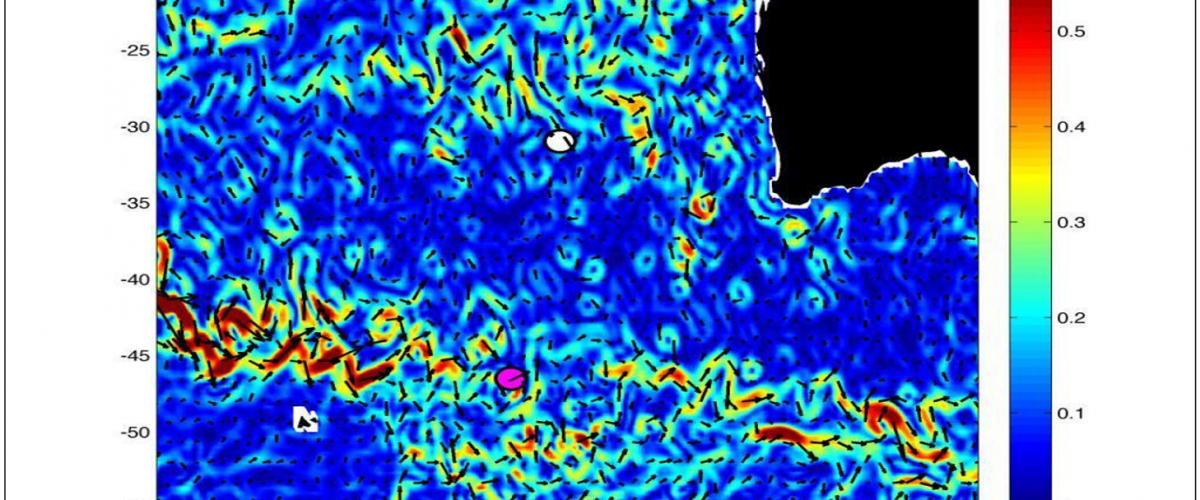
To aid in the quandary of debris movement, ocean current data generated with NASA observations were used. Ocean Surface Current Analyses Real-time (OSCAR) data, generated by Dr. Kathleen Dohan at Earth and Space Research (ESR), are ocean currents derived from multiple satellite measurements including the Ocean Surface Topography/Jason-2 (OSTM/Jason-2) mission, Quick Scatterometer (QuikSCAT), Advanced Very High Resolution Radiometer (AVHRR) instrument, and others.
Major Findings
OSCAR illustrates the large-scale motion of the ocean in addition to flow instabilities such as eddies. In the Southern Ocean, OSCAR shows a strong eastward current otherwise known as the Antarctic Circumpolar Current (ACC), as well as eddies due to flow instabilities in the ACC. The ACC could transport the debris to the east, while eddies could spin the debris in a circular pattern (counterclockwise and/or clockwise rotation) and slowly drift westward or eastward, depending on the rotation of the eddy.