Introduction
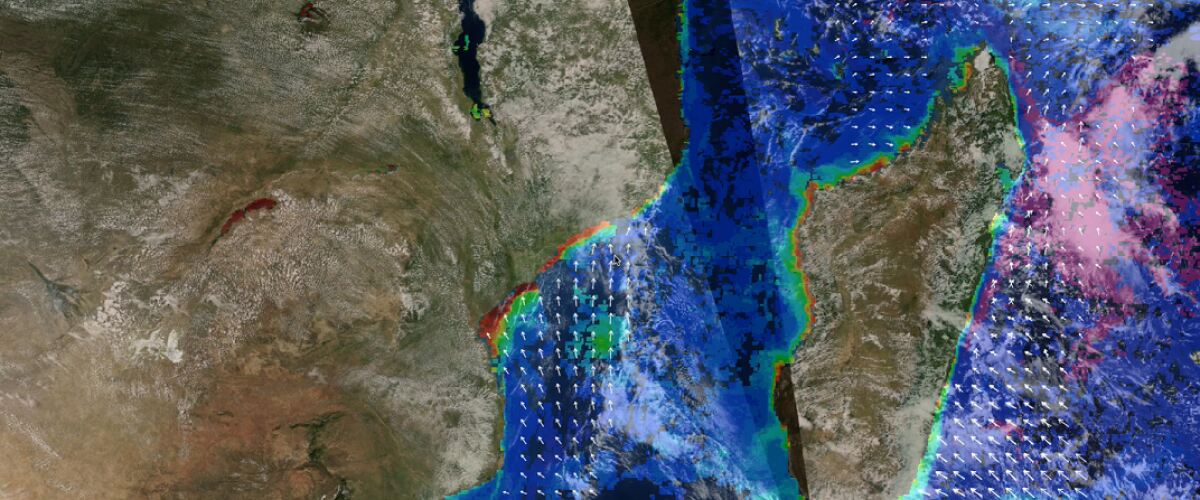
Cyclone Idai was a major tropical storm that made landfall in Africa, an unusual case, that had unfortunate consequences in Mozambique, Zimbabwe, and Malawi with severe flooding and loss of life.
Using SOTO to Study Ocean Responses
The ocean response to Cyclone Idai is examined using the State Of The Ocean (SOTO) visualization tool developed by NASA’s Physical Oceanography Distributed Active Archive Center (PO.DAAC). Strong vertical mixing and upwelling of cold, nutrient-rich waters prompted immediate sea surface temperature (SST) cooling followed by localized chlorophyll-a blooms. Both blooms occurred offshore in deep, oligotrophic (nutrient-poor) ocean waters. Nutrient injection into the upper ocean stimulated photosynthesis that lasted for several days, thus the chlorophyll-a blooms. Ocean responses like that to Cyclone Idai have been well cited in literature (e.g., Gierach and Subrahmanyam, 2008; Liu et al. 2009).
References
Gierach, M.M., and B. Subrahmanyam, 2008: Biophysical responses of the upper ocean to major Gulf of Mexico hurricanes in 2005. J. Geophys. Res. Oceans, 113, C04029. doi:10.1029/2007JC004419
Liu, X., M. Wang, and W. Shi, 2009: A study of a Hurricane Katrina-induced phytoplankton bloom using satellite observations and model simulations. J. Geophys. Res. Oceans,114, C3. doi:10.1029/2008JC004934