Introduction
The El Niño-Southern Oscillation (ENSO) is a climate pattern in the Pacific Ocean that has two phases: El Niño (warm/wet phase) and La Niña (cold/dry phase). Because the temperature of the water during these events changes, it can have consequences on fisheries in South America and weather across the globe, with extreme events such as flooding and droughts often affecting South America, Indonesia, and Australia.
We have been experiencing La Niña conditions for the last two and a half years. The last strong El Niño event occurred in 2015-2016 and a weak El Niño event was also experienced during the winter of 2018-2019.
Tracking Sea Surface Height and Temperature With TOPEX/Poseidon, Jason, and Sentinel-6 Michael Freilich Data
Sea surface height (SSH) data from the TOPEX/Poseidon, Jason-3, and Sentinel-6 Michael Freilich missions along with satellite sea surface temperature (SST) data help us study and understand the complex interactions between the ocean and the atmosphere that affect global weather and climate. El Niño is one well-known example of this interaction.
While the SST is a direct indicator of El Niño (El Niño is commonly defined at several locations when the SST anomaly is 0.5 degrees Celsius or greater for five to six consecutive months), SSH data can also help to monitor El Niño events. Indeed, when the water warms up (which is the case during El Niño), it expands causing sea level to rise. TOPEX/Poseidon was the first oceanographic research mission that was able to capture the largest El Niño in 100 years which gave a global perspective on the short term climate events, such as La Niña.
Major Findings
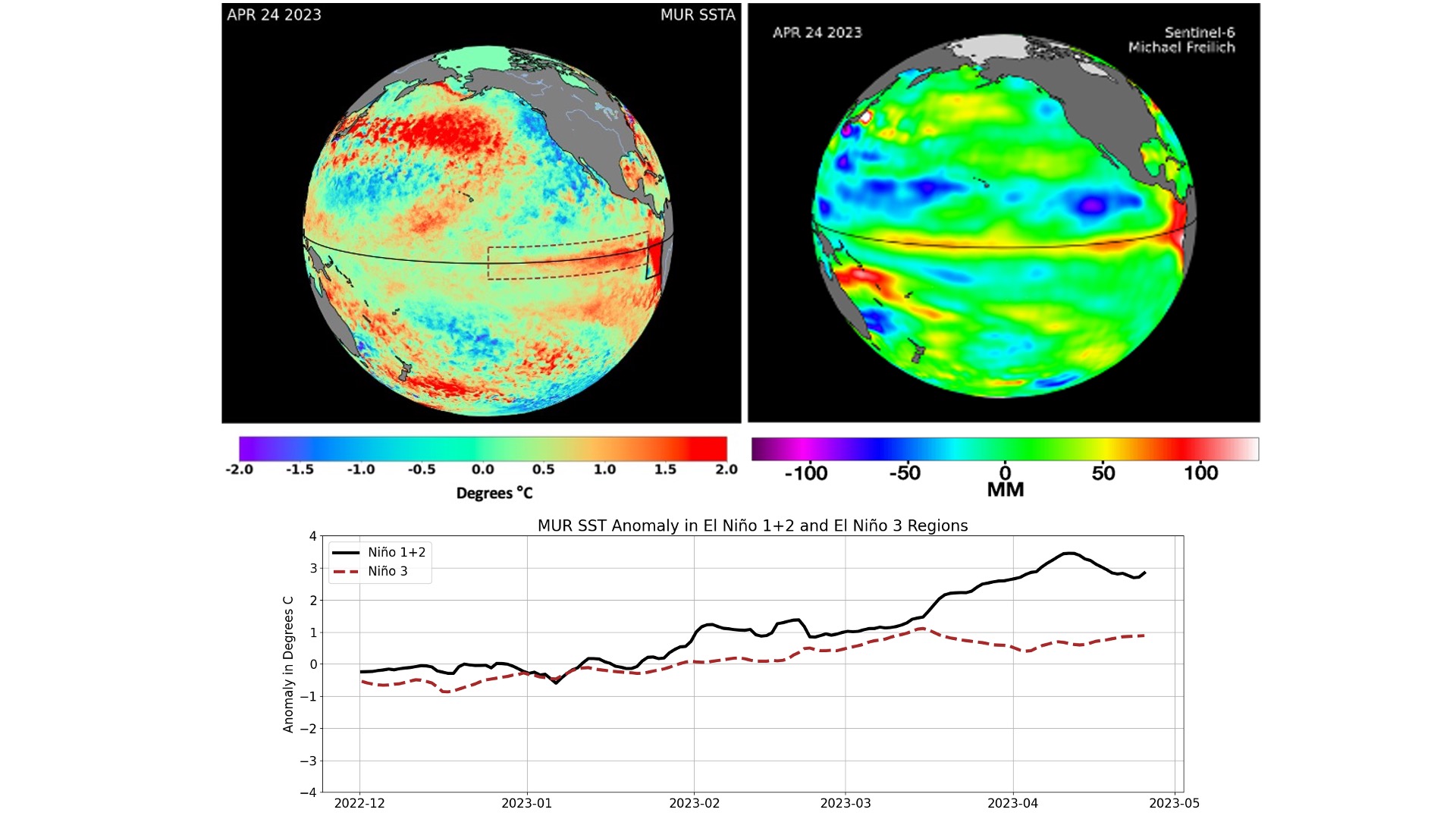
Figures 1 and 3 display SST anomalies on April 24, 2023, derived by applying a long term climatology (2003-2022) to the daily Making Earth System Data Records for Use in Research Environments (MEaSUREs) Multi-Scale Ultra-High Resolution (MUR) dataset. It shows that in April 2023, SST is now greater than 0.5 degrees Celsius above normal along the Equatorial Pacific and 3 degrees Celsius above normal further East. The MUR SST product is based on merging multiple infrared and microwave SST datasets to create a daily 1 km gridded global SST product.
Figure 2 shows sea level anomalies (SLA) measurements from the MEaSUREs SSH project. Kelvin waves transporting warm waters (with a higher sea level in red as warm water tends to expand) are seen propagating from the western part of the Pacific Ocean towards the East along the Equator. This is typically a well-known precursor to an El Niño event. The MEaSUREs SSH product used along track altimetry data from the Sentinel-6 Michael Freilich mission to create a 1/6th of a degree gridded global SSH product.
Related Links
- International Sea Level Satellite Spots Early Signs of El Niño
- Ocean Surface Topography From Space
- Notebook tutorial to recreate SSTA and time series shown above, and explore datasets