Introduction
Our planet is rapidly warming and the vast majority of the extra heat is being stored in the ocean.1 Water expands as it warms, therefore, when the ocean absorbs heat, the expanding seawater causes sea levels to rise.
Seawater thermal expansion represents about one-third of modern-day global mean sea level rise. The other two-thirds of global sea level rise comes from the addition of water from melting ice sheets and glaciers on land. Global sea level rise threatens coastal communities with increased flooding, causes erosion of the coastline, etc. Because these changes have impacts on society and ecosystems, it is critical that we closely monitor sea level rise over the entire planet.
Tracking Sea Level Rise With TOPEX/Poseidon, Sentinel-6, and Jason Satellites
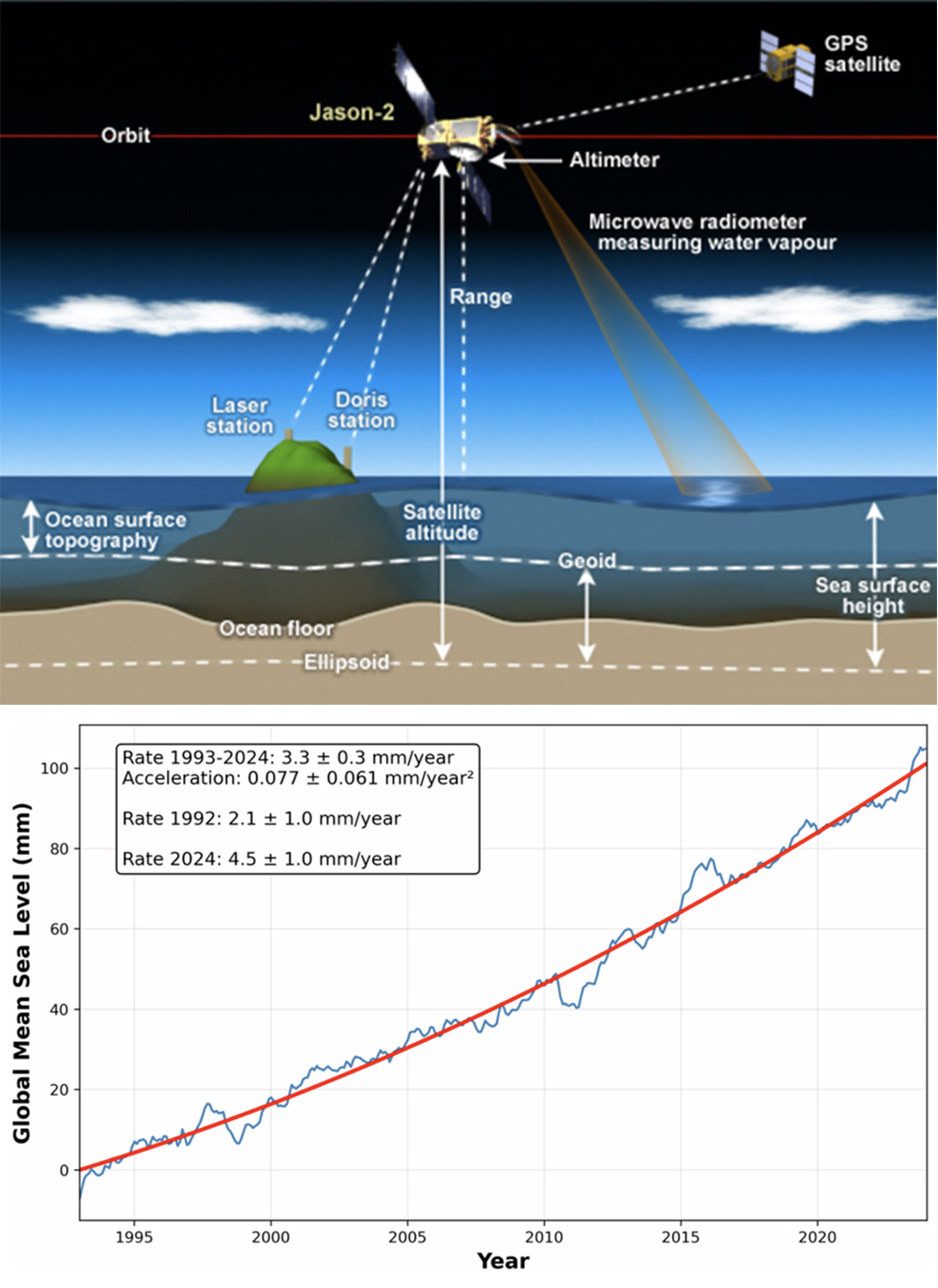
Satellite altimeters are special radar instruments in orbit that measure sea level at a very high accuracy. These radars emit a signal every second that bounces off the surface of the ocean and returns to the satellite antennas. By counting how much time it takes for the emitted signal to return to the satellite and knowing the speed of this signal, the distance between the satellite and the ocean surface (the range) can be measured (top figure).
The use of positioning systems, such as GPS, allow for the precise determination of the satellite's location in orbit. By combining the range measurements with the satellite location measurements, scientists can map even small changes in sea level across the entire planet (top figure).
For over thirty years, NASA and the French Space Agency (CNES) have flown satellite altimeter missions, starting with TOPEX/Poseidon (1992) and then followed by Jason-1 (2001), Jason-2 (2008), Jason-3 (2016), and, most recently, Sentinel-6 Michael Freilich (2020) with more partners, such as ESA (European Space Agency), EUMETSAT (European Meteorological Service), and the National Oceanic and Atmospheric Administration (NOAA). By combining the sea level measurements from all of these missions, scientists can see how average sea level has changed over the past three decades.
Major Findings
The total sea level rise from 1993 to 2023 was 11.1 cm (bottom figure). Overall, the rate of global mean sea level is about 3.3 mm/year +/- 0.3 mm/year, but there has been a significant acceleration of this rate in the past three decades: 0.077 +/- 0.061 mm/year.3 The rate of sea level rise was about 2.1 mm per year in 1993 and doubled to 4.5 mm per year by 2024 (bottom figure).
Past and current altimetry measurements allow us to monitor global sea level and to make projections for the future. If the current trajectory continues, global sea levels will increase by more than 16.9 cm over the next three decades (bottom figure).
Continuing to monitor the ocean from space provides essential information for coastal communities so they can prepare for sea level changes along their coastlines. Looking ahead, Sentinel-6B is expected to be launched in November 2025 and Sentinel-6C in 2030. These future satellite altimetry missions will ensure continuity of the sea level measurements through the next decade.
References
Von Schuckmann, K., Minière, A., Gues, F., Cuesta-Valero, F.J., Kirchengast, G., Adusumilli, S., Straneo, F., Ablain, M., Allan, R.P., Barker, P.M. and Beltrami, H., 2023. Heat stored in the Earth system 1960–2020: where does the energy go?. Earth System Science Data, 15(4), pp.1675-1709.
Hamlington, B.D., Bellas-Manley, A., Willis, J.K., Fournier, S., Vinogradova, N., Nerem, R.S., Piecuch, C.G., Thompson, P.R. and Kopp, R., 2024. The rate of global sea level rise doubled during the past three decades. Communications Earth & Environment, 5(1), p.601. doi:10.1038/s43247-024-01761-5