Introduction
Groundwater consumption has become a critical element of urban development and the expansion of human populations into regions that would be otherwise uninhabitable. Unfortunately, groundwater use is difficult to monitor globally.
GRACE-FO to Continue Groundwater Data Record
NASA’s Gravity Recovery and Climate Experiment (GRACE) satellite mission, launched in 2002, provides the first opportunity to directly measure groundwater changes from space. By observing changes in the Earth’s gravity field, scientists can estimate changes in the amount of water stored in a region, which cause changes in gravity. GRACE provides a more than 10-year-long data record (and counting) for scientific analysis. Plans are underway to continue this record with the GRACE Follow-On (GRACE-FO) satellite mission, with a tentative launch date in 2017. This makes a huge difference for scientists and water managers who want to understand trends in how our resources are being consumed over the long term.
Major Findings
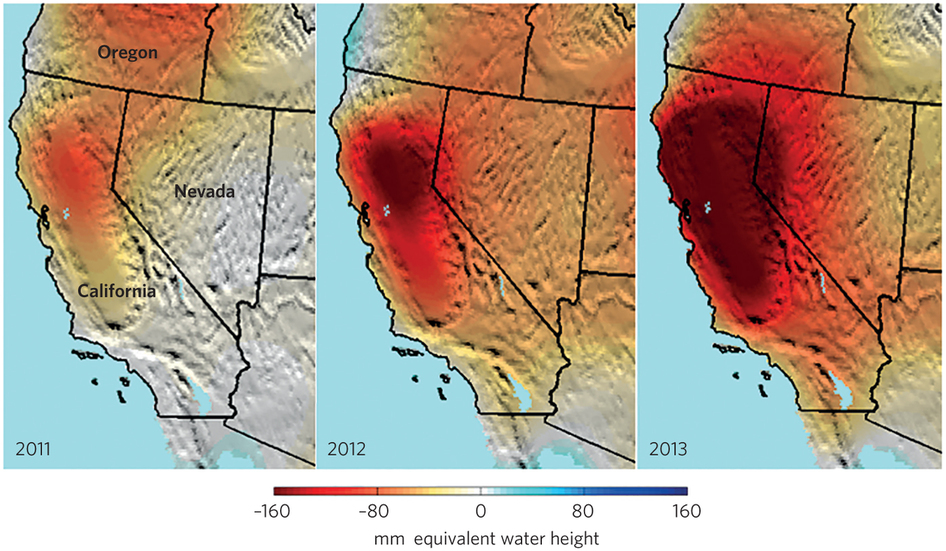
GRACE has returned data on some of the world’s biggest aquifers and how their water storage is changing. If we use estimates of changes in snow and surface soil moisture, scientists can calculate an exact change in groundwater in volume. For instance, it is estimated that the Central Valley aquifer in California has lost roughly 1.5 times the full volume of Lake Mead (40 km3) during the last 10 years. This is a large amount of water. Scientists estimate that about 30 km3 of this was groundwater.
Related Links
- Groundwater Deficit Out West (NASA Earth Observatory Article)
- Satellite Study Reveals Parched U.S. West Using Up Underground Water (NASA Article)
- GRACE Sees Groundwater Losses Around the World (YouTube Animation)
- NASA Shows Severity of California's Drought (YouTube Animation)
References
Famiglietti, J.S., (2014) The global groundwater crisis, Nature Climate Change 4, 945–948. doi:10.1038/nclimate2425