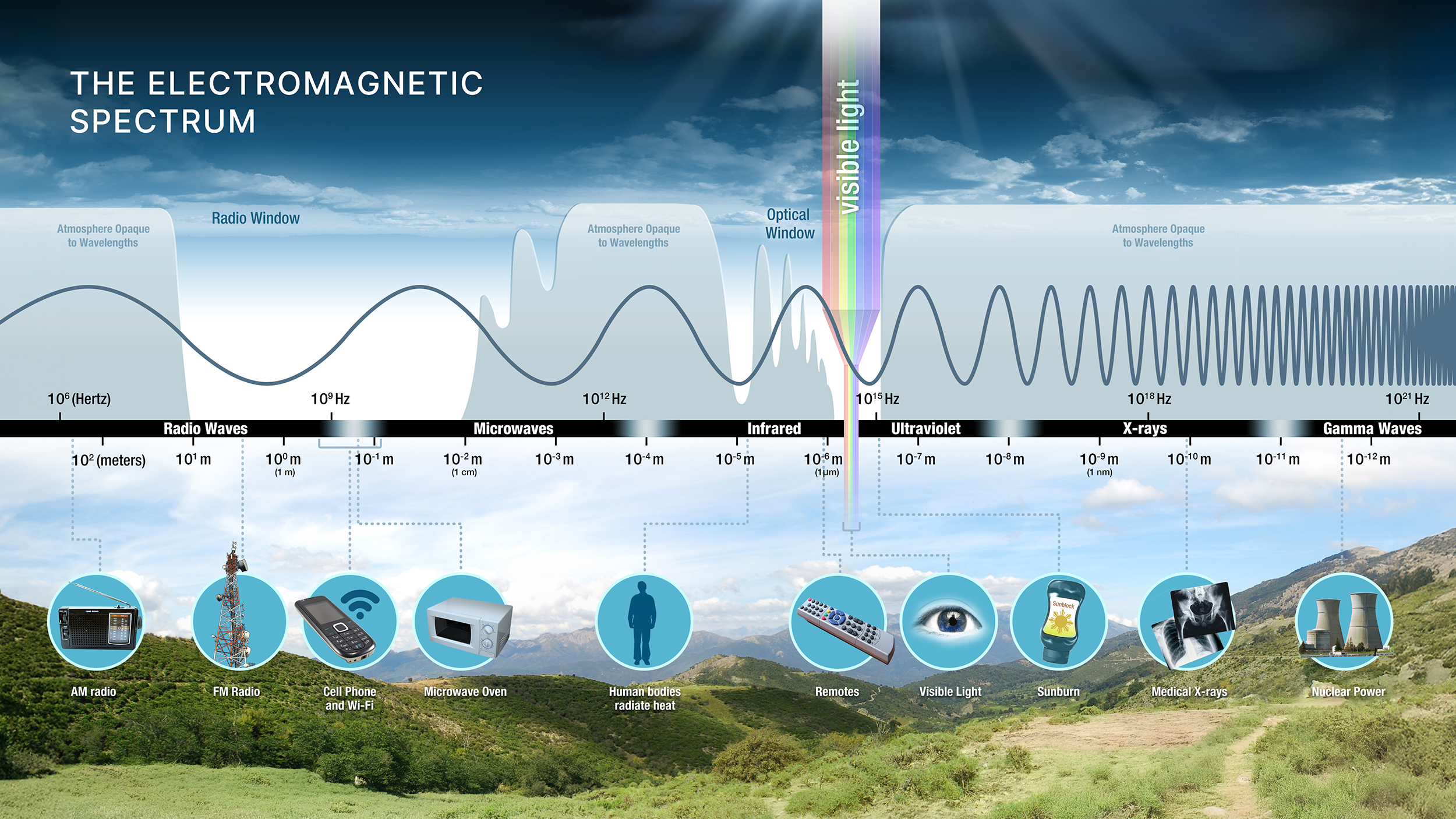
Electromagnetic energy, produced by the vibration of charged particles, travels in the form of waves through the atmosphere and the vacuum of space. These waves have different wavelengths (the distance from wave crest to wave crest) and frequencies; a shorter wavelength means a higher frequency. Some, like radio, microwave, and infrared waves, have a longer wavelength, while others, such as ultraviolet, x-rays, and gamma rays, have a much shorter wavelength. Visible light sits in the middle of that range of long to shortwave radiation. This small portion of energy is all that the human eye is able to detect. Instrumentation is needed to detect all other forms of electromagnetic energy. NASA instruments utilize the full range of the electromagnetic spectrum to explore and understand processes occurring on Earth and on other planetary bodies.

Image
Image Caption

Diagram of the electromagnetic spectrum. Credit: NASA Science.

Some waves are absorbed or reflected by atmospheric components, like water vapor and carbon dioxide, while some wavelengths allow for unimpeded movement through the atmosphere; visible light has wavelengths that can be transmitted through the atmosphere. Microwave energy has wavelengths that can pass through clouds, an attribute utilized by instruments aboard many weather and communication platforms.

The primary source of the energy observed by instruments aboard space-based platforms is the Sun. The amount of the Sun's energy that is reflected depends on the roughness of the surface and its albedo, which is how well a surface reflects light instead of absorbing it. Snow, for example, has a very high albedo and reflects up to 90% of incoming solar radiation. The ocean, on the other hand, reflects only about 6% of incoming solar radiation and absorbs the rest. Often, when energy is absorbed, it is re-emitted, usually at longer wavelengths. For example, the energy absorbed by the ocean gets re-emitted as infrared radiation.

All things on Earth reflect, absorb, or transmit energy, the amount of which varies by wavelength. Just as your fingerprint is unique to you, everything on Earth has a unique spectral fingerprint. Researchers can use this information to identify different Earth features as well as different rock and mineral types. The number of spectral bands detected by a given instrument, its spectral resolution, determines how much differentiation a researcher can identify between materials.

For more information on the electromagnetic spectrum, with companion videos, view NASA's Tour of the Electromagnetic Spectrum.