Earth Observation Data Basics

The life cycle of Earth observation data is rich and complex, with many points of entry along the pipeline. From collection to visualization, we dive deep into the basics to demystify the incredible data in our catalog.

Remote Sensing

Remote sensing is the acquiring of information from a distance. NASA observes Earth and other planetary bodies via remote instruments on space-based platforms (e.g., satellites or spacecraft) and on aircraft that detect and record reflected or emitted energy. Remote instruments, which provide a global perspective and a wealth of data about Earth systems, enable data-informed decision making based on the current and future state of our planet.

For more information, check out the Fundamentals of Remote Sensing training from the Applied Remote Sensing Training (ARSET) program.
Get Data

Explore the world’s largest repository of open-access Earth science data.

Remote Sensing Data Basics

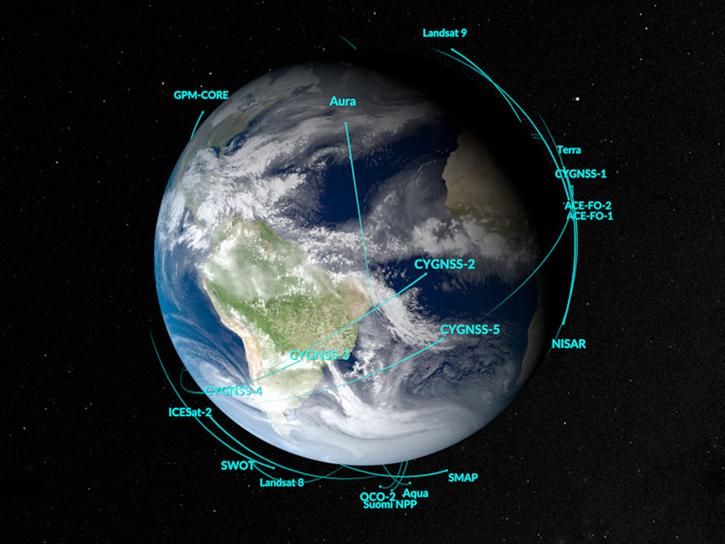
An orbit is the curved path a satellite follows around the Earth due to gravitational force.
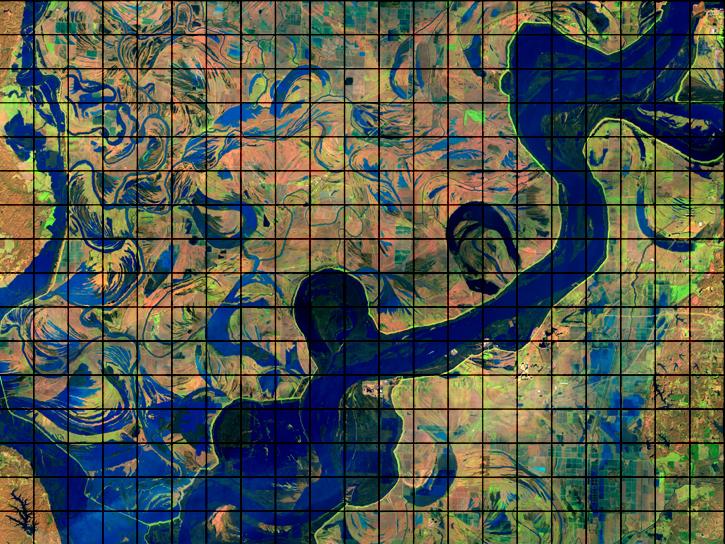
There are four types of resolution to consider for any dataset—radiometric, spatial, spectral, and temporal. Resolution plays a role in how data from a instrument can be used. Resolution can vary depending on the platform's orbit and instrument design.
Active instruments emit energy and collect data based on changes in the return signal.
Essential variables are known to be critical for observing and monitoring a given facet of the Earth system

Understanding Metadata

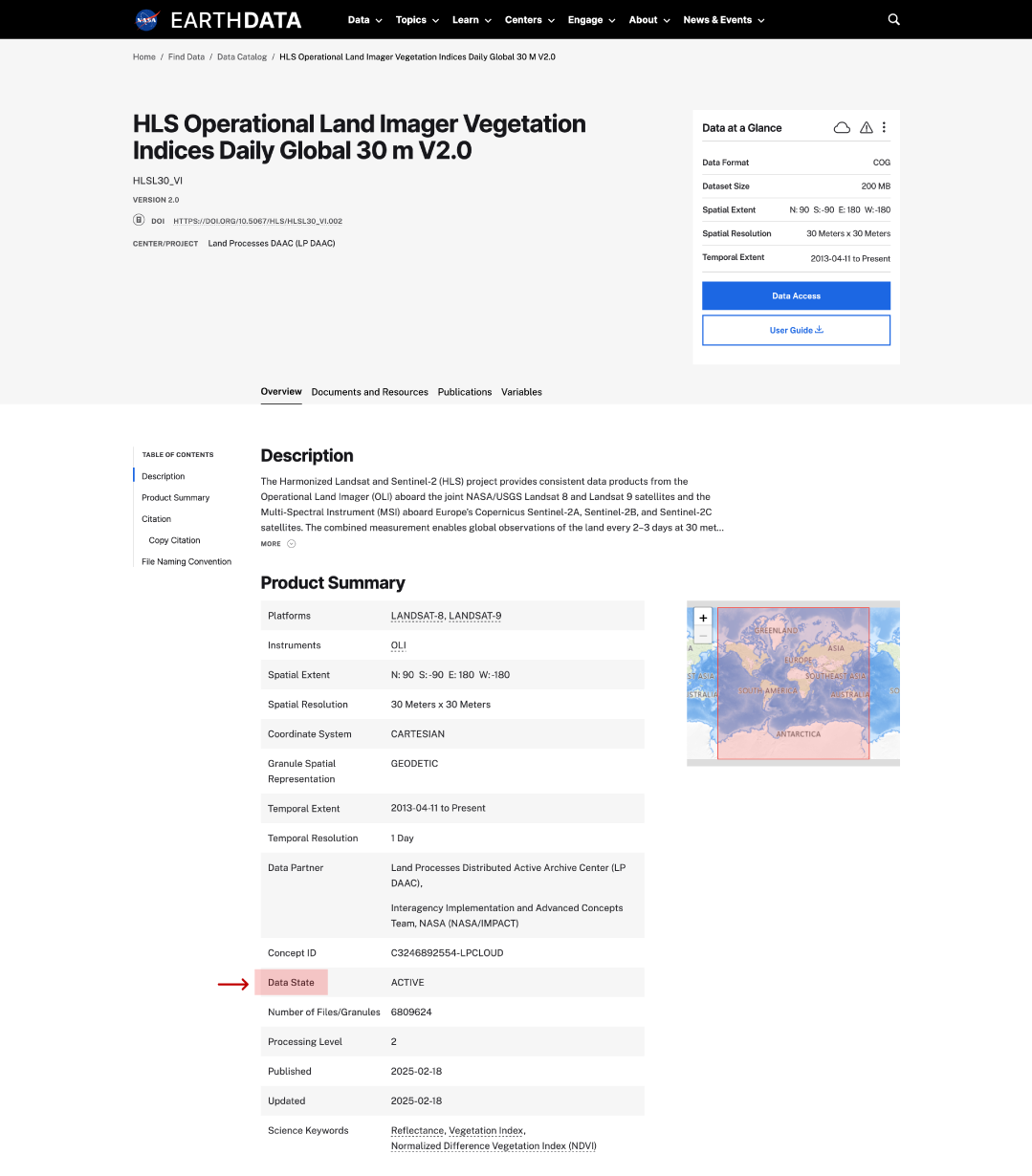
This interactive tool helps users navigate and understand essential metadata on our Earth science dataset landing pages. Through guided examples and hands-on exploration, learn critical context about our data to aid you in your own scientific discoveries.
Interactive

Parts of the Earthdata Dataset Landing Page

Explore
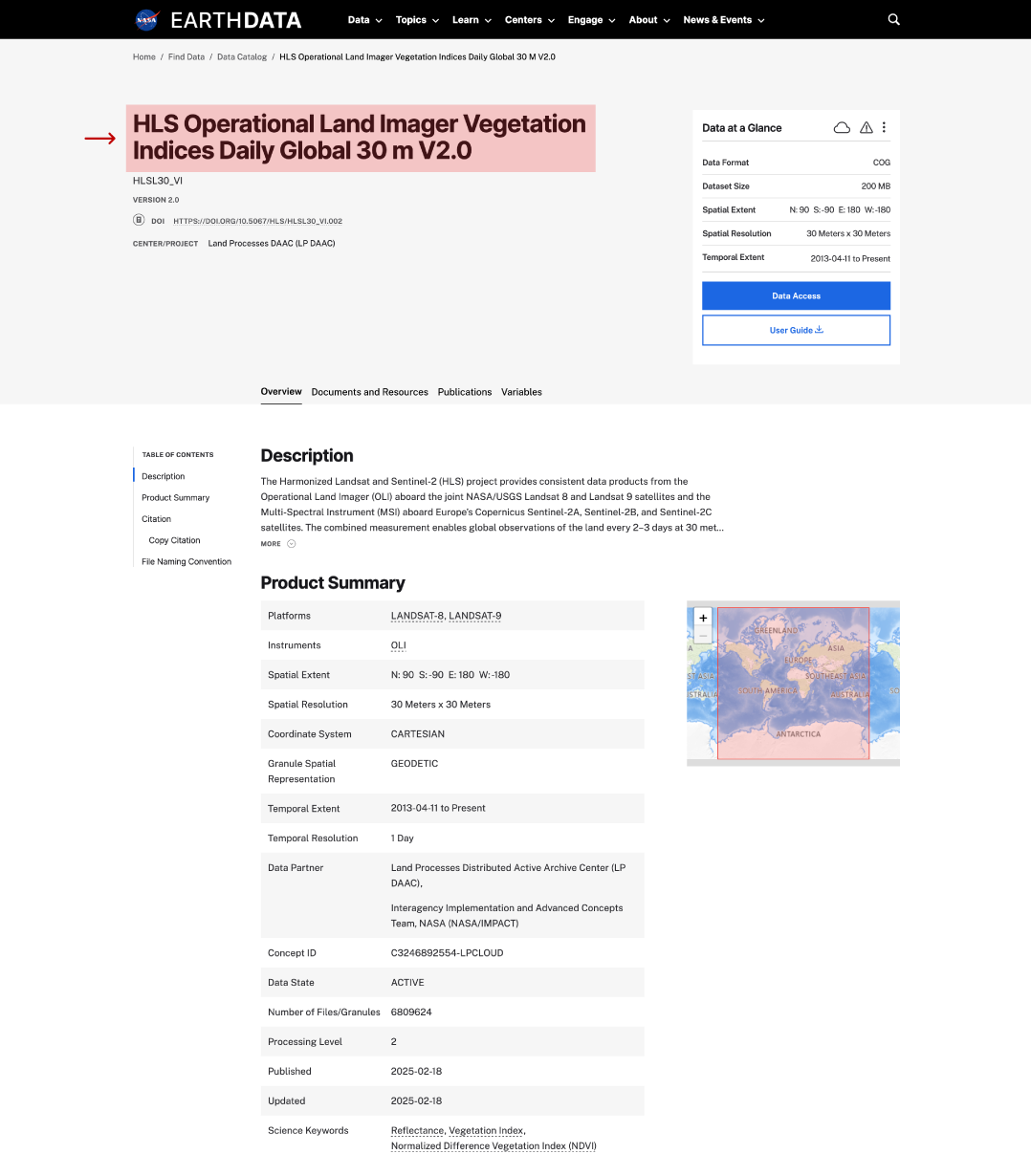
long name on dataset page
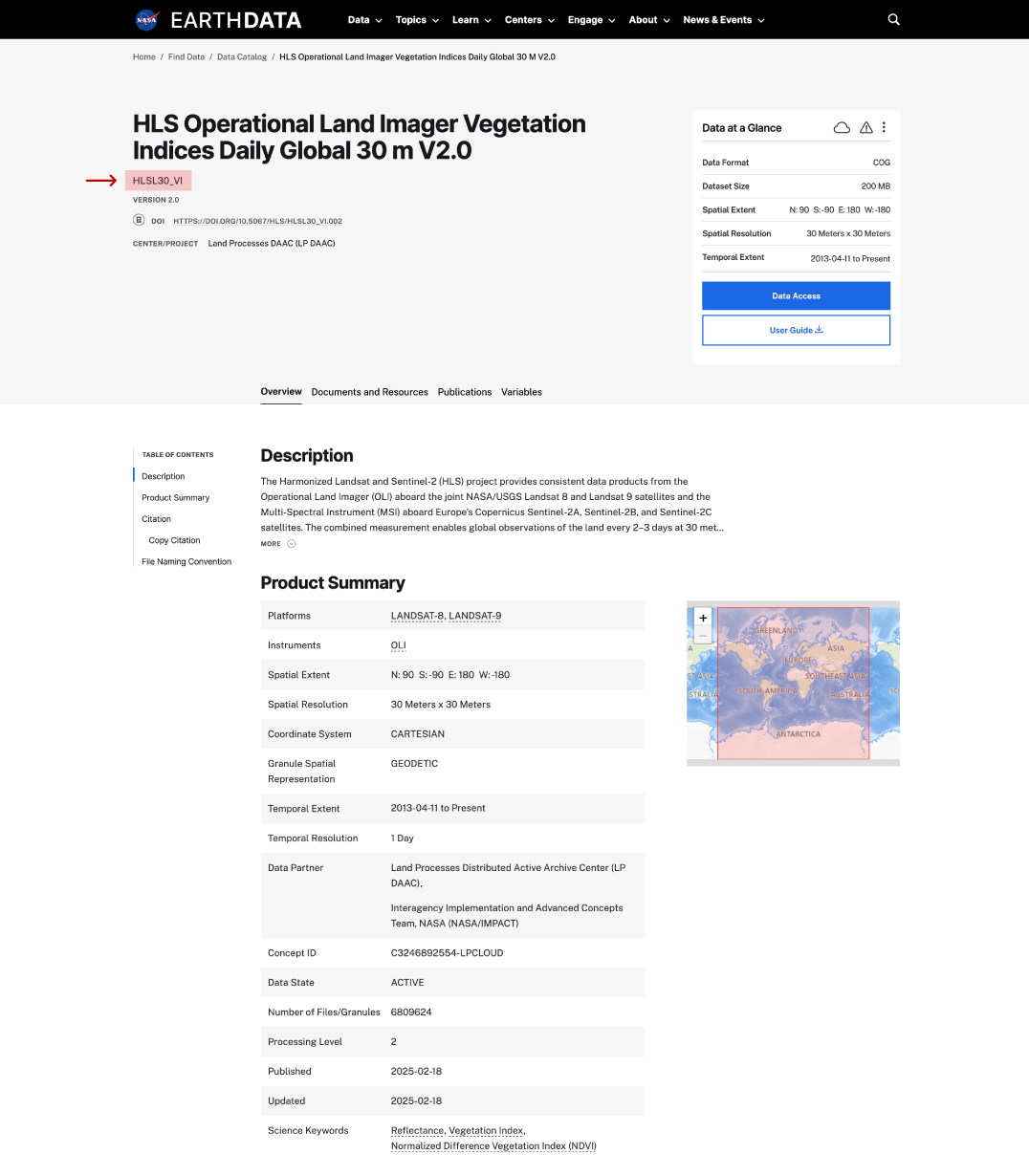
short name on dataset page
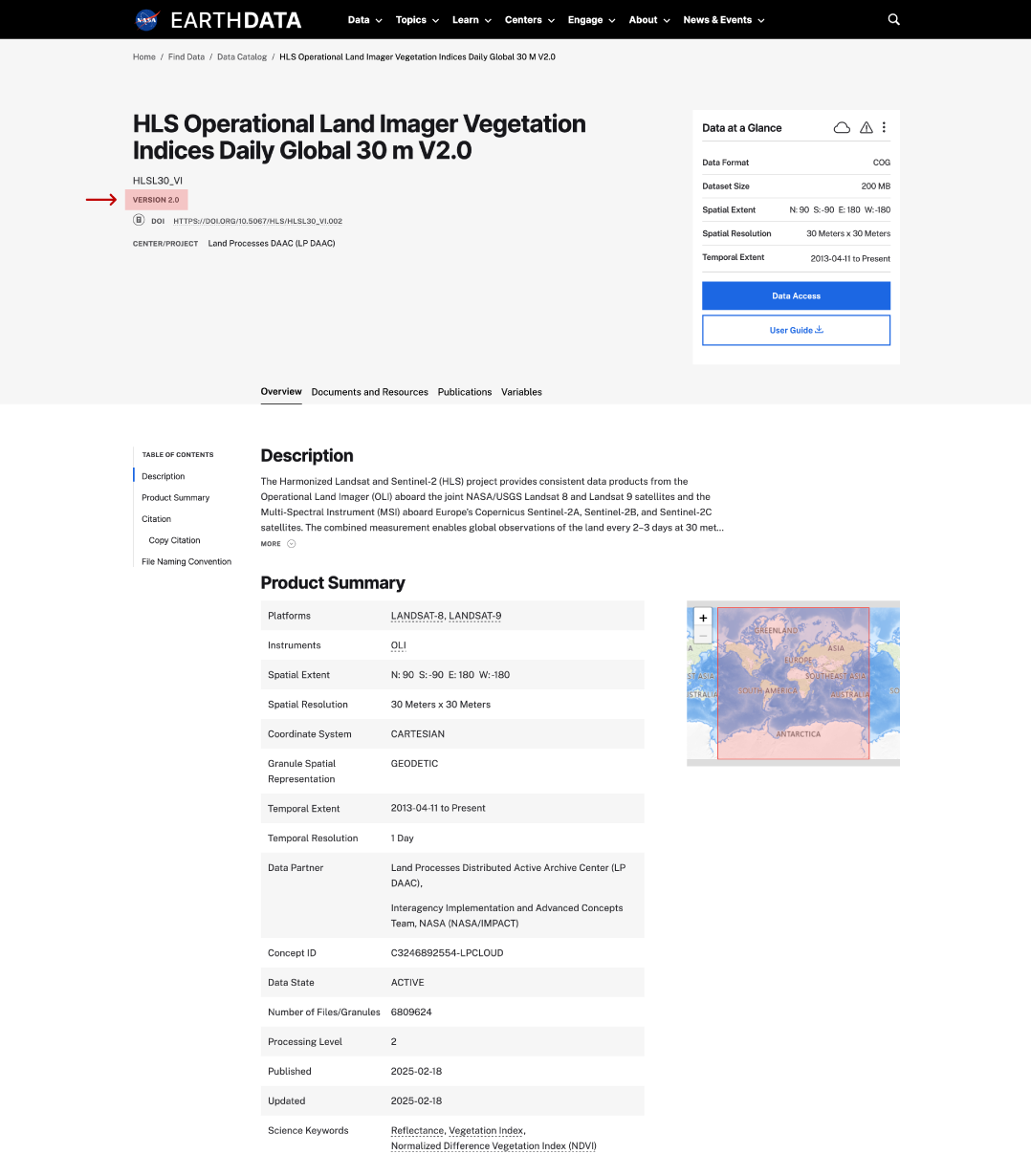
version on dataset page
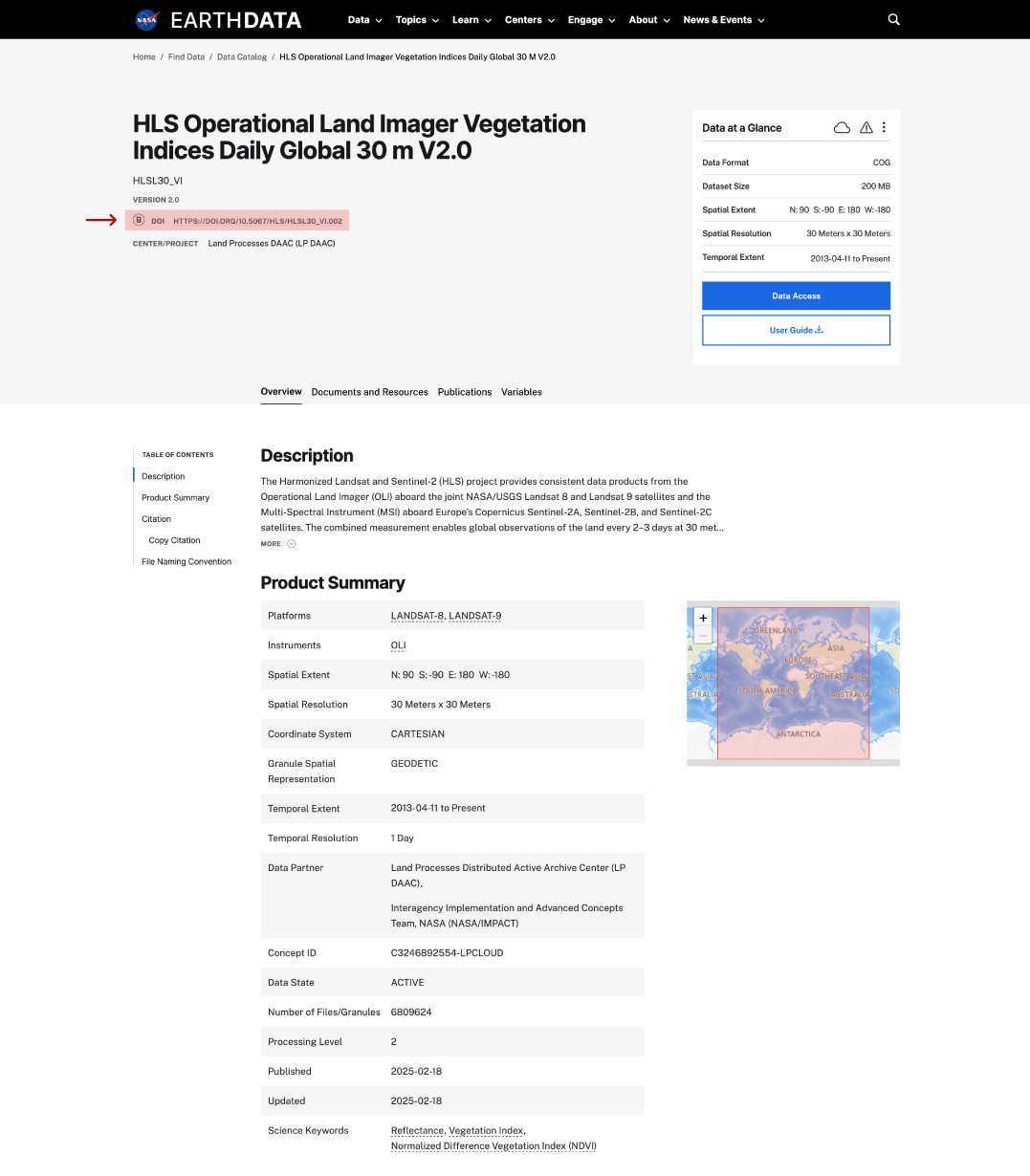
DOI on dataset page
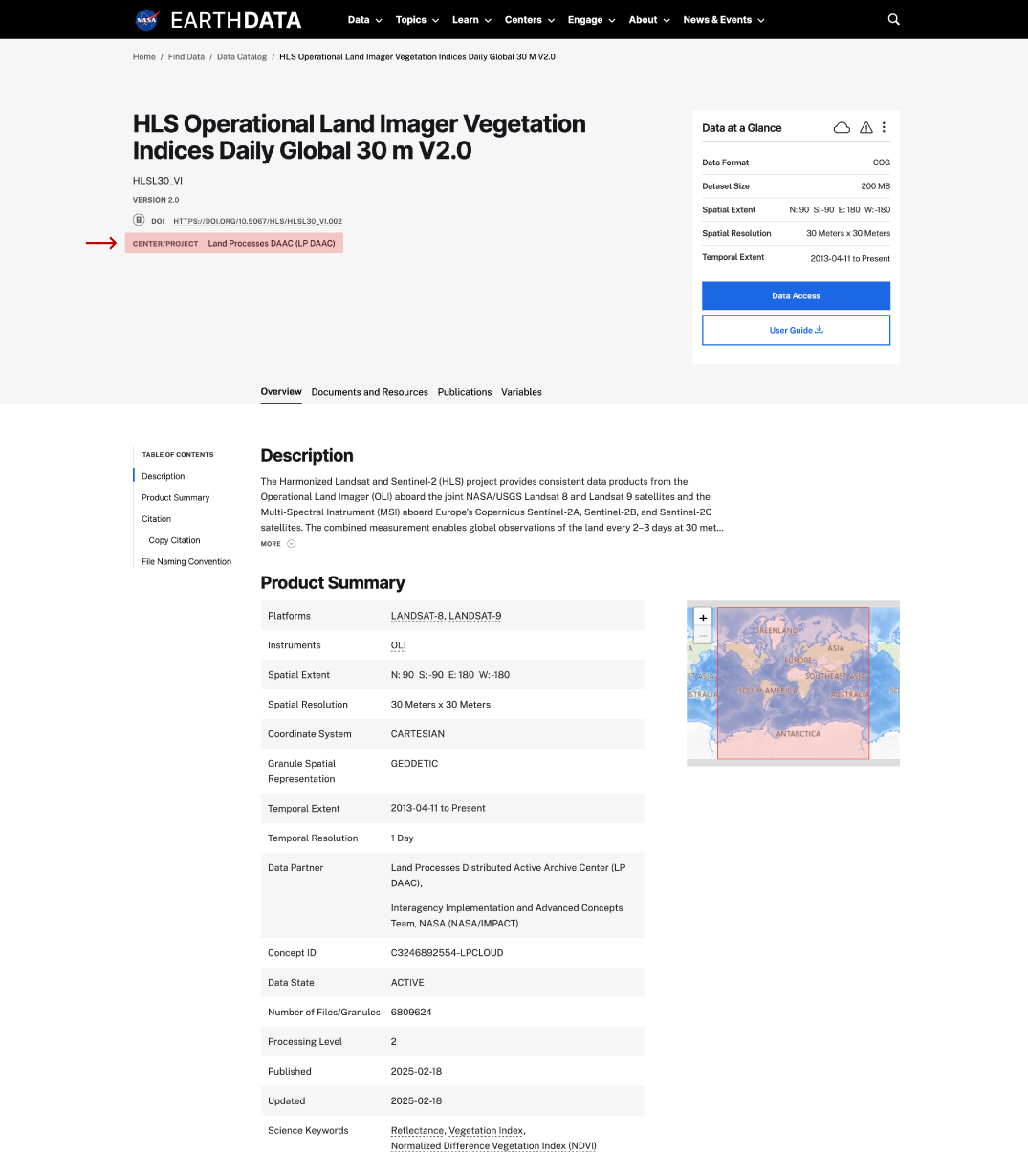
center/project on dataset page
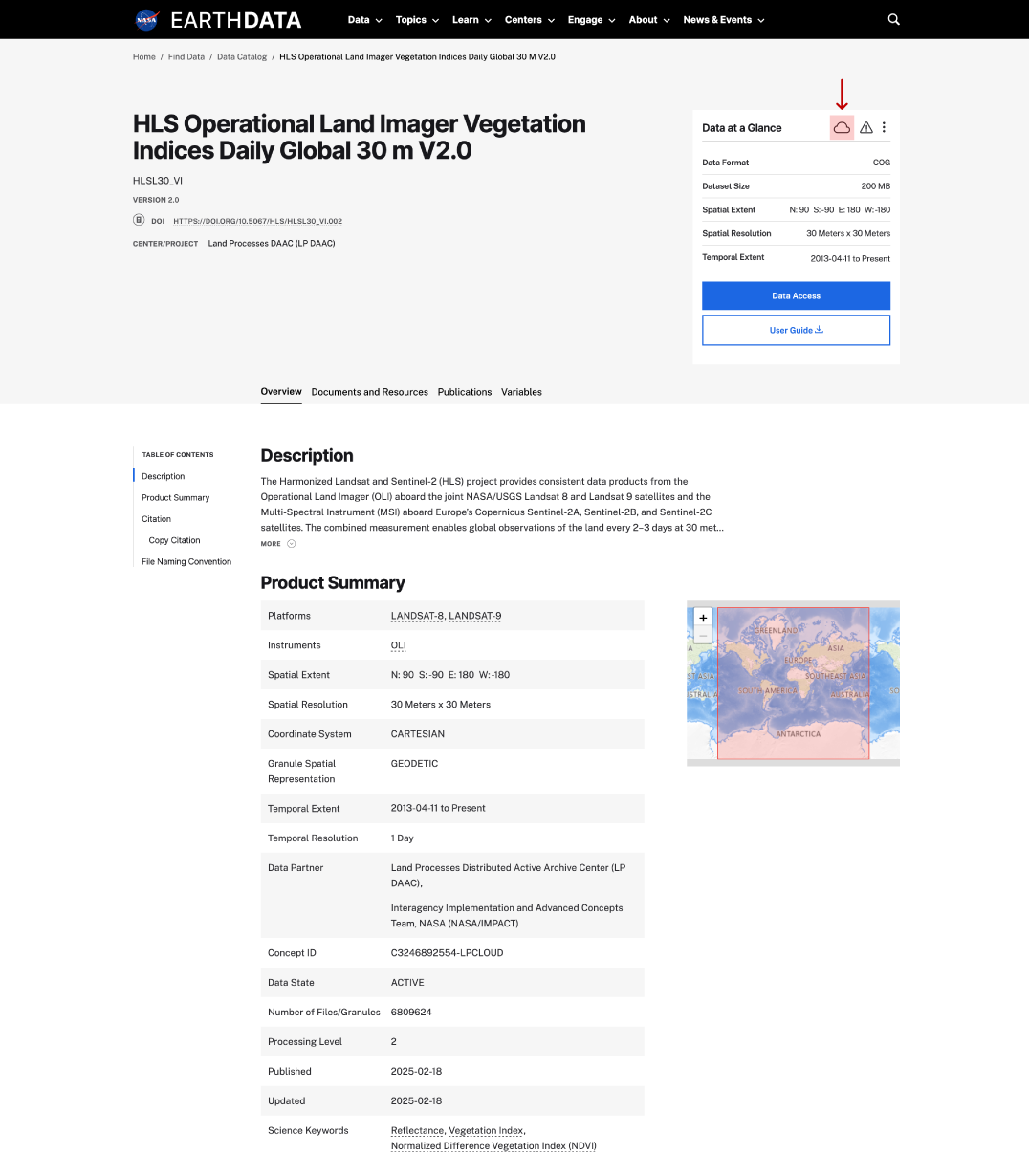
cloud icon on dataset page
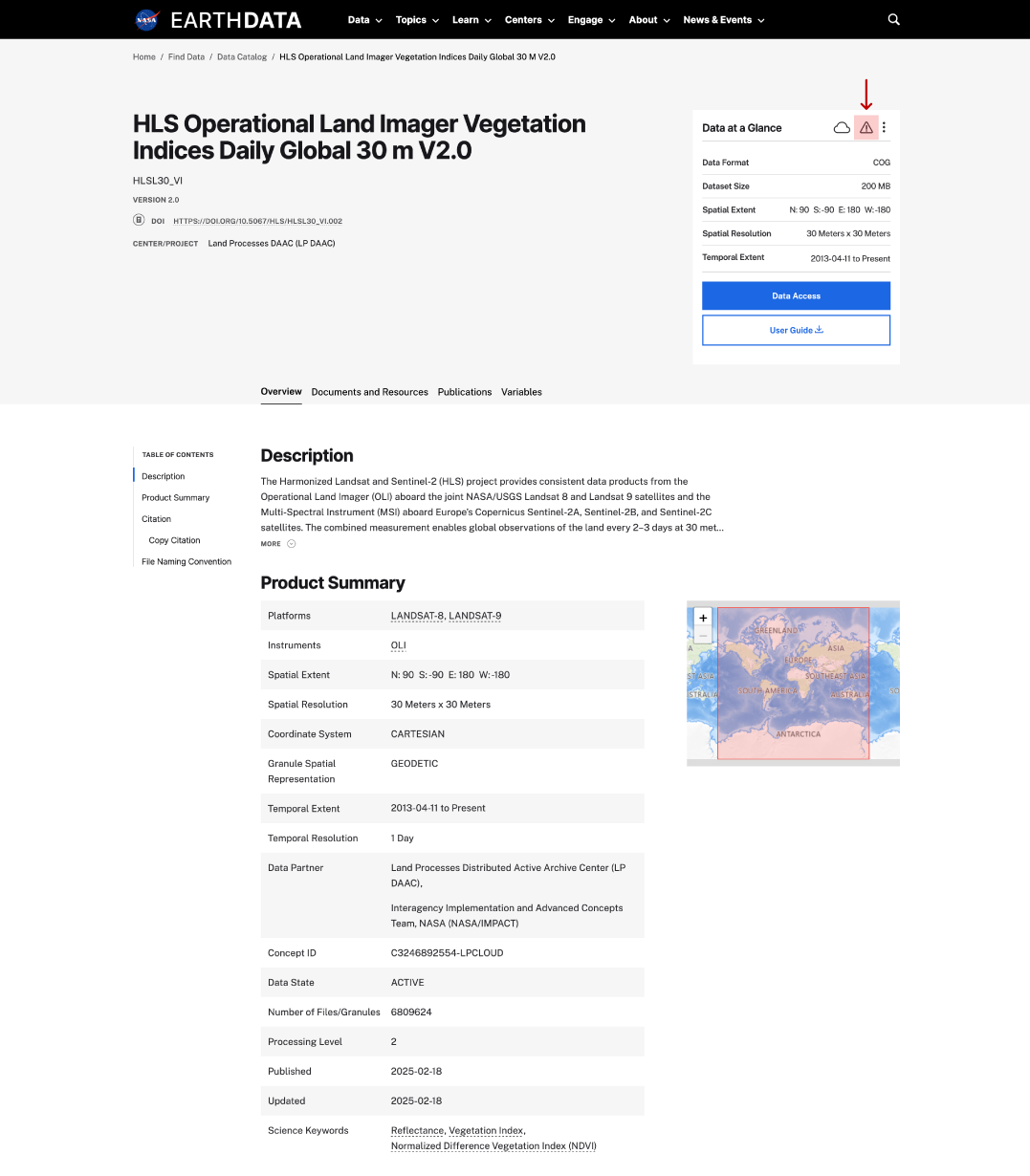
This is a screenshot of a dataset landing page showing the location of the alert icon.
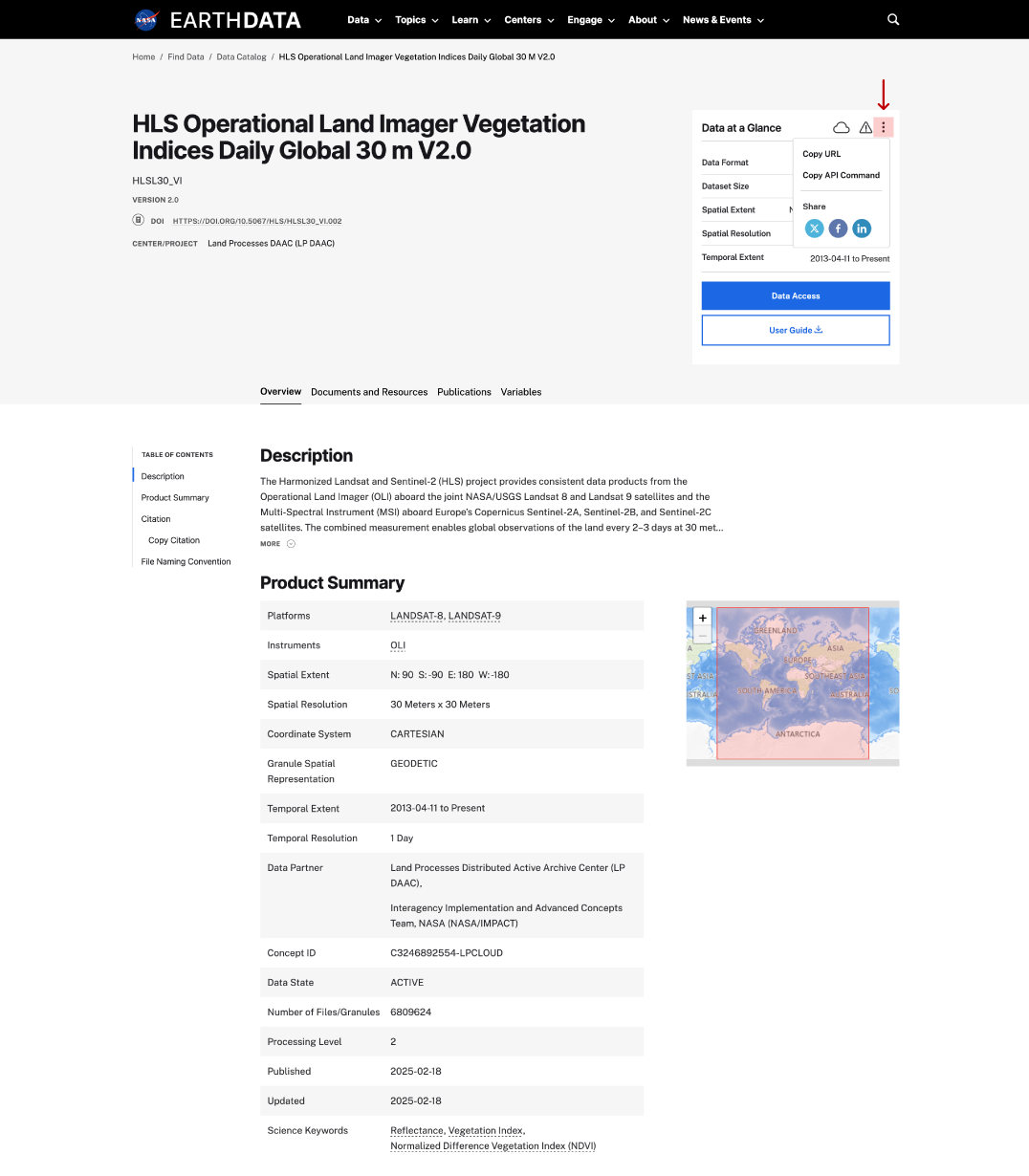
copy URL/API on dataset page
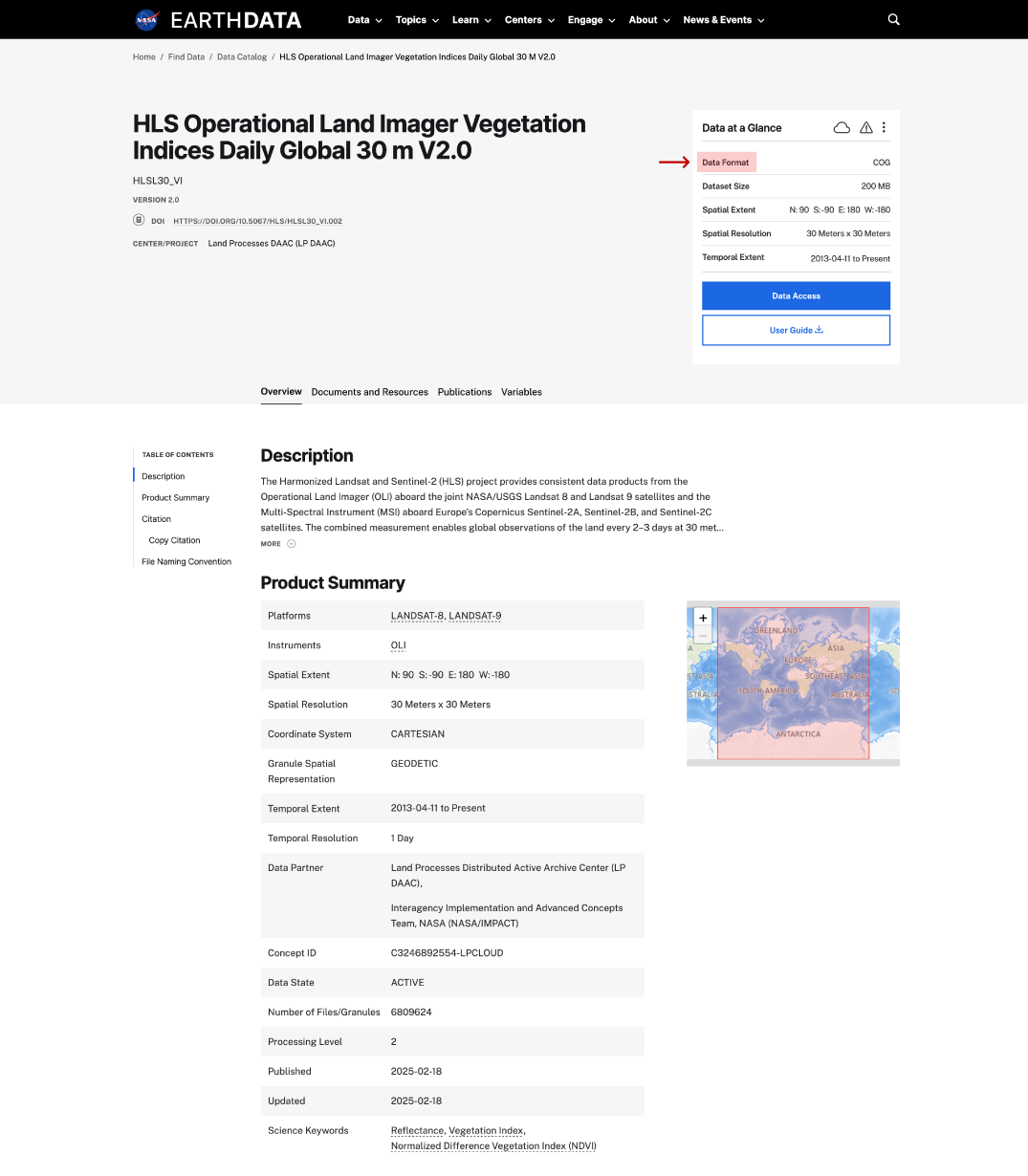
data format on dataset page
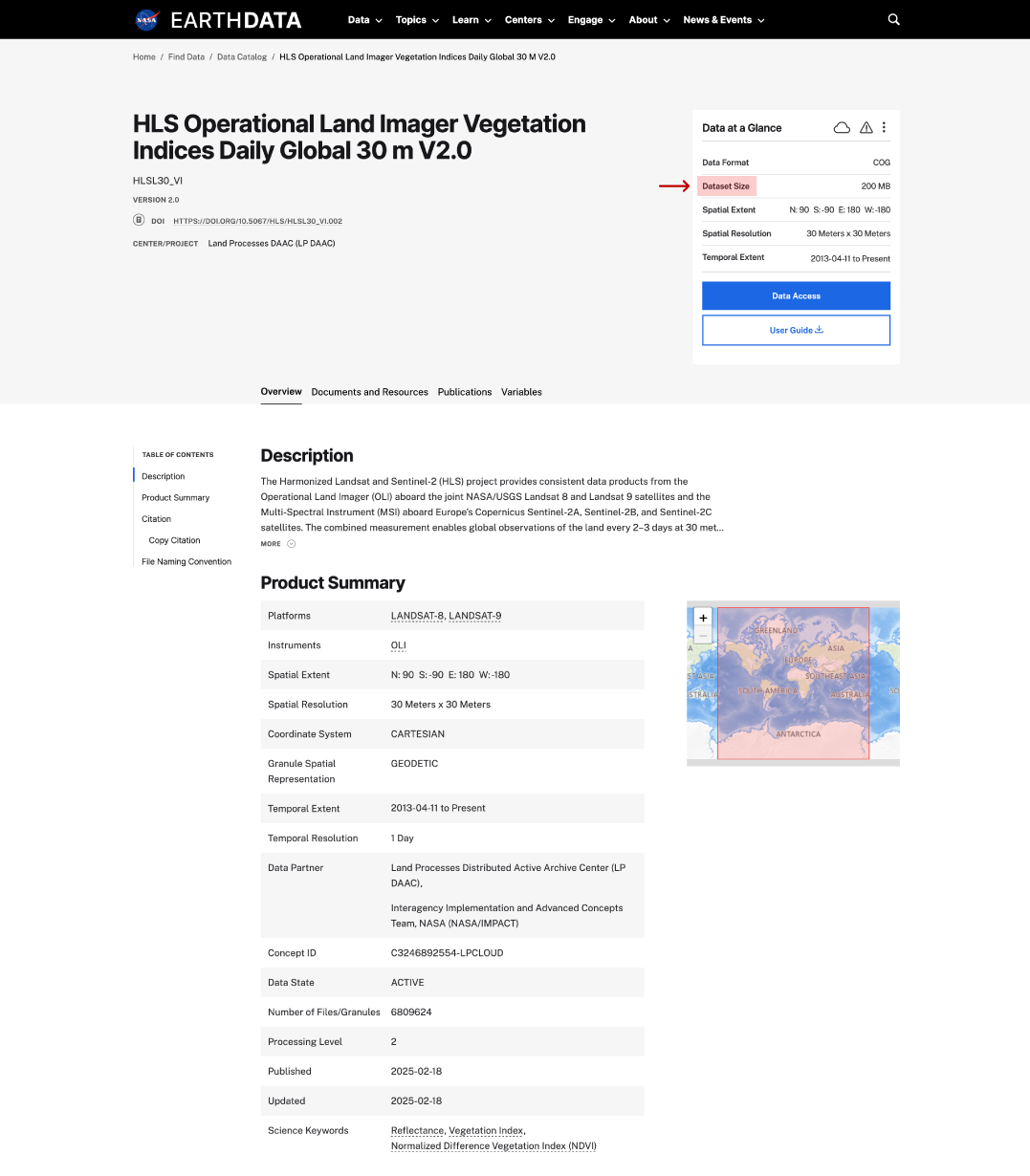
dataset size on dataset page
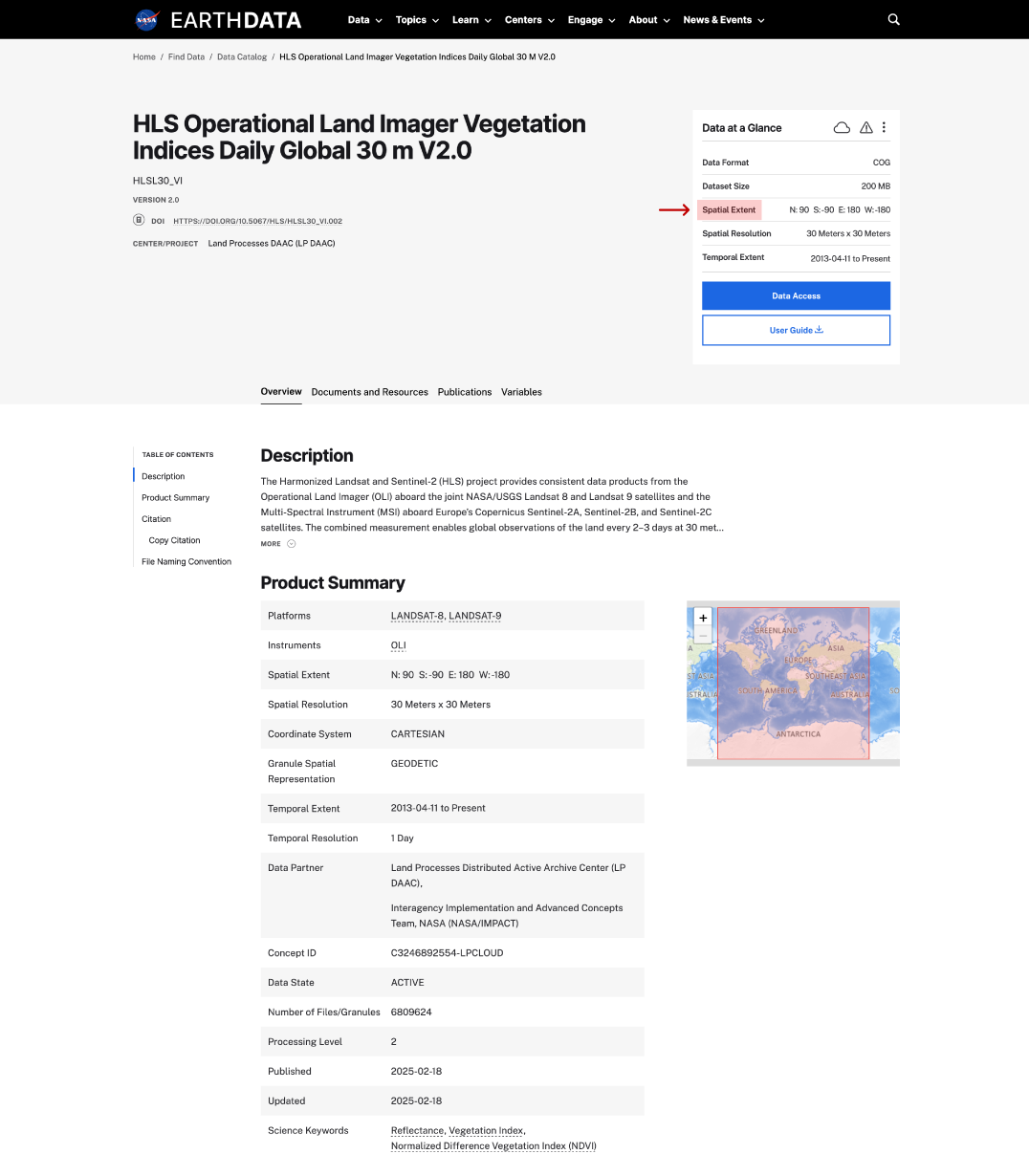
spatial extent on dataset page
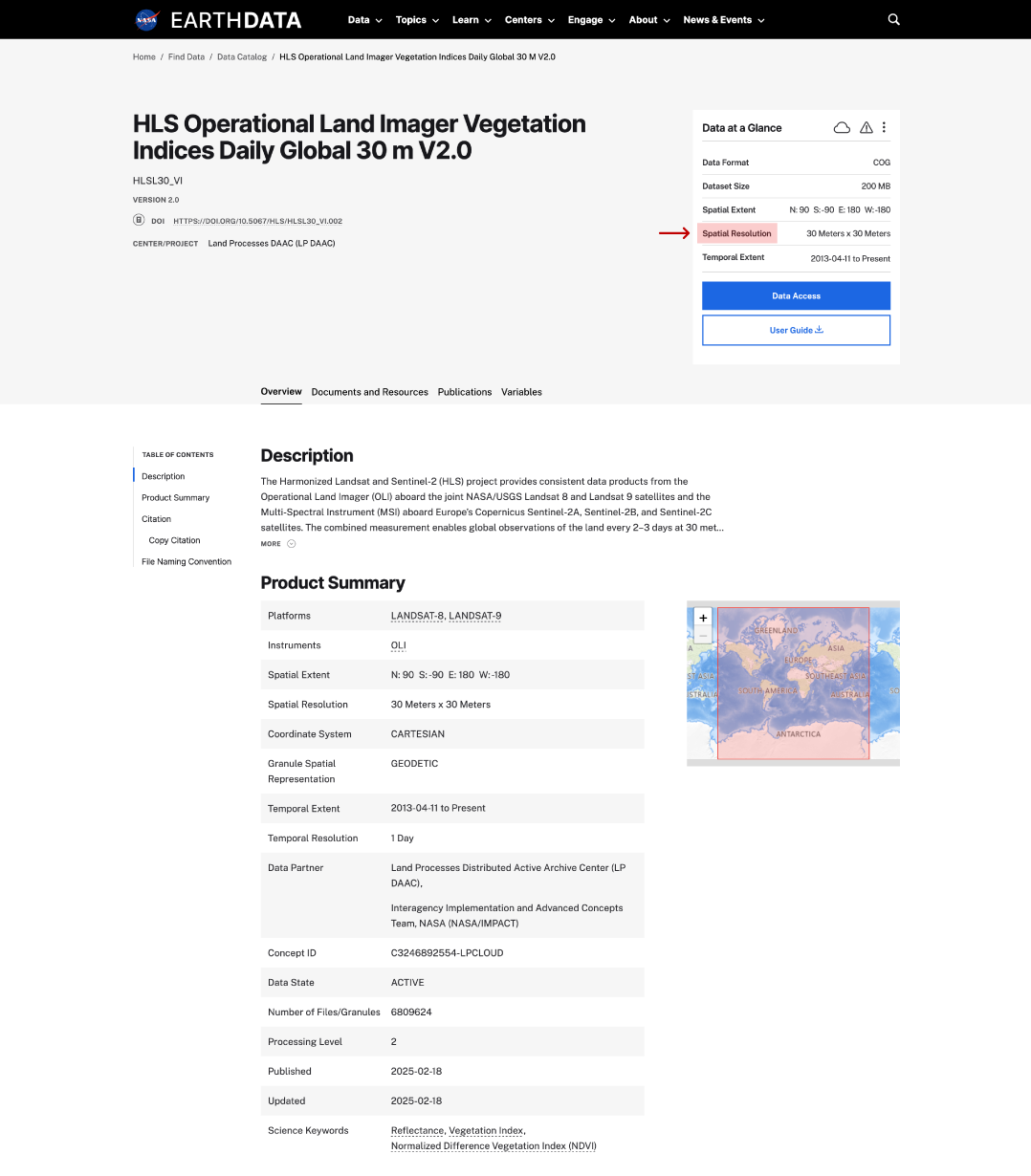
spatial resolution on dataset page
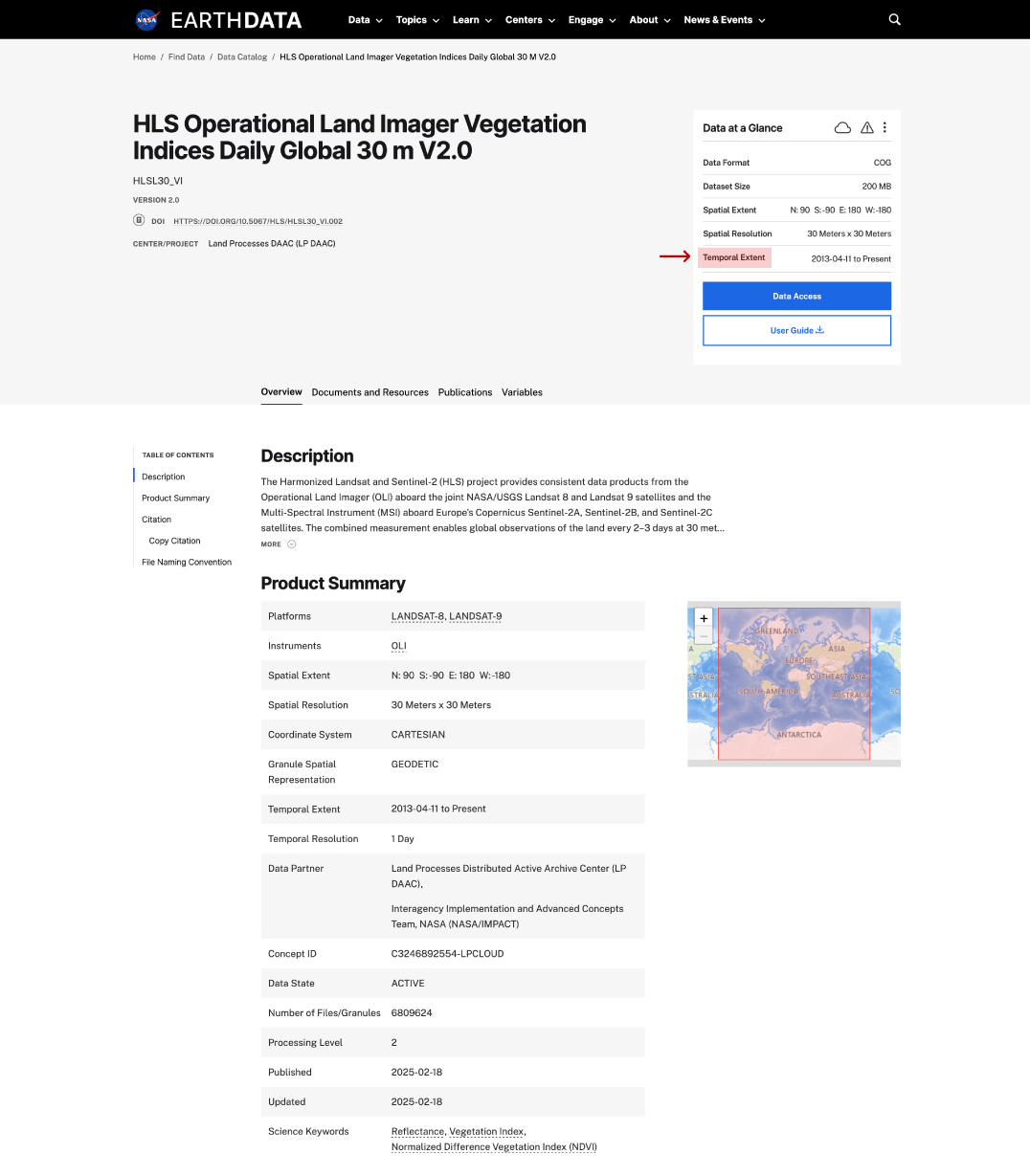
temporal extent on dataset page
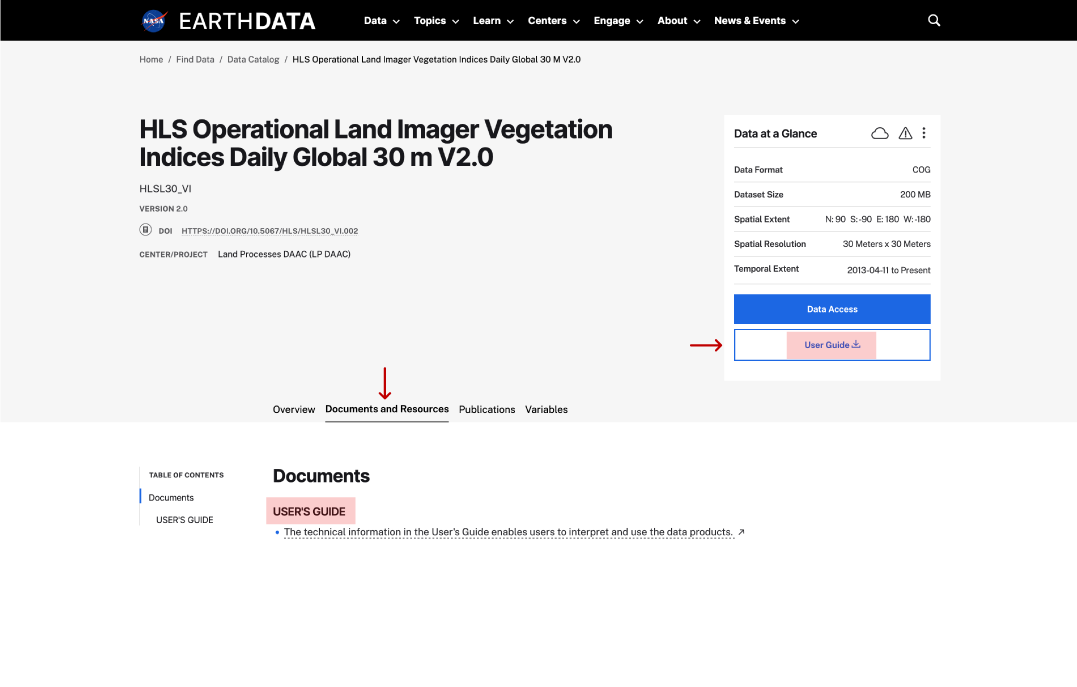
user guide on dataset page
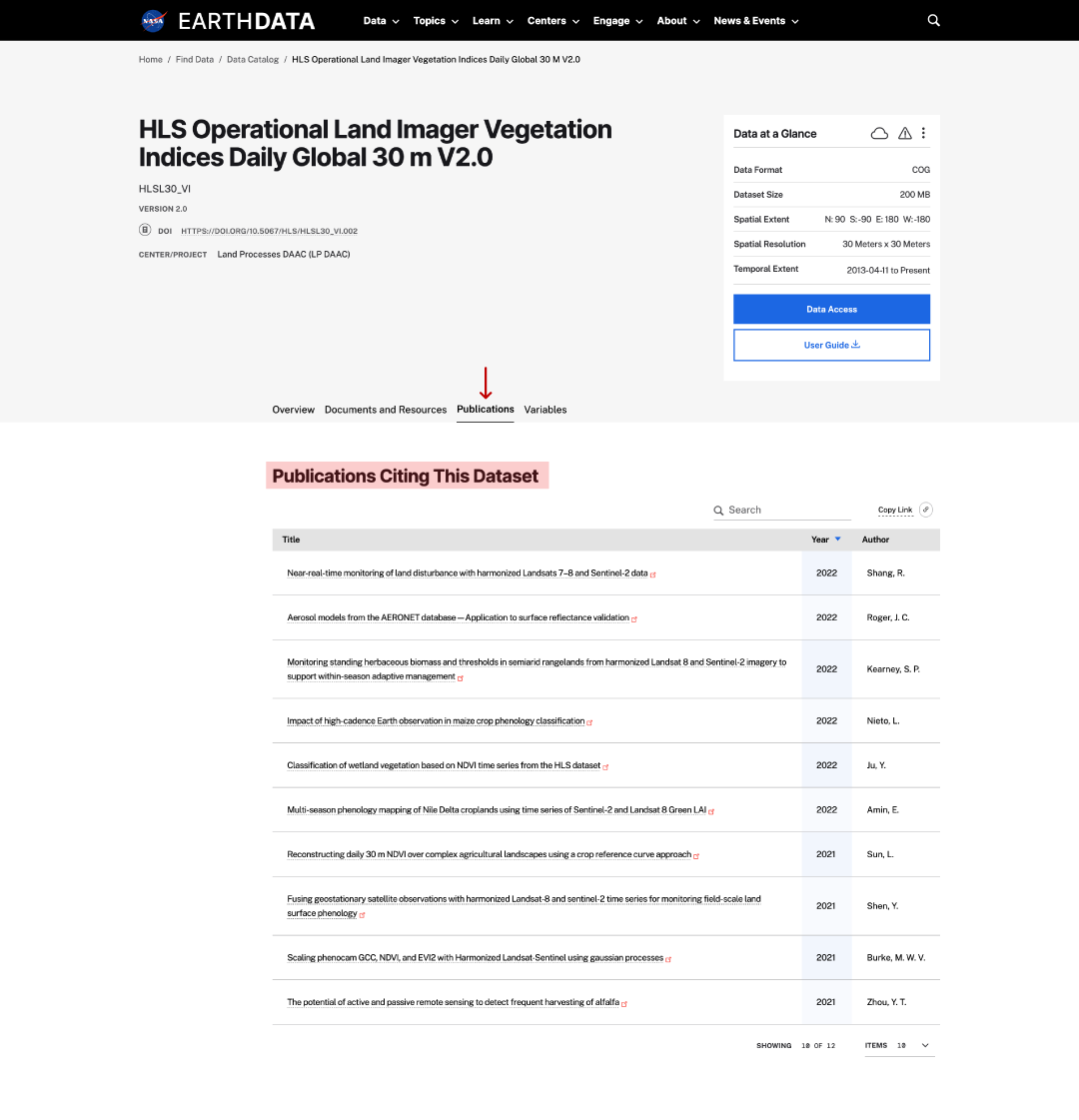
publications on dataset page
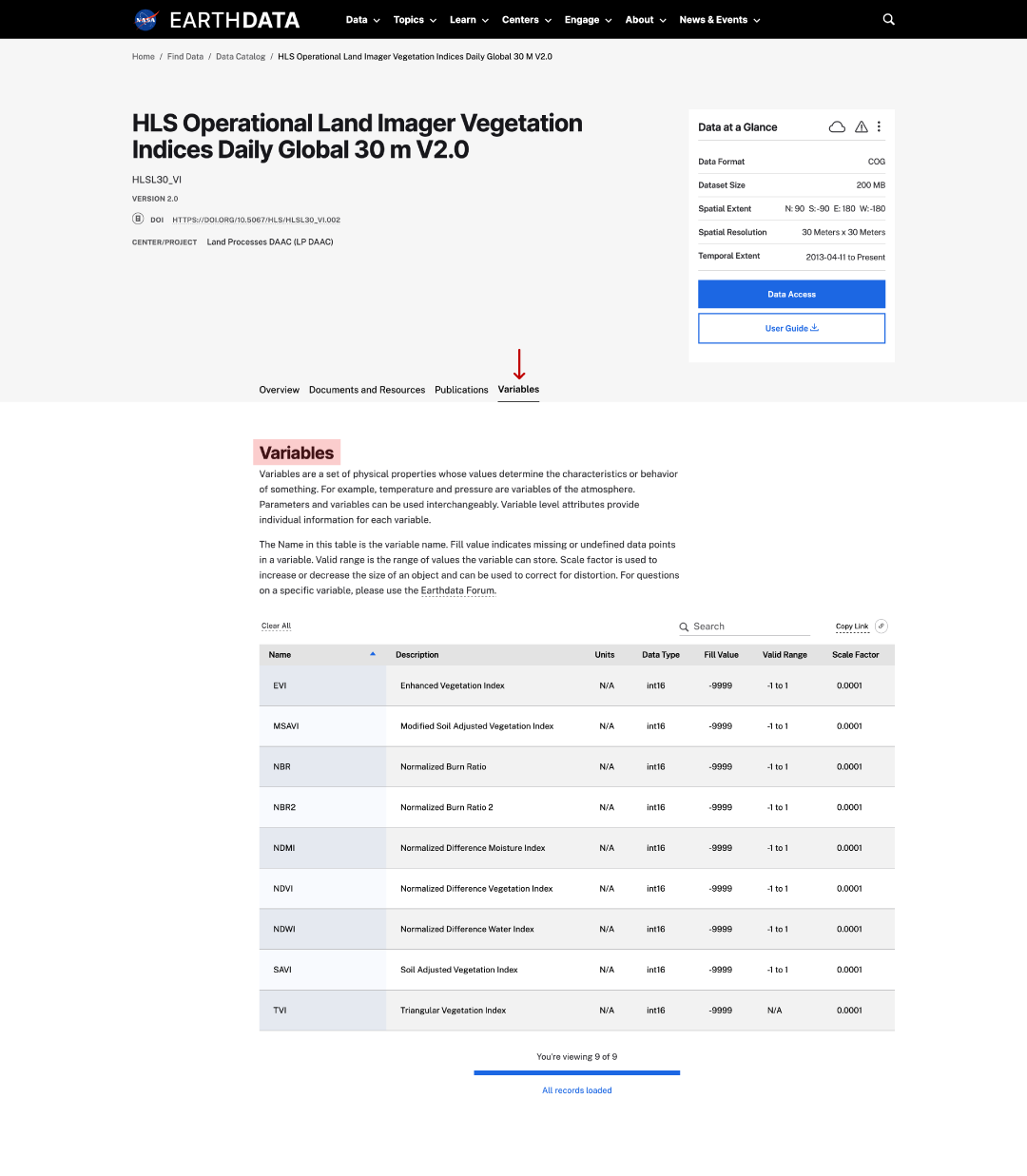
variables on dataset page
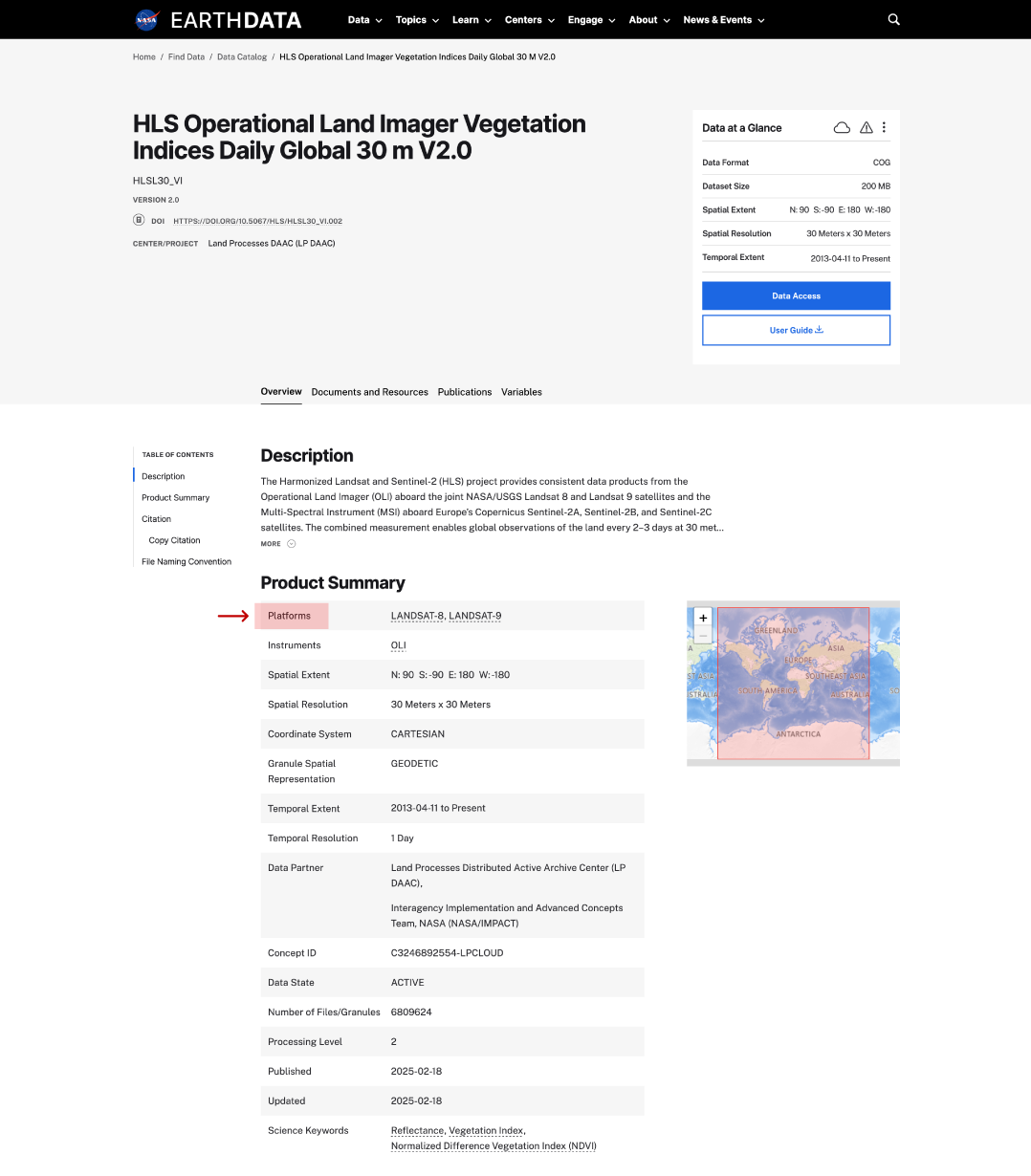
platforms on dataset page
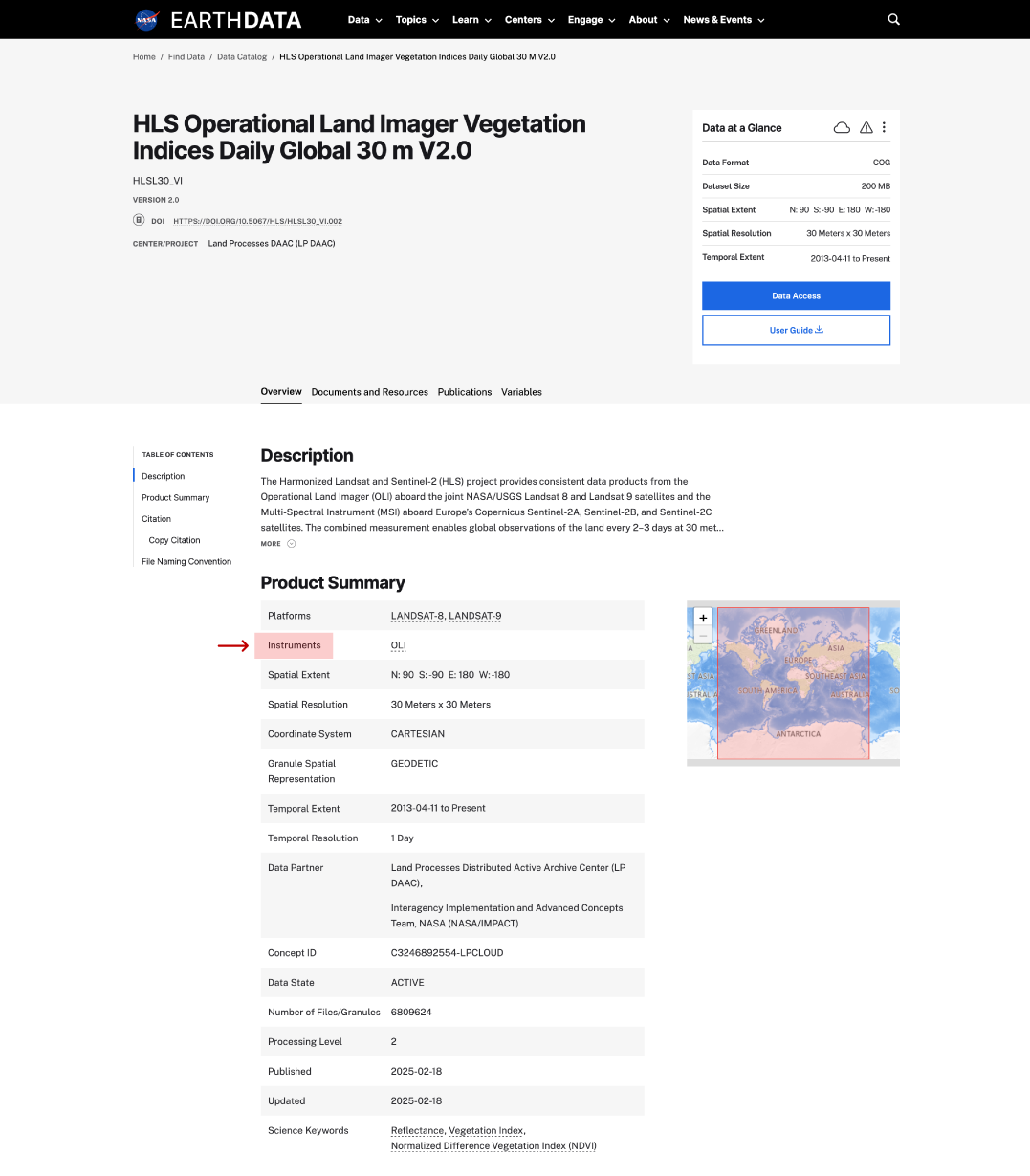
instruments on dataset page
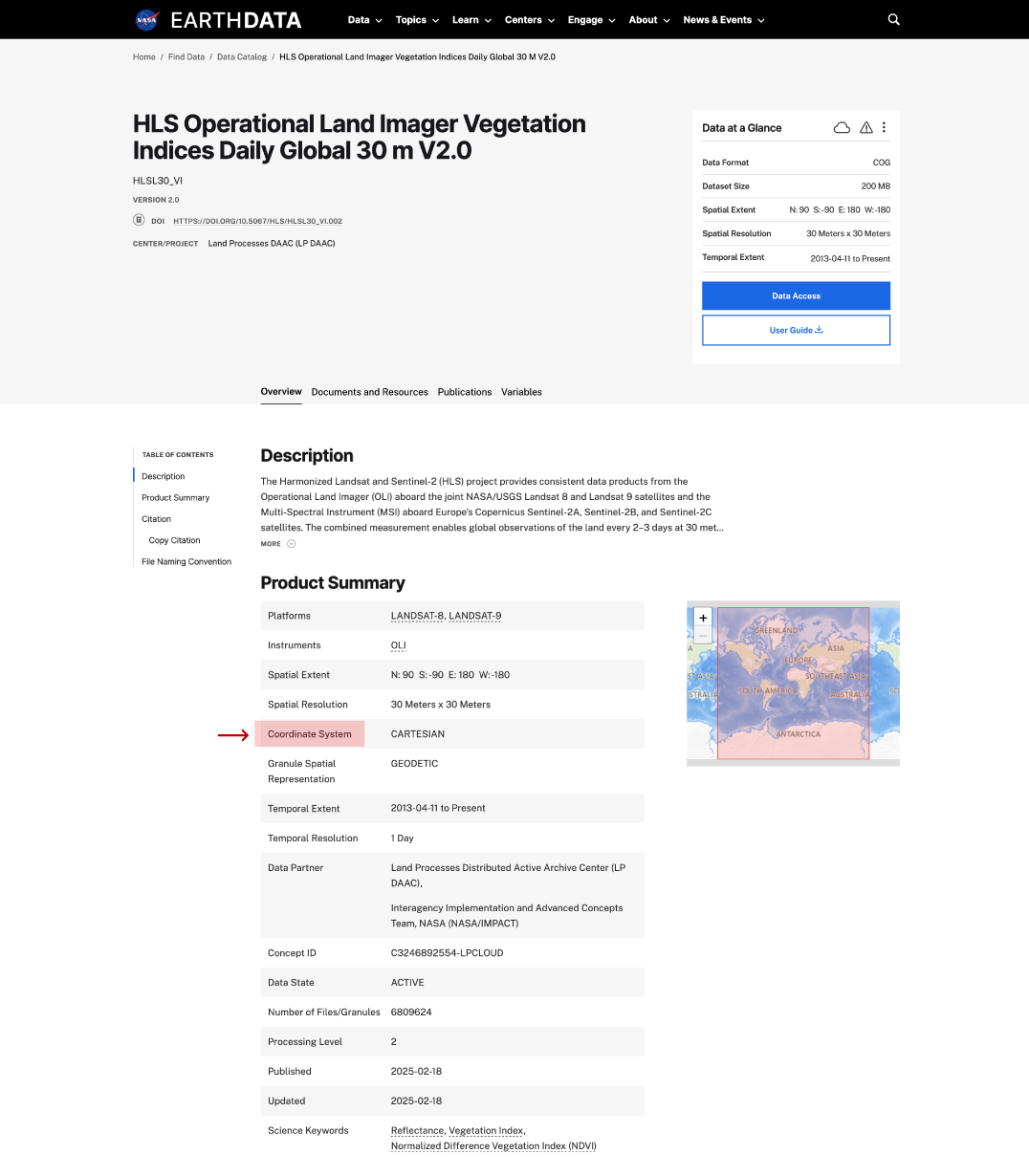
coordinate system on dataset page
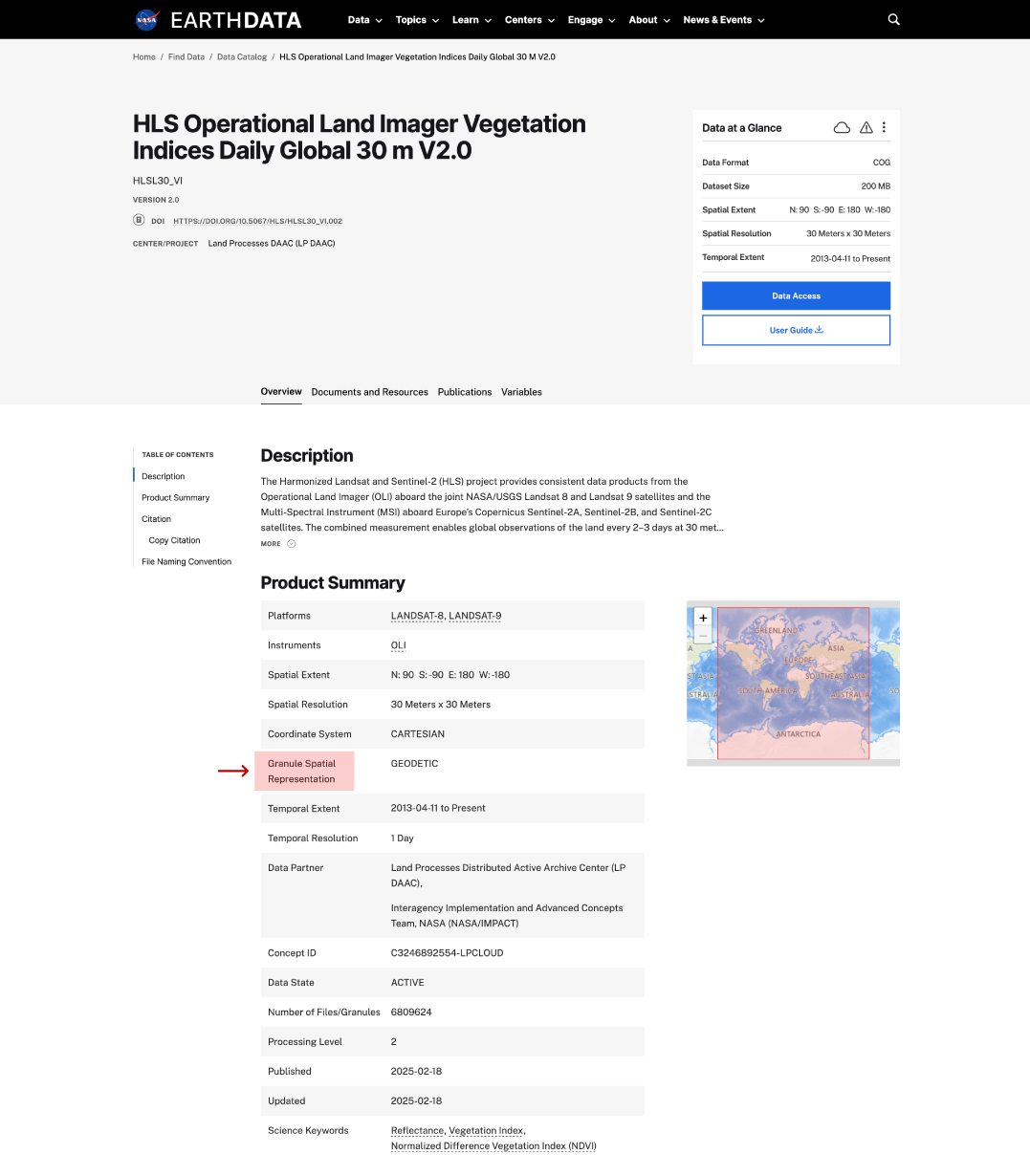
granule spatial representation on dataset page
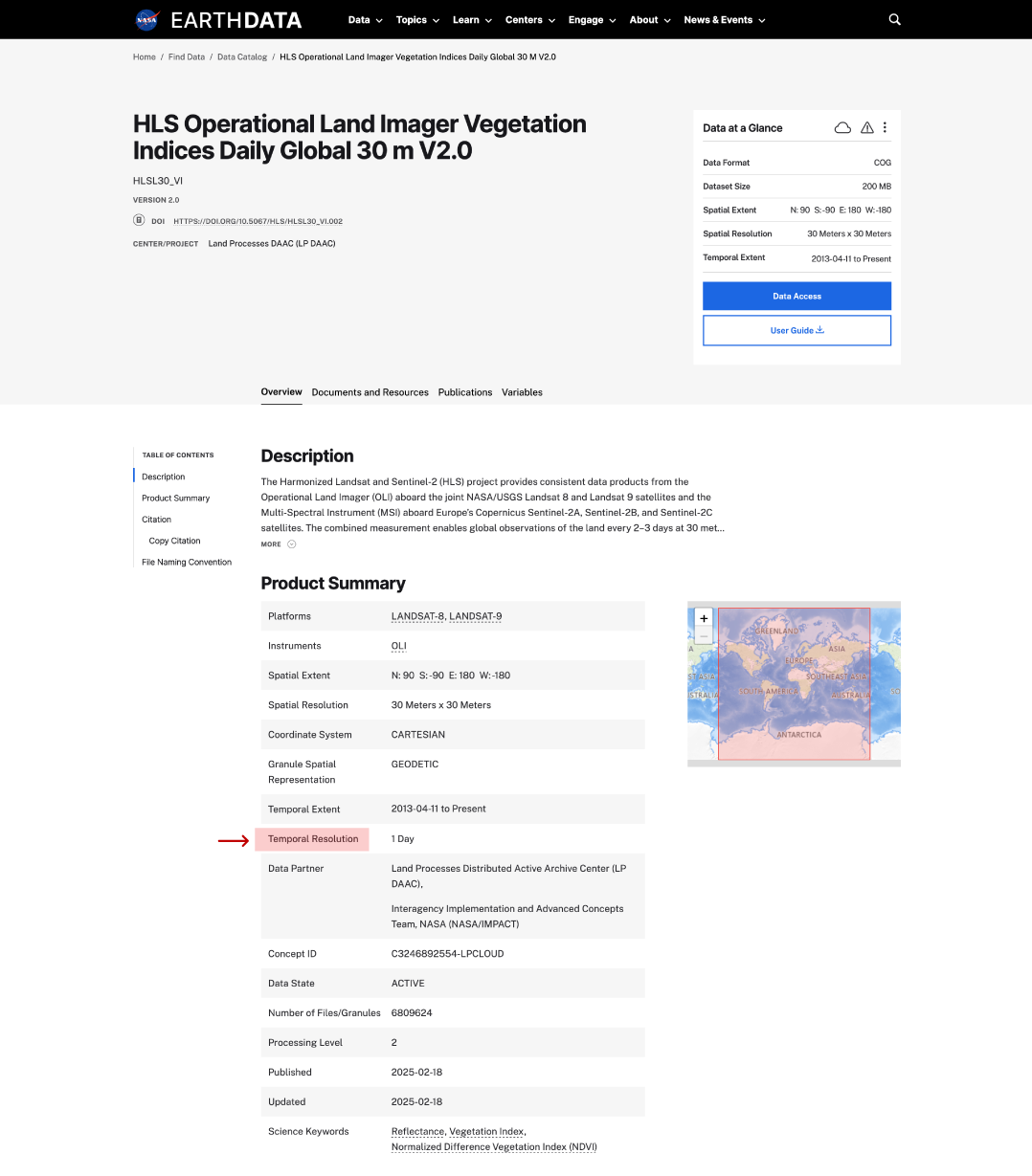
temporal resolution in dataset page
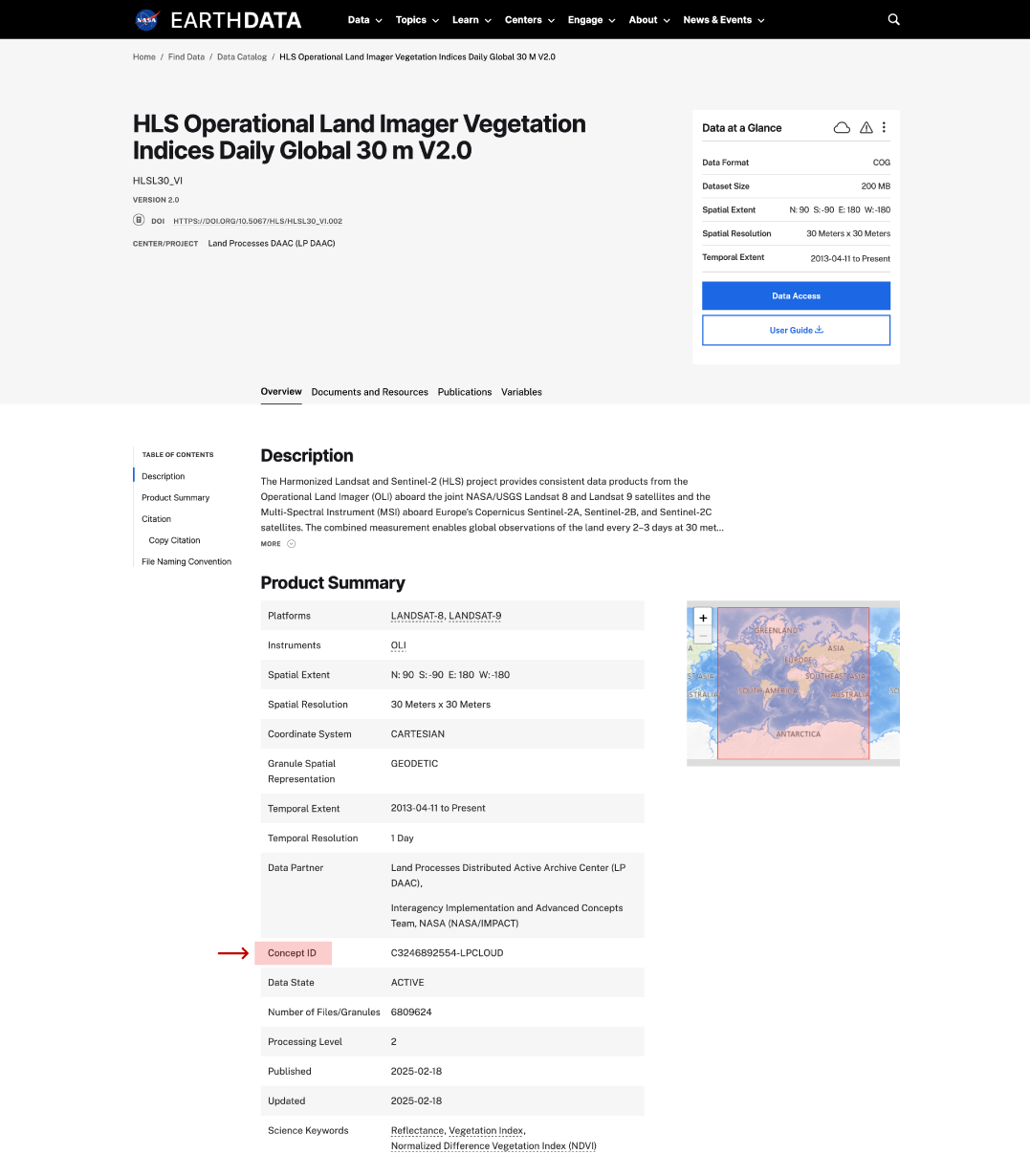
concept ID on dataset page
data state on dataset page
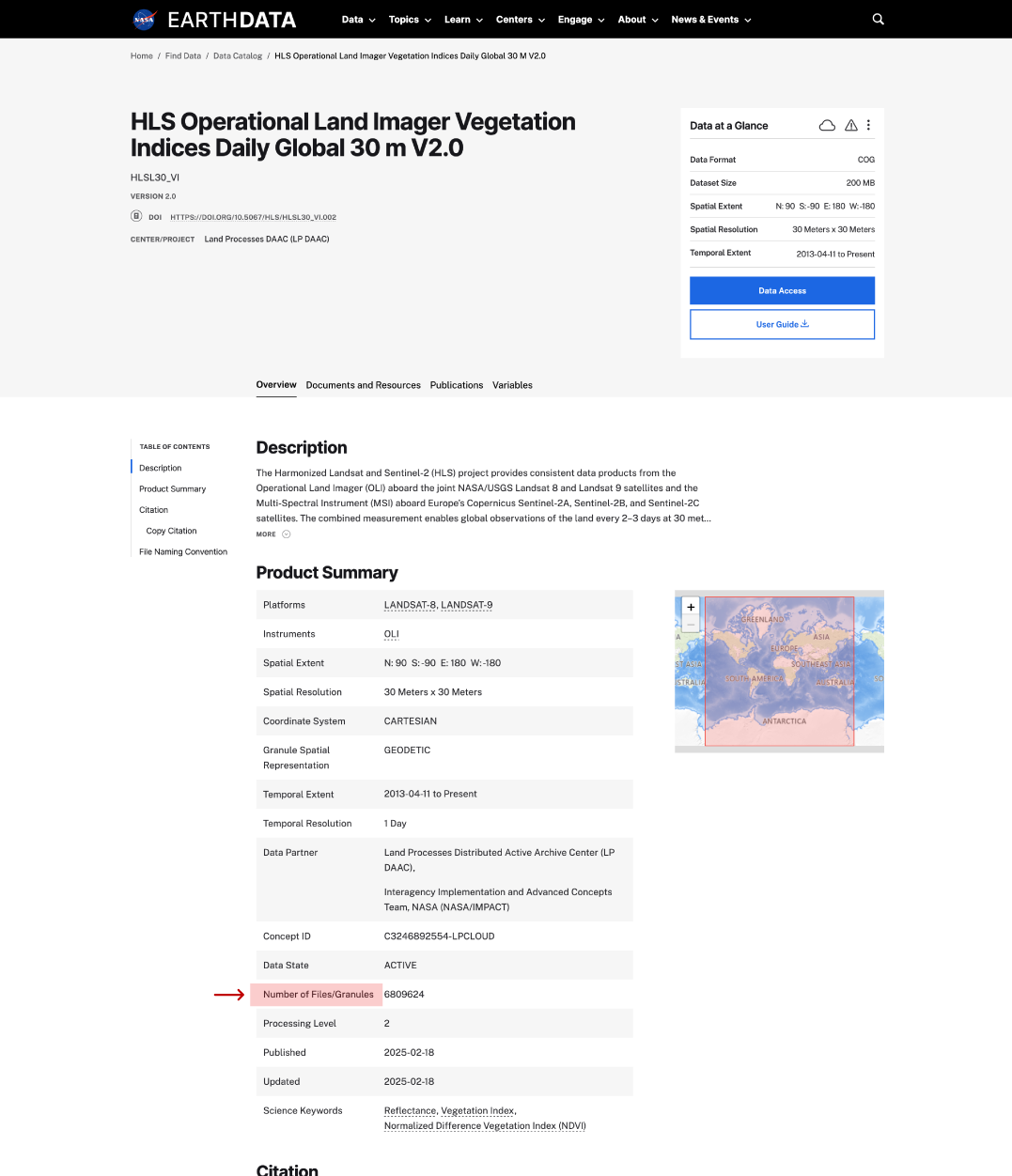
Number of files or granules
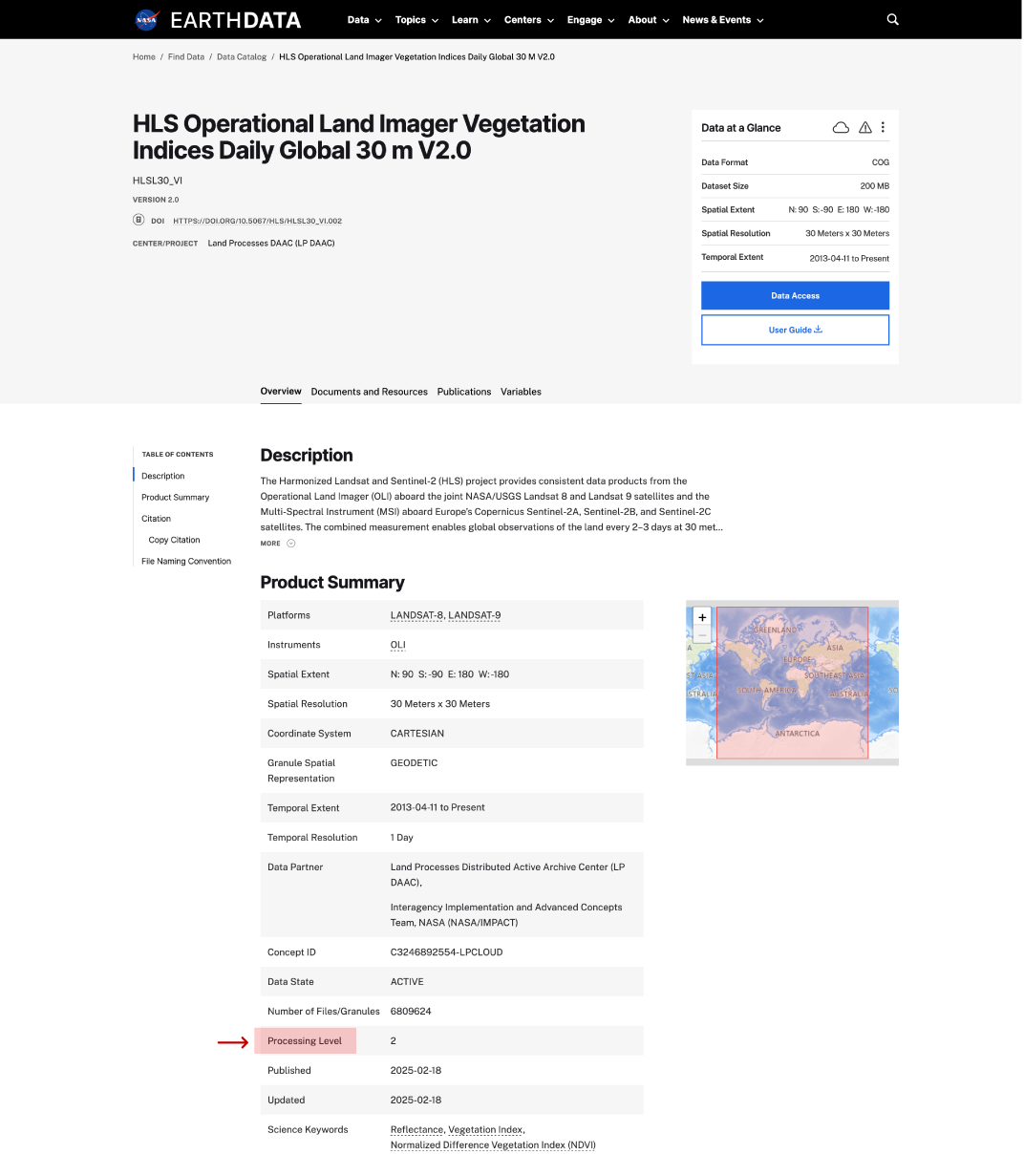
data processing level on dataset ppage
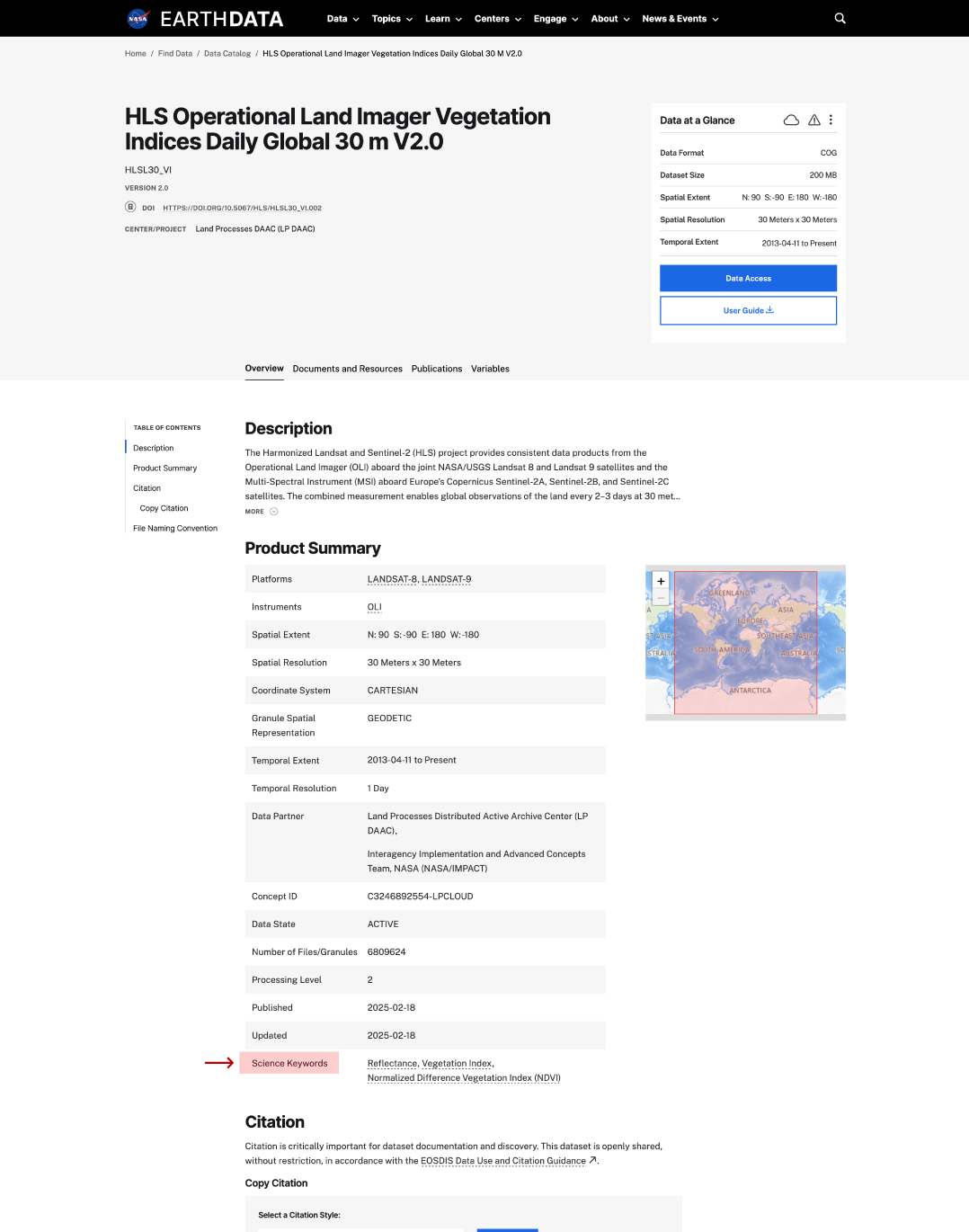
science keywords on dataset page
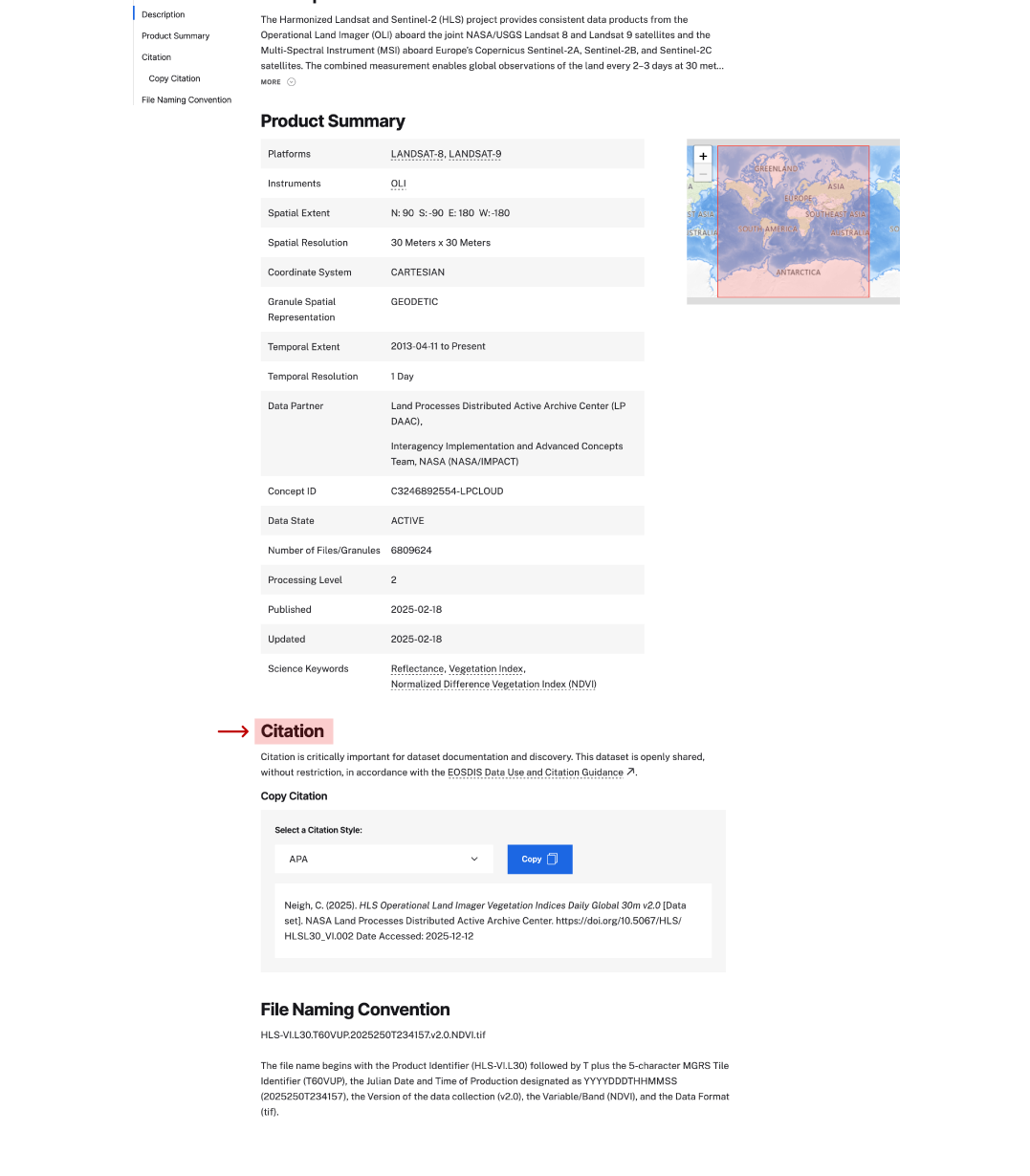
citation on dataset page
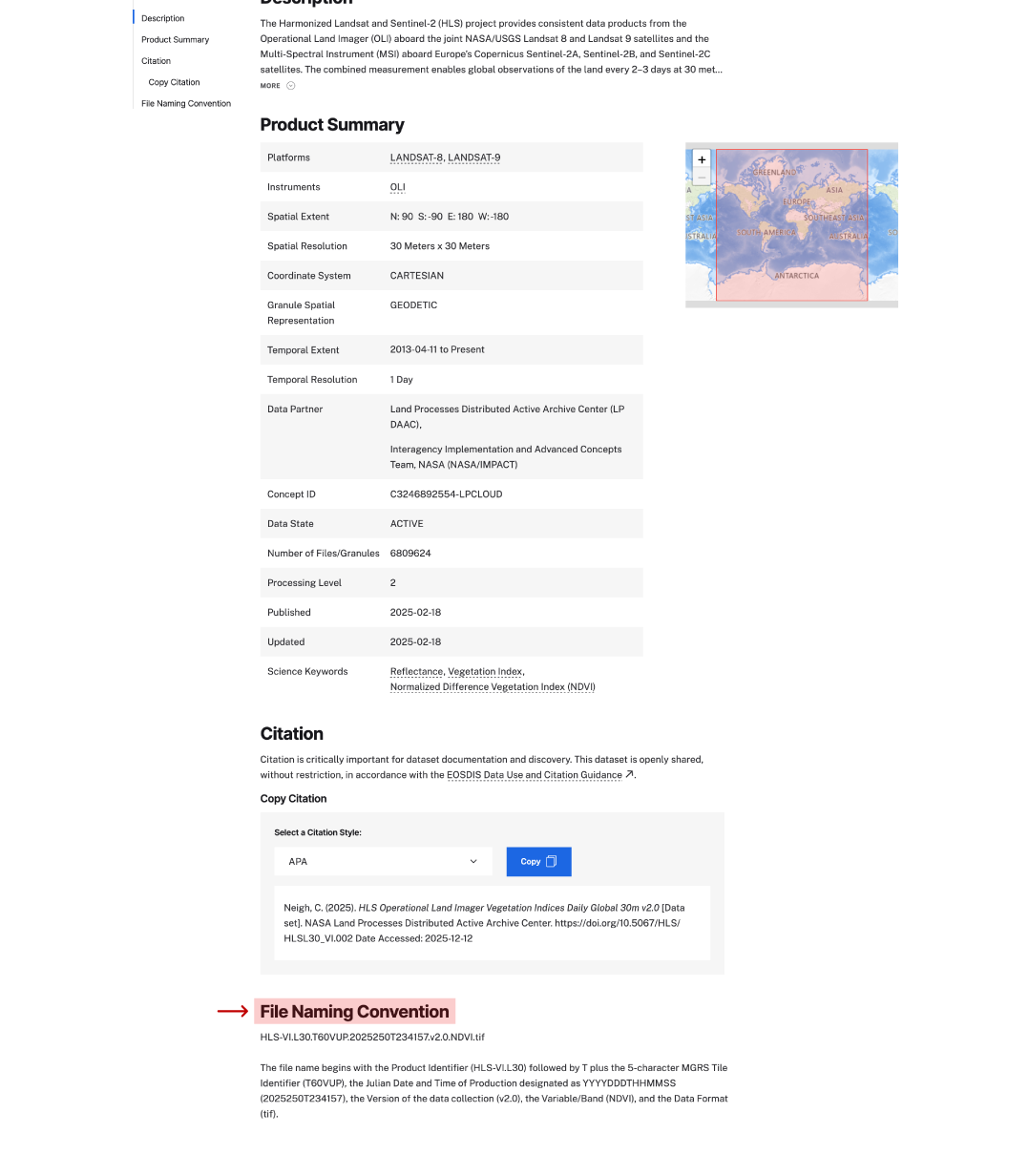
file naming convention on dataset page

Technology

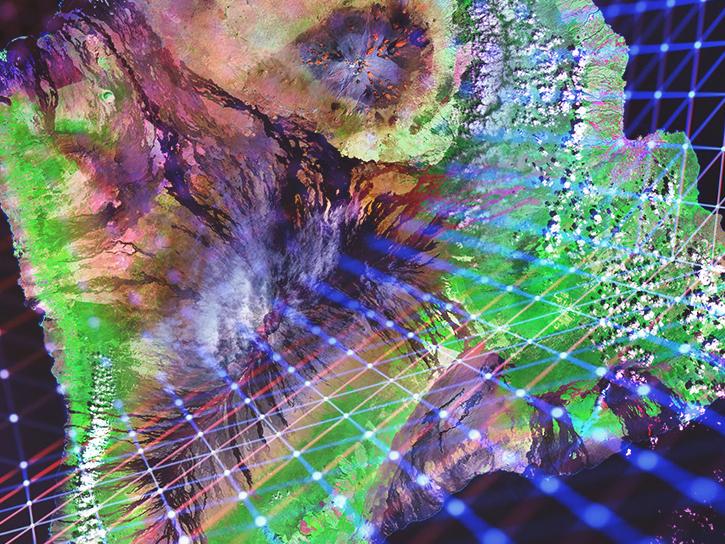
Innovations in artificial intelligence, climate models, and cloud computing are improving the ways users work with Earth science data, especially massive datasets like those expected from NISAR. NASA leverages modern computing approaches to optimize the quality of data collected and the speed at which users are able to drill down to the details they need to support on-the-ground science.

Image

Cloud Computing

Nearly all of NASA’s Earth science data is accessible through Earthdata Cloud, making access, analysis, and visualization more efficient and cost effective. We offer resources including Python libraries, tutorials, and data recipes to help users optimize working with data in the cloud.

Image

Earth Observation Data and Artificial Intelligence

The application of artificial intelligence (AI) to Earth science data makes it possible to search through large amounts of data to find relationships.

Synthetic Aperture Radar

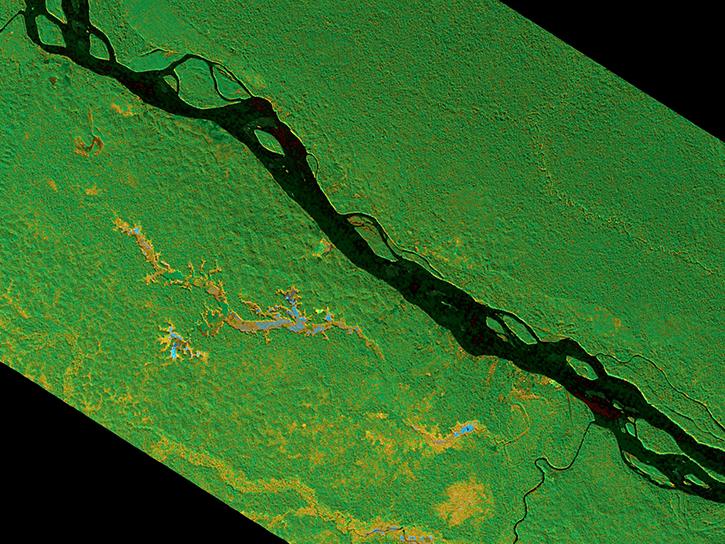
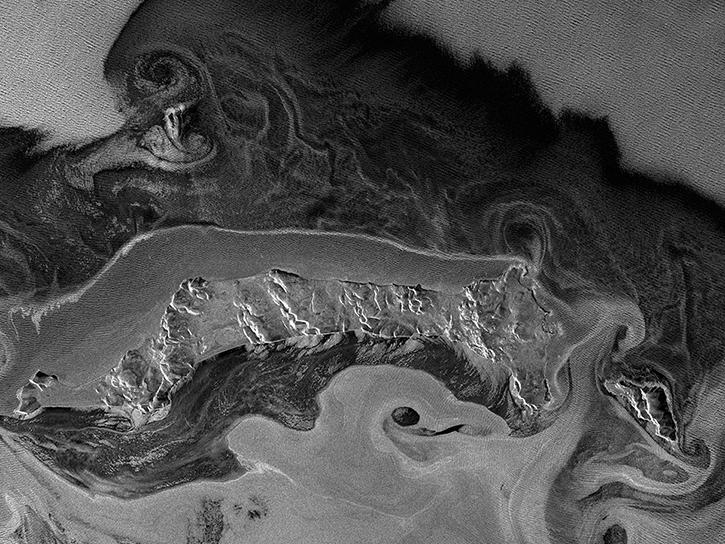
Synthetic aperture radar (SAR) is a type of remote sensing that produces fine-resolution data using a technology that, over time, can detect even minute changes on Earth’s surface.

SAR is one of the power technologies of remote sensing, and enables high resolution imagery to be created night or day, regardless of weather conditions.
The SAR Handbook was created in 2019 as a guide for forest monitoring and biomass estimation with synthetic aperture radar (SAR).
View a table of synthetic aperture radar (SAR) products and their processing levels available through NASA's Earth Science Data Systems (ESDS) Program.
General rules of thumb for interpreting synthetic aperture radar (SAR) imagery and resources for viewing SAR imagery.

Glossary of Terms

Reference the Earth Observation Data Basics Glossary to better understand terms related to the data provided by our program.
All
A B C D E F G H I J K L M N O P Q R S T U V W X Y Z
Acquisition Strategy Meeting (ASM)

An ASM is a forum where senior Agency management reviews major acquisitions in programs and projects before authorizing significant budget expenditures. The ASM is held at the Mission Directorate/Mission Support Office level, implementing the decisions that flow out of the earlier Agency acquisition strategy planning. The ASM is typically held early in Formulation, but the timing is determined by the Mission Directorate. The ASM focuses on considerations such as impacting the Agency workforce, maintaining core capabilities and make-or-buy planning, and supporting Center assignments and potential partners.

Algorithm

A formula or set of steps used, sometimes repetitively, to solve a problem. Algorithms implemented as software are delivered to NASA's Science Investigator-led Processing System (SIPS) or to NASA's Science Data Processing Segment (SDPS) by a science investigator (principal investigator, team leader, or Interdisciplinary Investigator) to use as primary tools in the generation of science products. The term includes executable code, source code, job control scripts, and documentation.

Algorithm Theoretical Basis Document (ATBD)

An ATBD describes the physical and mathematical description of the algorithms to be used in the generation of data products. It includes a description of variance and uncertainty estimates and considerations of calibration and validation, exception control, and diagnostics. In some cases, internal and external data product flows are required.

Ancillary Data

Data which are not obtained from the sensor itself (usually provided in the science telemetry) and have the primary purpose to serve the processing of instrument data. This can be divided into data referred to as spacecraft ‘engineering’, ‘core housekeeping’ or ‘subsystem’ data obtained from other parts of the platform and includes parameters such as orbit position and velocity, attitude and its range of change, time, temperatures, pressures, jet firings, water dumps, internally produced magnet fields, and other environmental measurements. Ancillary refers to data that exist purely to serve the data processing; auxiliary data, while helping the process, are also data sets in their own right.

Application Programming Interface (API)

A system access point or library function that has a well-defined syntax and is accessible from application programs or user code to provide well-defined functionality. Check out the Earthdata Developer Portal for a list of APIs managed by the ESDS Program.
Definition from NIST

Archive

The archive stores data products, guaranteeing their preservation for future use. This function includes all operations to identify, store and retrieve the data and ensure their integrity.

Archiving, Distribution and User Services Requirements Document

(ADURD) A document which provides generic requirements for data archiving, data distribution and user services for EOSDIS-supported data.

Attitude Data

Data that represent spacecraft orientation and onboard pointing information. Attitude data includes: attitude sensor data used to determine the pointing of the spacecraft axes, calibration and alignment data, Euler angles or quaternions, rates and biases, and associated parameters. Attitude generated onboard in quaternion or Euler angle form. Refined and routine production data related to the accuracy or knowledge of the attitude.

Attribute

An element of metadata, e.g., title, summary, format, dataset language.

Big Data

Big data is a broad term for data sets so large or complex that traditional data processing applications are inadequate. Challenges include analysis, capture, data curation, search, sharing, storage, transfer, visualization, querying and information privacy. 

Browse Data

1. Subsets of data set other than the directory and metadata that facilitates user selection of specific data having the required characteristics. For example, for image data, browse data could be a single channel of multi-channel data, and with degraded resolution. The form of browse data is generally unique for each type of data set and depends on the nature of the data and the criteria used for data selection within the related science discipline.

2. Data produced primarily to provide other investigators with an understanding of the type and quality of data available. Typically, browse data sets are limited in size or resolution. The specific form of browse data depends on the type of instrument or discipline with which the browse data is related. Browse data is sometimes considered to be a sample of available data.

3. Browse data facilitates access to real-time or priority playback data which receive minimal processing and are forwarded to the user for his review/use. The user may provide additional processing to suit his requirements.

Browse Image

Visual representation of a product (as an image) to help and support product selection in the frame of the user service facility. Synonyms are: Browse, Quick-look, and Preview.

Calibration

The process of quantitatively defining the system responses to known, controlled signal inputs.

Calibration Data

The collection of data required to perform calibration of the instrument science data, instrument engineering data, and the spacecraft or platform engineering data. It includes pre-flight and in-flight calibration measurements, calibration equation coefficients derived from calibration software routines, and ground truth data that is to be used in the data calibration processing routine.

Campaign

An observational study used to acquire targeted observations or samples to support a clearly defined science or research objectives. Also called (or at least related to) what some stakeholders call a Mission, Project, Field Campaign, or Field Investigation. A campaign may be a multi-year program with multiple projects, such as the Arctic-Boreal Vulnerability Experiment (ABoVE), an Earth Ventures Suborbital (EVS) mission, such as Delta-X, or a single project targeting a specific set of measurements, such as the CARbon Atmospheric Flux Experiment (CARAFE).

Definition from Airborne Data and Management Group (ADMG) Catalog of Suborbital Earth Science Investigations (CASEI)

Climate and Forecast Metadata Conventions

A set of metadata conventions that were invented for climate and weather forecast data but have since been applied to describe other kinds of Earth Science data, with the intention of promoting the processing and sharing of data.

Collection

See Data Set Series

Collection or aggregate metadata

These are metadata elements that describe an entire set of data products or files. Values of collection metadata apply to all of the products in a specific collection. Collections may represent the same release of any given data product, sets of data generated during an experiment, a campaign or an algorithmic test.

Content Organization Scheme

A means for enhancing the addressing and access of elements contained in a digital object in the cloud.

Critical Design Reviews (CDR)

CDRs evaluate the integrity of the program integrated design, including its projects and ground systems. CDRs also help meet mission requirements with appropriate margins and acceptable risk within cost and schedule constraints. CDRs also determine if the integrated design is appropriately mature to continue with the final design and fabrication phase.

Critical Events Readiness Reviews (CERR)

CERRs evaluate the readiness of the program and its projects to execute a critical event during the flight operations phase of the life cycle.

Data

Scientific or technical measurements, values calculated therefrom, observations, or facts that can be represented by numbers, tables, graphs, models, text, or symbols which are used as a basis for reasoning and further calculation.

For NASA's Earth Science Program and according to NASA's Earth Science Data & Information Policy, the term 'data' includes observation data, metadata, products, information, algorithms, including scientific source code, documentation, models, images, and research results.

Data Assimilation

Data assimilation is defined as the process of combining observations with model simulations to enhance the accuracy of predictions.

Definition from ScienceDirect

Data Collection

A major release of a data product, or of a set of closely related data products, which can be followed by minor releases within the same collection.

See also: Data Set Series on this page.

Data Distributor

An entity responsible for archiving and distributing data products. 

See also: DAAC.

Data Format

A standard way that information is encoded for storage in a computer file (see more about data formats). An example is HDF5.

Data Format Control Documents (DFCD)

Data Format Control Documents (DFCDs), and other data format documents (e.g., Data Format Requirements Documents (DFRDs)), define the formats of data units that are transferred across an interface and the control codes used in the data formats.

Data Management

As defined for an OAIS entity that contains the services and functions for populating, maintaining, and accessing a wide variety of information. Some examples of this information are catalogs and inventories on what may be retrieved from Archival Storage, processing algorithms that may be run on retrieved data, Consumer access statistics, Consumer billing, Event Based Orders, security controls, and OAIS schedules, policies, and procedures.

Data Maturity Levels

Beta
Products intended to enable users to gain familiarity with the parameters and the data formats. 

Provisional
Product was defined to facilitate data exploration and process studies that do not require rigorous validation. These data are partially validated and improvements are continuing; quality may not be optimal since validation and quality assurance are ongoing. 

Validated
Products are high quality data that have been fully validated and quality checked, and that are deemed suitable for systematic studies such as climate change, as well as for shorter term, process studies.

Stage 1 Validation: Product accuracy is estimated using a small number of independent measurements obtained from selected locations and time periods and ground-truth/field program efforts. 

Stage 2 Validation: Product accuracy is estimated over a significant set of locations and time periods by comparison with reference in situ or other suitable reference data.

Stage 3 Validation: Product accuracy has been assessed. Uncertainties in the product and its associated structure are well quantified from comparison with reference in situ or other suitable reference data.

Stage 4 Validation: Validation results for stage 3 are systematically updated when new product versions are released and as the time-series expands.

Data Model

An Earth science metadata model, which supports the data standardization necessary for total system interoperability within a heterogeneous, open systems environment. The Data Model includes diagrams, which graphically illustrate the relationships of classes, the attributes contained within the classes, the characteristics of the relationships between classes, and the attribute specifications.

Data Processing Level

The level of processing that results in data products ranging from raw instrument data to refined analyses that use inputs from various sources. See also: Data Maturity Levels.

Data Producer

A person or group that directly collects/creates data to be submitted to a NASA DAAC for archiving and public distribution.

Data Product

A set of data files that can contain multiple parameters and that compose a logically meaningful group of related data.

Data Quality

See: Quality Indicator

Data Services

NASA ESDIS processes, archives, documents, and distributes data from NASA's past and current Earth-observing satellites and field measurement programs. Each DAAC serves a specific Earth system science discipline and provides users with data products, services, and data-handling tools unique to the center's specialty. User services include:

  • Assistance in selecting and obtaining data
  • Access to data-handling and visualization tools
  • Technical support and referrals
Data Set Documentation

Information describing the characteristics of a data set and its component granules, including format, source instrumentation, calibration, processing, algorithms, etc.

Data Set or Dataset
  1. A logically meaningful grouping or collection of similar or related data. Data having all of the same characteristics (source or class of source, processing level, resolution, etc.) but different independent variable ranges and/or responding to a specific need are normally considered part of a single data set. A data set is typically composed by products from several missions, gathered together to respond to the overall coverage or revisit requirements from a specific group of users. In the context of EO data preservation, a data set consists of the data records and their associated knowledge (information, tools).
     
  2. A broadly used term that can be used to describe any set of data. The official term “HDF5 dataset” describes a data array in an HDF5 file (equivalent to a NetCDF-4 variable in a NetCDF-4 file or an HDF-EOS field in an HDF-EOS file). An entire data collection is sometimes referred to as a dataset.
Data Set Series or Dataset Series

A major release of a data product, or of a set of closely related data products, which can be followed by minor releases within the same collection.

Data Structure

In Earth Science data products, a multi-dimensional container for geolocation and science data tailored for a specific type of instrument acquisition mode or spatial arrangement of the data (e.g., swath, grid, zonal mean, trajectory)

Data User Guide

A document, either on-line or hardcopy, containing the necessary information for the correct usage of the data.

Data Visualization

See: Visualization

Decommissioning Review (DR)

DRs evaluate the readiness of the program and its projects to conduct closeout activities, including final delivery of all remaining program/project deliverables and safe decommissioning/disposal of space flight systems and other program/project assets.

Derived Products

Derived products are higher level products (level 1b through 4) where calibration and geo-location transformations have been applied to generate sensor units, and/or algorithms have been applied to generate gridded geophysical parameters.

Detailed Mission Requirements (DMR)

DMRs include Mission-Specific Requirements Documents (MSRDs) and mission requirement documents (e.g., Ground System Requirements Documents (GSRDs), and Mission Operations Requirements Documents (MORDs)). DMRs contain the results of the requirements identification and derivation activities and provide the basis for system design for individual missions.

Discipline

A field of study such as oceanography, meteorology, geology, or marine biology.

Discovery

Successful identification and location of data products of interest. 

Any service that helps the user to identify and locate EO resource starting from his needs. 

See also: Search and Discovery.

Disposal Readiness Review (DRR)

DRRs evaluate the readiness of the project and the flight system for execution of the spacecraft disposal event.

Distributed Active Archive Center (DAAC)

EOSDIS is designed as a distributed system, with major facilities at Distributed Active Archive Centers (DAACs) located throughout the United States. These institutions are custodians of EOS mission data and ensure that data will be easily accessible to users. EOSDIS DAACs process, archive, document, and distribute data from NASA's past and current Earth-observing satellites and field measurement programs. Acting in concert, DAACs provide reliable, robust services to users whose needs may cross the traditional boundaries of a science discipline, while continuing to support the particular needs of users within the discipline communities. User services include:

  • Assistance in selecting and obtaining data
  • Access to data-handling and visualization tools
  • Technical support and referrals
Distributed Architecture

The allocation of ESDIS elements to various locations to take best advantage of each location's different institutional capabilities and science expertise.

See: EOSDIS

Earth Observing System

A series of small- to intermediate-sized spacecraft that is the centerpiece of NASA's Earth Science Enterprise (ESE). Planned for launch beginning in 1999, each of the EOS spacecraft will carry a suite of instruments designed to study global climate change. ESE will use space-, aircraft-, and ground-based measurements to study our environment as an integrated system. Designing and implementing the ESE is, of necessity, an international effort. The ESE program involves the cooperation of the U.S., the European Space Agency (ESA), and the Japanese National Space Development Agency (NASDA). The ESE program is part of the U.S. interagency effort, the Global Change Research Program.
Definition from Earth Observatory

Join Our Community of NASA Data Users

While NASA data are openly available without restriction, an Earthdata Login is required to download data and to use some tools with full functionality.

Learn About the Benefits of Earthdata Login

Frequently Asked Questions

Earthdata Forum

Our online forum provides a space for users to browse thousands of FAQs about research needs, data, and data applications. You can also submit new questions for our experts to answer.

Submit Questions to Earthdata Forumand View Expert Responses

Earthdata
Forum