Resolution

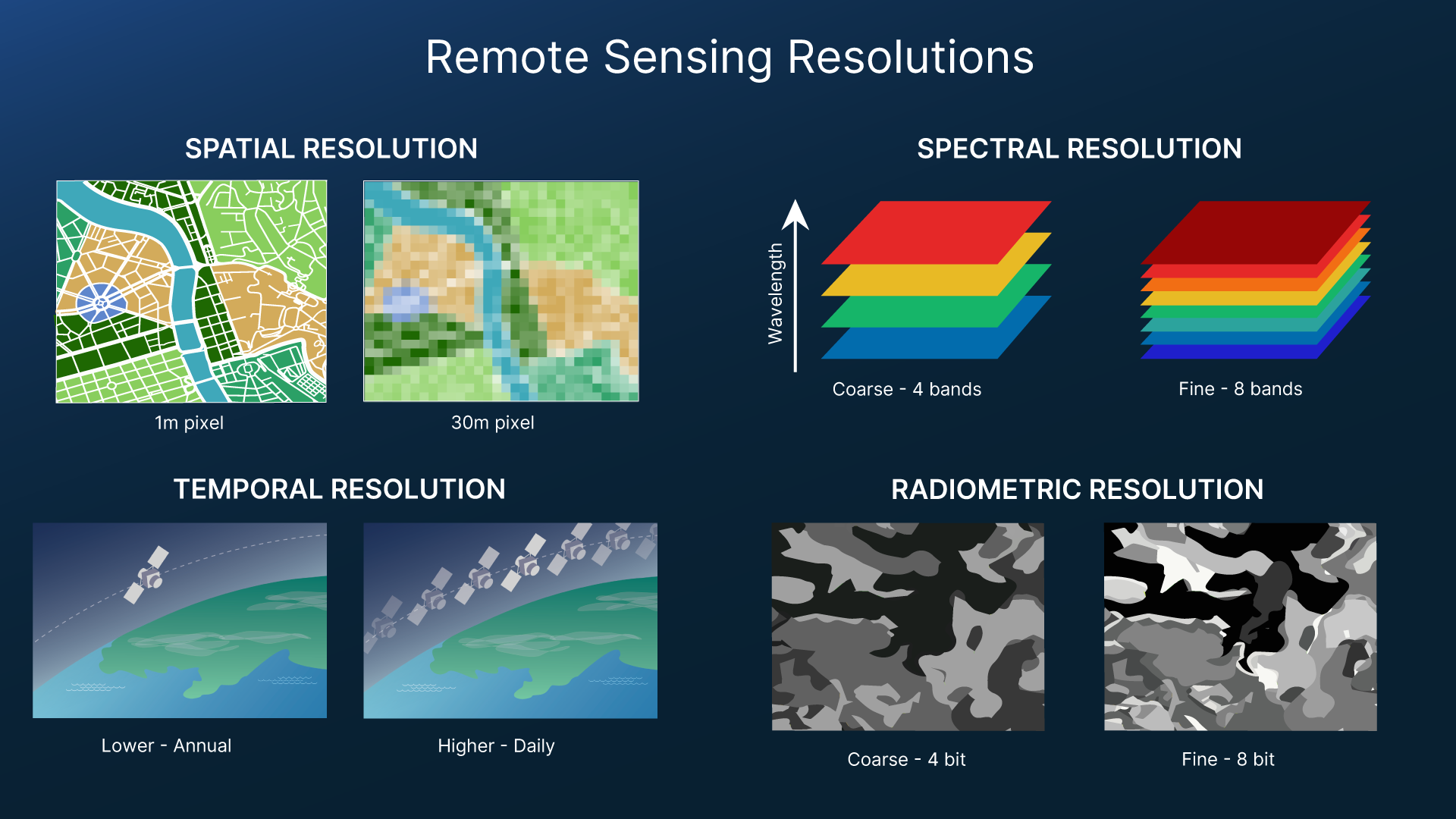
There are four types of resolution to consider for any dataset—radiometric, spatial, spectral, and temporal. Resolution plays a role in how data from a instrument can be used. Resolution can vary depending on the platform's orbit and instrument design.

Radiometric Resolution

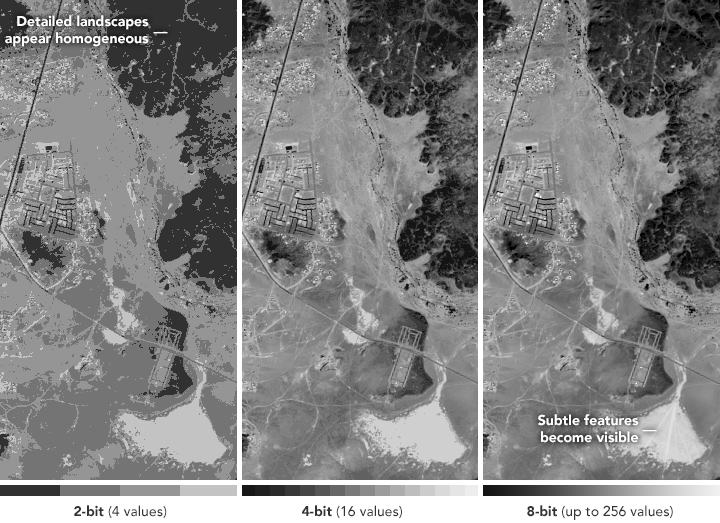
Radiometric resolution is the amount of information in each pixel, that is, the number of bits representing the energy recorded. Each bit records an exponent of base 2. For example, an 8 bit resolution is 28, which indicates that the instrument has 256 potential digital values (0-255) to store information. Thus, the higher the radiometric resolution, the more values are available to store information, providing better discrimination between even the slightest differences in energy. For example, when assessing water quality, radiometric resolution is necessary to distinguish between subtle differences in ocean color.
Image
Image Caption

Advances in remote sensing technology have significantly improved imagery acquired by instruments aboard space-based platforms. Among the advances are improvements in radiometric resolution, or how sensitive an instrument is to small differences in electromagnetic energy. Instruments with high radiometric resolution can distinguish greater detail and variation in light. Credit: NASA Earth Observatory images by Joshua Stevens, using Landsat data from the U.S. Geological Survey.

Spatial Resolution

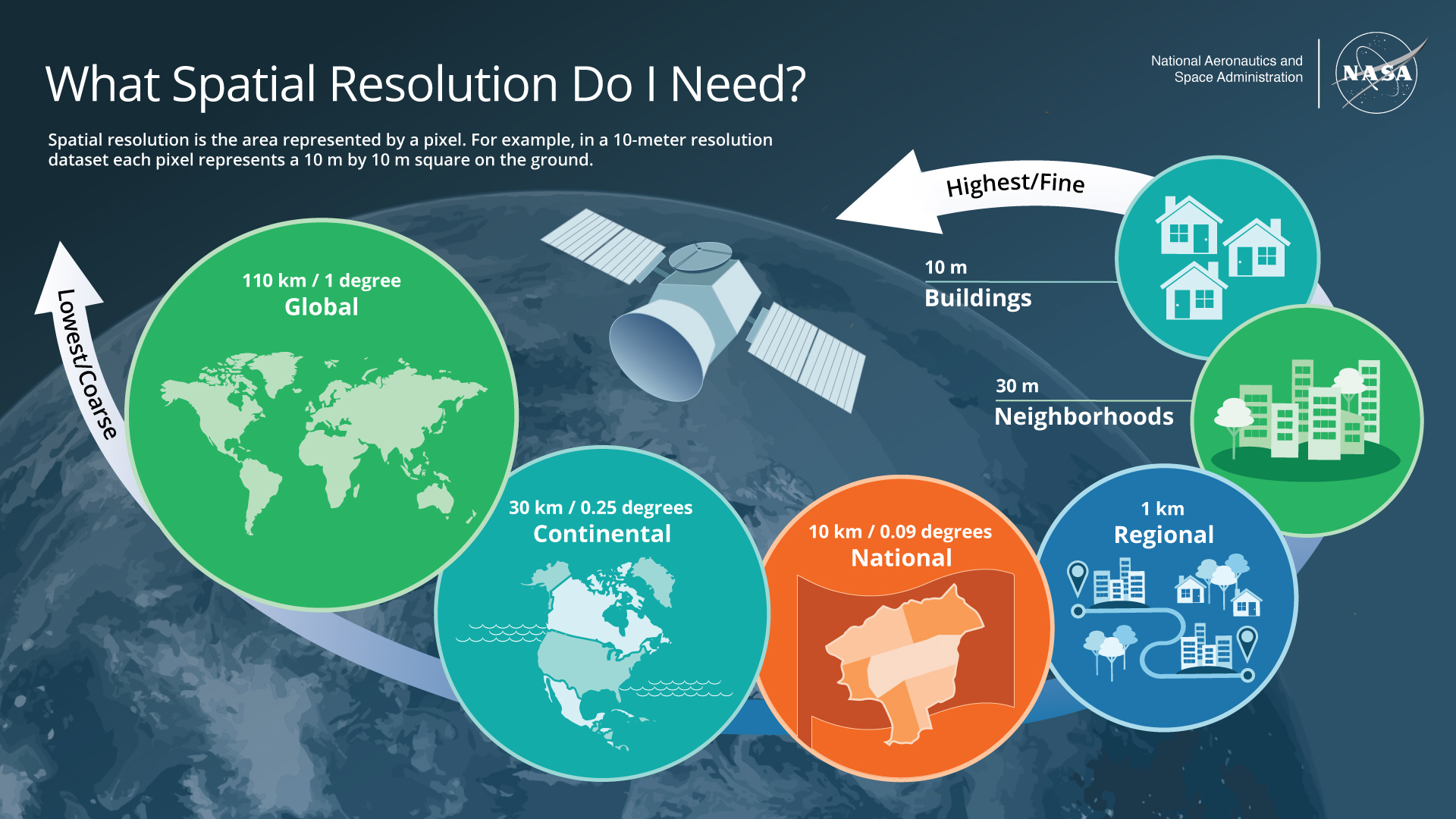
Spatial resolution is defined by the size of each pixel within a digital image and the area on Earth's surface represented by that pixel.

Image
Image Caption

Different spatial resolutions can be used for specific observational or research needs. This image shows spatial resolution examples for common NASA instrument products and a research scale for which they are best suited (regional, national, continental, etc.).

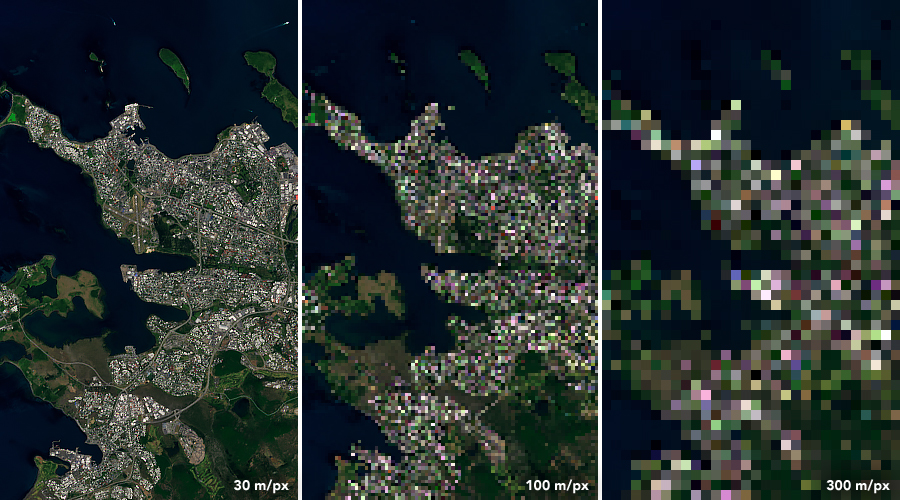
For example, the majority of the bands observed by the Moderate Resolution Imaging Spectroradiometer (MODIS) have a spatial resolution of 1km; each pixel represents a 1 km x 1km area on the ground. MODIS also includes bands with a spatial resolution of 250 m or 500 m. The finer the resolution (the lower the number), the more detail you can see. In the image below, you can see the difference in pixelation between a 30 m/pixel image (left image), a 100 m/pixel image (center image), and a 300 m/pixel image (right image).

Image
Image Caption

Landsat 8 image of Reykjavik, Iceland, acquired July 7, 2019, illustrating the difference in pixel resolution. Credit: NASA Earth Observatory.

Spectral Resolution

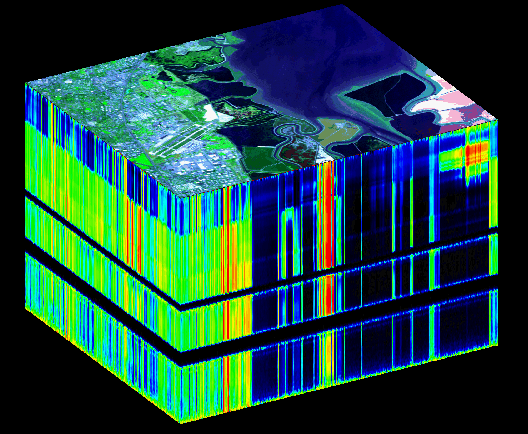
Spectral resolution is the ability of an instrument to discern finer wavelengths, that is, having more and narrower bands. Many instruments are considered to be multispectral, meaning they have 3-10 bands. Some instruments have hundreds to even thousands of bands and are considered to be hyperspectral. The narrower the range of wavelengths for a given band, the finer the spectral resolution. For example, the Airborne Visible/Infrared Imaging Spectrometer (AVIRIS) captures information in 224 spectral channels. The cube below represents the detail within the data. At this level of detail, distinctions can be made between rock and mineral types, vegetation types, and other features. In the cube, the small region of high response in the right corner of the image is in the red portion of the visible spectrum (about 700 nanometers), and is due to the presence of 1-centimeter-long (half-inch) red brine shrimp in the evaporation pond.

The top of the cube is a false-color image made to accentuate the structure in the water and evaporation ponds on the right. The sides of the cube are slices showing the edges of the top in all 224 of the AVIRIS spectral channels. The tops of the sides are in the visible part of the spectrum (wavelength of 400 nanometers), and the bottoms are in the infrared (2,500 nanometers).
Caption

The top of the cube is a false-color image made to accentuate the structure in the water and evaporation ponds on the right. The sides of the cube are slices showing the edges of the top in all 224 of the AVIRIS spectral channels. The tops of the sides are in the visible part of the spectrum (wavelength of 400 nanometers), and the bottoms are in the infrared (2,500 nanometers). Credit: NASA Jet Propulsion Laboratory.

Temporal Resolution

Temporal resolution is the time it takes for a space-based platform to complete an orbit and revisit the same observation area. Temporal resolution depends on the orbit, the instrument's characteristics, and the swath width. Because geostationary platforms match the rate at which Earth rotates, the temporal resolution is much finer. Polar orbiting platforms have a temporal resolution that can vary from 1 day to 16 days. For example, the MODIS instrument aboard NASA's Terra and Aqua platforms has a temporal resolution of 1-2 days, allowing the instrument to visualize Earth as it changes day by day. The Operational Land Imager (OLI) aboard the joint NASA/USGS Landsat 8 platform, on the other hand, has a narrower swath width and a temporal resolution of 16 days, meaning the imagery it acquires is best for showing bi-monthly changes.

Why not build an instrument combining high spatial, spectral, and temporal resolution? It is difficult to combine all of the desirable features into one remote instrument. For example, to acquire observations with high spatial resolution (like the OLI, aboard Landsat 8) a narrower swath is required, which requires more time between observations of a given area resulting in a lower temporal resolution. Researchers have to make trade-offs. This is why it is very important to understand the type of data needed for a given area of study. When researching weather, which is dynamic over time, a high temporal resolution is critical. When researching seasonal vegetation changes, on the other hand, a high temporal resolution may be sacrificed for a higher spectral or spatial resolution.