True-color image of Lake Pontchartrain and New Orleans on 2 February 2025 from the OLI instrument aboard the Landsat 8 satellite
Differencing OPERA DSWx images from September 14, 2024 (before the storm) and September 26, 2024 (storm) reveals an increase in water due to the storm surge (in light blue) over Cedar Key, Florida
image of TEMPO data over Northeastern US

NSITE

NASA's SNWG Implementation TEam

The Satellite Needs Working Group (SNWG) collects and communicates the Earth observation needs of federal agencies to NASA's SNWG Implementation TEam (NSITE) through a biennial survey.

Addressing Earth Observation Needs of the U.S. Government

Federal agencies rely on Earth observations for a wide range of critical tasks, including monitoring water and air quality, responding to natural disasters, predicting the weather, protecting wildlife habitats, and much more. NASA, as one of the main satellite Earth data providers, is in a unique position to assist with such efforts. Through the U.S. Group on Earth Observations (USGEO) Satellite Needs Working Group (SNWG), NASA's SNWG Implementation TEam (NSITE) identifies, communicates, and addresses the Earth observation needs of federal agencies to support their ongoing missions and applications.

Image
Image Caption

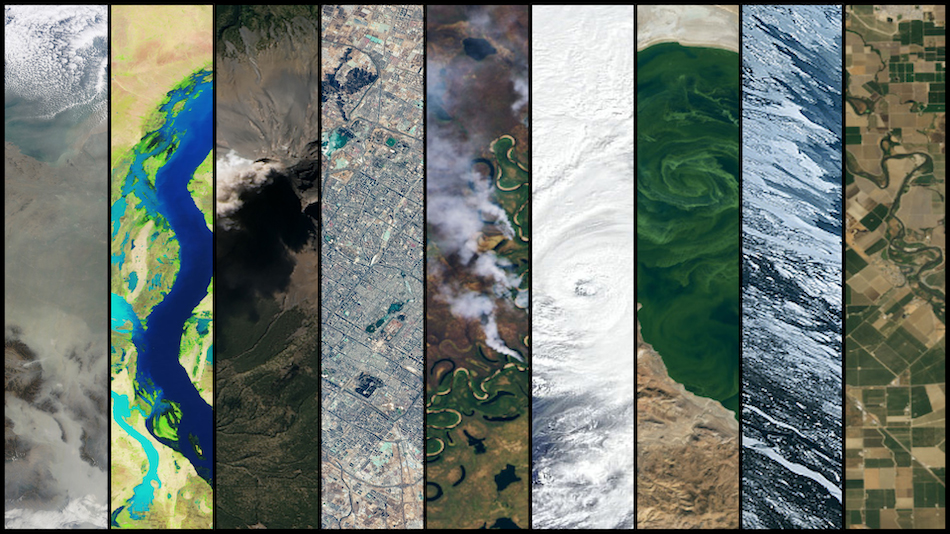
Agencies' needs span nine thematic areas (atmospheric composition, carbon cycle and ecosystems, disaster response, earth surface and interior, infrastructure, land cover and land use change, ocean and cryosphere, water and energy cycle, weather and atmospheric dynamics), and the graphic above represents the breadth of applications that SNWG solutions support. Credit: graphic created using NASA Earth Observatory imagery

Every two years, the SNWG surveys federal agencies to identify what Earth observation data they need to fulfill their mission. Survey responses are evaluated by the science agencies of the U.S. Government (NASA; the National Oceanic and Atmospheric Administration (NOAA); and the United States Geological Survey (USGS)) to understand agency needs, discern gaps in the current Earth Observation (EO) program of record, and recommend potential solutions. Solutions that are estimated to significantly increase satisfaction of multiple U.S. agencies are then selected to be proposed for funding and implementation. 

The SNWG effort is unique in that it fosters interactions between NASA and over 25 other agencies, capturing high-priority data needs across the federal government and connections across multiple agencies to formulate impactful solutions.

SNWG Solutions

SNWG solutions are unique in the diversity of size, scale, and scope compared to other activities implemented by NASA and other agencies. They often involve blending data from multiple satellites to create a single product that can be used directly by decision-makers, allowing agency needs to be met without depending on a single mission. They could also enable the scaling or operationalization of data products from a single mission that otherwise could not have happened. Some solutions also aim to make NASA data more actionable, such as improving data frequency or latency, or identifying and providing more accessible data formats. 

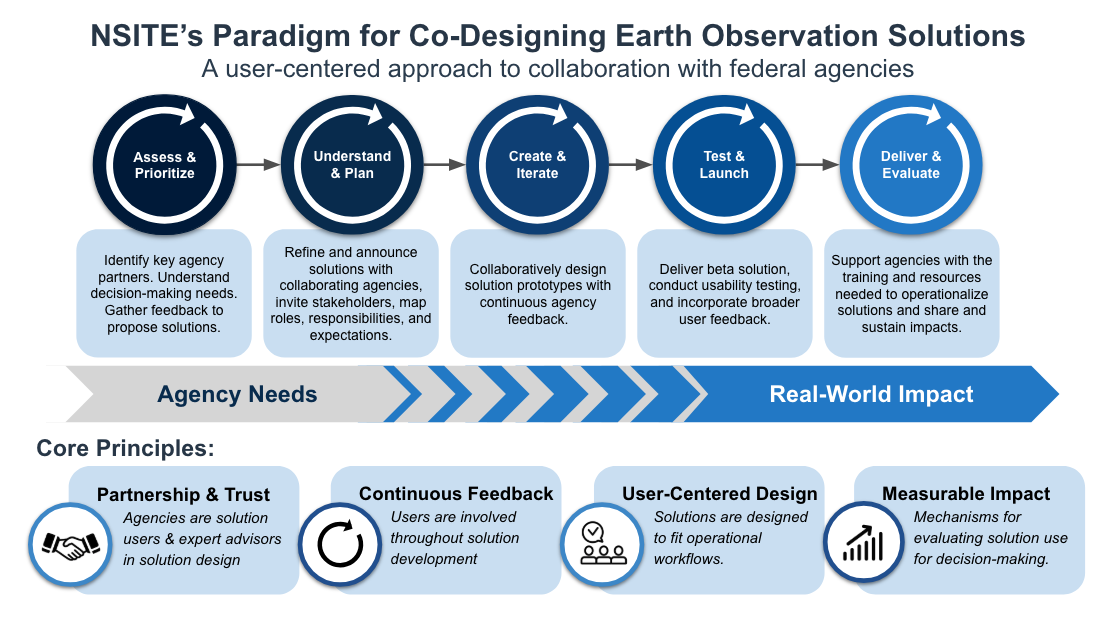
To achieve meaningful impact, solutions are co-designed with end users, a process that includes understanding agency partners and how they use Earth observations, testing and iterating on solutions with end users as the solution is developed, and evaluating solutions together with end users. This fosters easier integration into agencies' existing workflows and ensures that NSITE develops user-centric solutions that assist in targeted decision-making applications for federal agencies.

Image
Image Caption

NSITE's co-design paradigm illustrates a user-centered approach for collaborating with federal agencies on the development of SNWG solutions.

NSITE is currently implementing 30 solutions to help meet federal agency needs and challenges using existing Earth observation data and missions. While these solutions are designed for federal agencies, they are openly accessible to the broader community for use in other applications as well. Visit the SNWG solutions resource for a full list of solutions being implemented, including a description, current status, and relevant links. Browse the SNWG Earthdata Search Portal to access SNWG solution data.

Learn More

To learn more about SNWG solutions, visit the NSITE News and Learn resources to access recent announcements, articles demonstrating SNWG solutions in action, and tutorials for SNWG solutions.