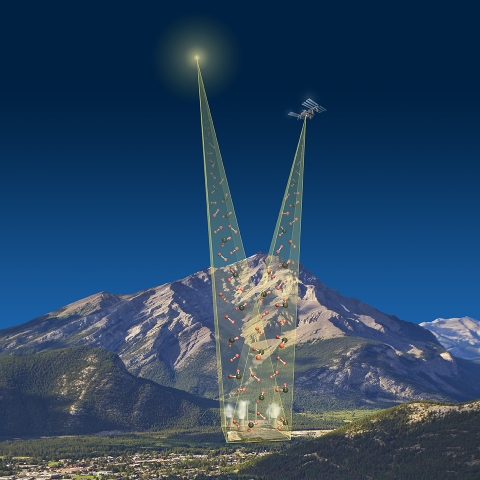
The Orbiting Carbon Observatory-3 (OCO-3) platform aboard the International Space Station carries a single instrument consisting of three high-resolution grating spectrometers, which measure properties of light within the electromagnetic spectrum. The grating separates incoming sunlight into a spectrum of multiple component colors. The instrument measures the intensity of three relatively small wavelength bands—weak carbon dioxide (CO2), strong CO2, and oxygen (O2). Each wavelength band is specific to one of the three spectrometers. The absorption levels indicate the presence of the different gases.
The OCO-3 instrument measures sunlight reflected off Earth's surface. The light entering the instrument passes through the atmosphere twice—once as sunlight travels from the Sun to Earth, and then again as the rays bounce off Earth's surface and return to the OCO-3 instrument. Carbon dioxide and molecular oxygen molecules in the atmosphere absorb light energy at very specific colors or wavelengths.