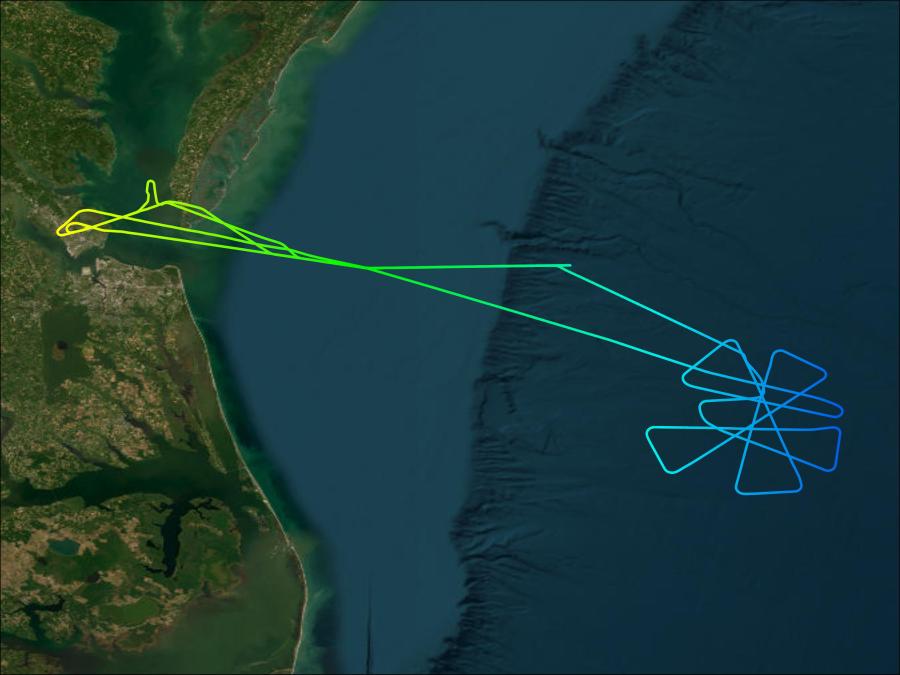
Image of flight path during the ACTIVATE field campaign off the eastern coast of Virginia.
This is an image of ACTIVATE flight tracks during the deployment to Bermuda. They have a white-to-blue color ramp stemming from the island of Bermuda.
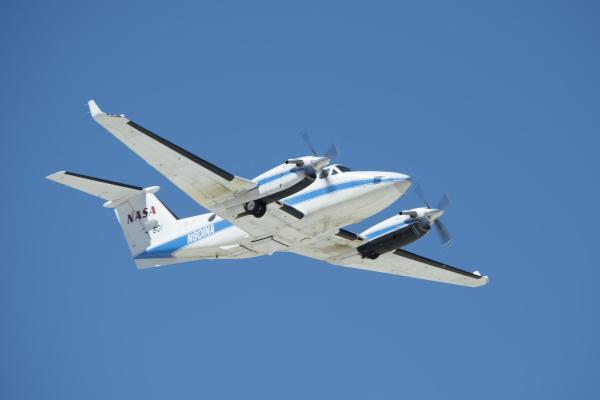
The NASA Beechcraft B200 King Air aircraft in flight

ACTIVATE

The Aerosol Cloud meTeorology INteractions oVer the western Atlantic Experiment

Principal Investigator

Armin Sorooshian

Data Centers

ASDC

Funding Programs

NASA Earth Venture Suborbital-3 (EVS-3)

The Aerosol Cloud meTeorology INteractions oVer the western Atlantic Experiment (ACTIVATE) provides knowledge on the relationships between aerosols and clouds to expand understanding of different cloud properties and their impact on climate and weather. 

Throughout the campaign, two aircraft were deployed: the King Air, and the HU-25 Falcon to conduct "statistical surveys" over the northwestern Atlantic Ocean. The King Air was equipped with remote sensing instrumentation and dropsondes, while the HU-25 was equipped with an in-situ payload for measurements of aerosol, cloud properties, trace gases, and meteorological parameters. 

The dual aircraft approach allowed for more comprehensive characterization of aerosol and cloud properties in a single atmospheric column at the same time. Both aircraft operated on the same flight path but flew at different altitudes. The King Air flew at ~9km, and the HU-25 flew in the lower troposphere (<3km) where boundary layer clouds evolve. ACTIVATE was a six-deployment Earth Venture Suborbital-3 (EVS-3) mission with the final half of the sixth deployment based out of L.F. Wade International Airport, located in St. George's Parish Bermuda.

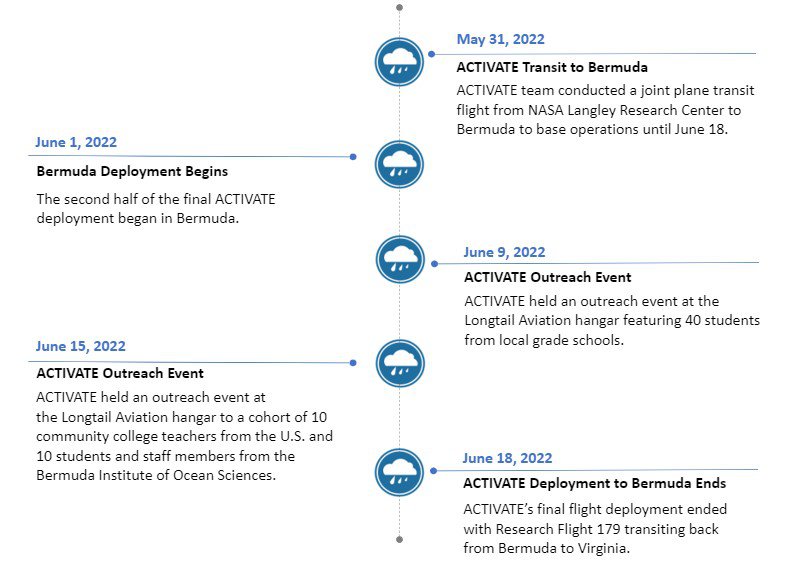
To make up for not flying there early in the campaign, the ACTIVATE team conducted a joint plane transit on 31 May 2022 from NASA’s Langley Research Center to L.F. Wade International Airport to conduct science flights farther out over the Atlantic Ocean. Deploying out of Bermuda allowed ACTIVATE researchers to take measurements that were less affected by emissions from East Coast cities and the differences in sea surface temperatures caused by the Gulf Stream. 

The first series of flights conducted through Sunday, June 5, 2022, helped obtain statistics of atmospheric conditions around Bermuda. Many of the local Bermuda flights ended with a spiral sounding offshore the Tudor Hill facility which allowed for the aircraft to obtain vertical data for trace gases, aerosol, and weather parameters that complement extensive surface monitoring work. This surface monitor work was conducted in coordination with the NSF-funded BLEACH project focusing on halogen chemistry.

During the second week of flights, there was evidence of African dust in the region that the aircraft sampled. On June 9, 2022, the ACTIVATE team hosted a successful outreach event at the Longtail Aviation hangar featuring 40 students from three local grade schools, in addition to 6 students and staff from the Bermuda Institute of Ocean Sciences, staff from the Bermuda Civil Aviation Authority, and the US Consular General. 

As part of the event, ACTIVATE team members gave tours of both aircraft and talked to the guests and students about the science instrumentation and goals of the mission. Outreach has been an integral part of ACTIVATE, and this event was a unique opportunity to engage with students and get them inspired about science. Due to the success of this event, a second outreach event was conducted in the same hangar on June 15, 2022 with a cohort of U.S. community college teachers.

During the last week of the Bermuda deployment, several flights continued to build on the dataset for aerosol-cloud-meteorology interactions surrounding the Bermuda area. One highlight was a joint research flight synchronized with a CALIPSO overpass in conditions that were ideal for intercomparisons of data, including cloud-free air with significant aerosol concentrations and diverse aerosol types (including African dust). The ACTIVATE deployment concluded June 18, 2022, with Research Flight 179 returning to Virginia from Bermuda, and now the ACTIVATE team is focusing on analysis of the full three years of archived data.
A total of 150 coordinated flights over the western North Atlantic occurred through 6 deployments from 2020-2022. The ACTIVATE science observing strategy targeted the shallow cumulus cloud regime and collected sufficient statistics over a broad range of aerosol and weather conditions which enabled robust characterization of aerosol-cloud-meteorology interactions. This strategy was implemented by two nominal flight patterns: Statistical Survey and Process Study. The statistical survey pattern involved close coordination between the remote sensing and in-situ aircraft to conduct near coincident sampling at and below cloud base as well as above and within cloud top. The process study pattern involved extensive vertical profiling to characterize the target cloud and surrounding aerosol and meteorological conditions.

The ACTIVATE campaign seeks to:

  1. Quantify relationships between number concentrations of aerosols (Na), cloud condensation nuclei (CCN), and cloud droplets (Nd) and reduce uncertainty in model cloud droplet activation parameterizations.
  2. Expand process-level understanding and model representation of factors controlling cloud properties and their relationships with cloud effects on aerosol.
  3. Improve remote sensing capabilities in the retrieval of aerosol and cloud properties that related to aerosol-cloud interactions.

ACTIVATE scientists collected data using a variety of platforms, including airborne, mobile, and ground-based. These measurements collected with the instruments on the platforms were used in conjunction with various satellite data. The following table goes briefly into the instruments and payloads used in ACTIVATE:

PlatformsInstruments
Beechcraft B-200 King AirResearch Scanning Polarimeter (RSP)
High Spectral Resolution Lidar 2 (HSRL-2)
Dropsondes
Generic-Atmospheric State (Gen-AtmsState)
Pitot-Static System
Pressure Transducers
Dassault HU-25A Guardian (Falcon)Rosemount Temperature Probe
Cloud Droplet Probe (CDP)
Pyranometer
2B Technologies Ozone Monitor
laser Aerosol Spectrometer (LAS)
Gen-AtmsState
Turbulent Air Motion Measurement System (TAMMS)
Scanning Mobility Particle Sizer (SMPS)
Particle Into Liquid Sampler (PILS)
Picarro Gas Analyzer
Condensation Particle Counter (CPC)
2D-Stereo Particle Probe (2D-S)
Condensation Nuclei Counter (CNC)
Diode Laser Hygrometer (DLH)
Frost Point Hygrometer (FPH)
Cloud Imaging Probe (CIP)
Fast Clous Droplet Probe (FCDP)
Nephelometer
Particle SOOT Absorption Photometer (PSAP)
Cloud and Aerosol Spectrometer (CAS)
Langley Aerosol Research Group Experiment (LARGE)
Axial Cycle Cloud-water Collector (AC3)
Aerosol Mass Spectrometer (AMS)
Applanix POSAV
Cavity Ring-Down Spectroscopy (CRDS)

The following image illustrates events of interest from ACTIVATE's deployment to Bermuda.

Image
Image Caption

Caption: TK Credit: TK