Composite image of the city lights of the United States at night.
nighttime lights
Black Marble Nighttime At Sensor Radiance (Day/Night Band) Image Europe and North Africa

Black Marble

NASA’s Black Marble nighttime lights product suite is derived from the Visible Infrared Imaging Radiometry Suite (VIIRS), which is hosted on three satellite platforms: Suomi NPP (launched October 2011), NOAA-20 (launched in November 2017), and NOAA-21 (launched November 2022). The Black Marble product utilizes the VIIRS Day/Night Band (DNB), a specialized sensor with variable gain settings designed to capture low-light imagery of Earth at night.

The Black Marble products (VNP46, VJ146, and VJ246) provide a long-term record of global nighttime light composites at daily, monthly, and yearly temporal resolutions. These science-quality products are provided in near real-time (NRT), within a three-hour window, and enable insights on human activity patterns such as light pollution, illegal fishing, and the flaring of waste natural gas, as well as to the provision of assessments within conflict areas and for national security.


Principal Investigator

Zhuosen Wang, University of Maryland, NASA Goddard Space Flight Center

Data Centers

LAADS DAAC
Remote video URL

How Are the Data Created?

The Black Marble team harnesses current and emerging technologies to generate novel, high-quality datasets. Complex algorithms correct for atmospheric, terrain, lunar bidirectional reflectance distribution function (BRDF), and stray light effects to generate an Earth surface radiance measure of the field of view. These corrected nighttime radiances allow for superior retrieval of nighttime lights at short time scales and a reduction in background noise, thus enabling data users to conduct quantitative analyses of daily, seasonal, and annual variations in surface radiance.

These highly reliable metrics, delivered in near-real time, provide decision makers high confidence in determining actions during operational activities across such as wildfire management, energy infrastructure, disasters, and clandestine activities (e.g. illegal fishing).

Data are available through NASA’s open science policy and are provided in standard Hierarchical Data Format–Earth Observing System 5 (HDF-EOS5) format. Currently, the VNP46 products from Suomi NPP are available from January 19, 2012, to present; VJ146 products from NOAA-20 (JPSS-1) are available from January 5, 2018, to present; and VJ246 products from NOAA-21 (JPSS-2) are in development.

As of August 25, 2025, VNP and VJ1 are Collection 2. Collection 1 processing has been terminated.

This GIF from Black Marble shows how the nighttime lights data is captured.

Black Marble data is generated from measurements taken by VIIRS, hosted aboard Suomi NPP, NOAA-20, and NOAA-21 as well as two forthcoming polar orbiting satellites: NOAA-22 and NOAA-23.

VIIRS serves as the Moderate Resolution Imaging Spectroradiometer (MODIS) continuity instrument and consists of 22 spectral bands from the ultraviolet to the mid-infrared. New to VIIRS is the panchromatic day-night-band (DNB). The DNB has a spectral wavelength range of 0.5 and 0.9 micrometers, centered at 0.705 and a spatial resolution of 750 m. The detector uses a multiple gain stage configuration to capture low levels of light emitted from the Earth at night. See detailed design specs for VIIRS.

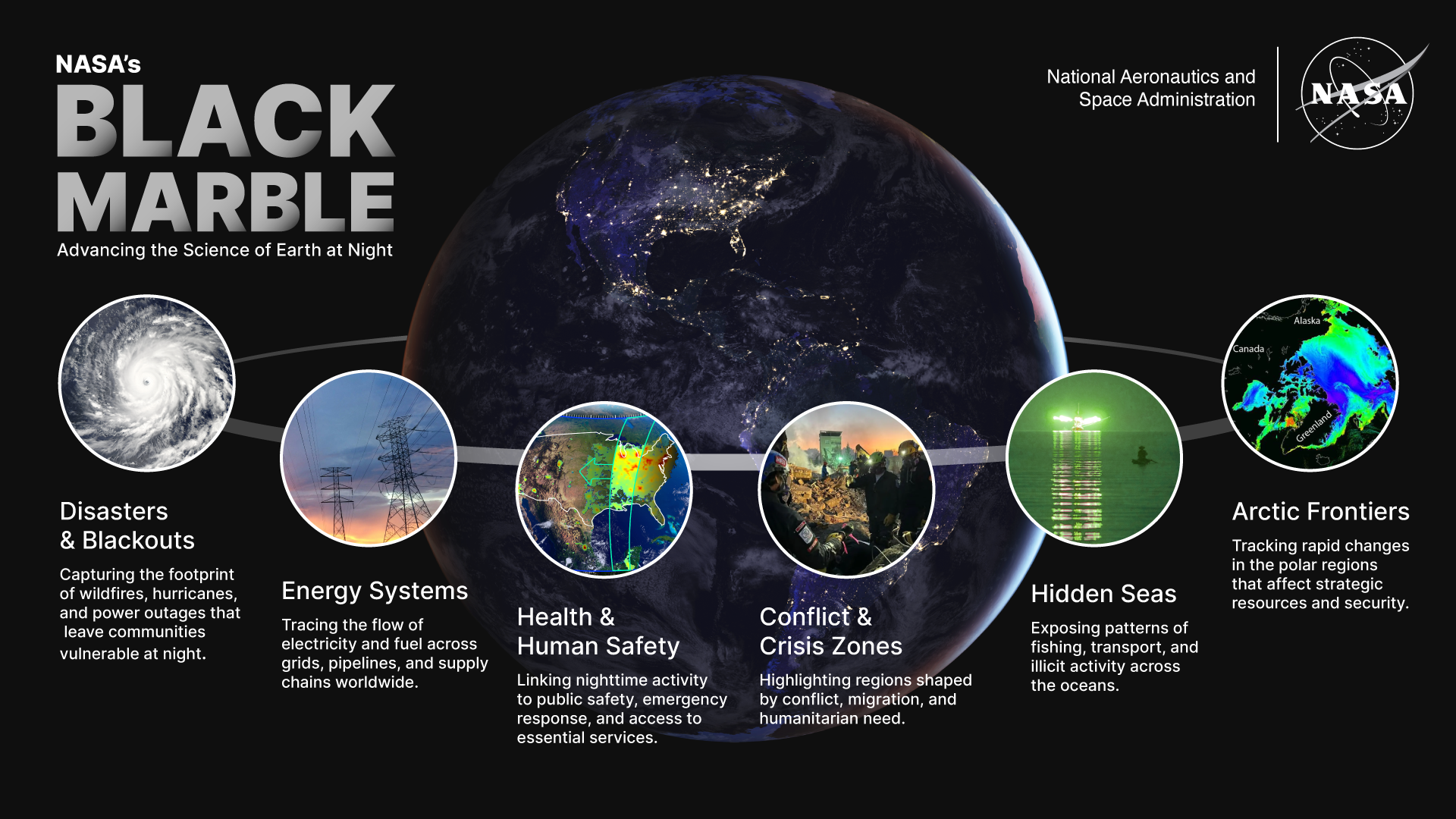
NASA’s Black Marble enables a wide range of applications for a broad spectrum of data users. Along with their primary purpose of supporting the short-term weather prediction and disaster response communities, the data also contribute to new methods for tracking wildfires, waste natural gas flares, and light pollution, along with numerous socioeconomic uses, including proxy economic activity, monitoring changes in energy infrastructure in urban areas, and providing data to humanitarian organizations in conflict areas. 

A wide variety of sources contribute to the nighttime environment, including city lights, lightning, fishing fleet navigation lights, gas flares, lava flows, and even auroras. When partial to full illumination from the moon is available, reflection of this lunar illumination off ice, snow, and other highly reflective surfaces enables the study of ocean and terrestrial features.

Image
Image Caption

Caption TK. Credit: NASA