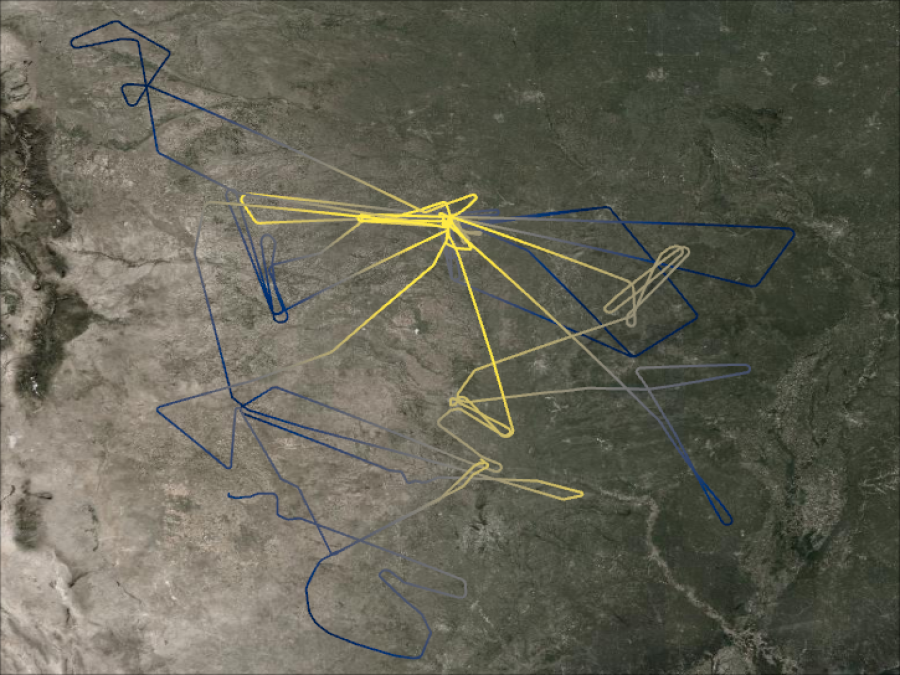
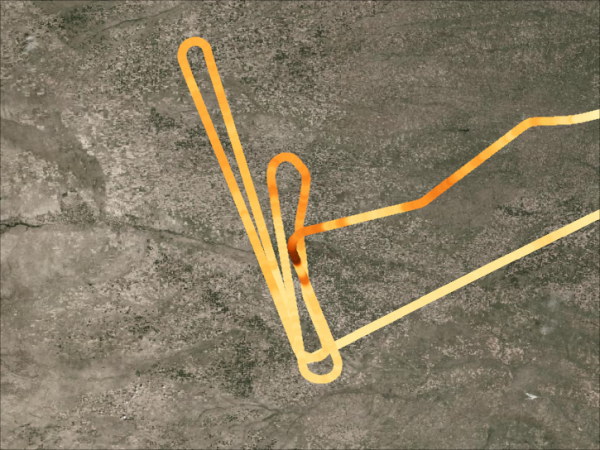
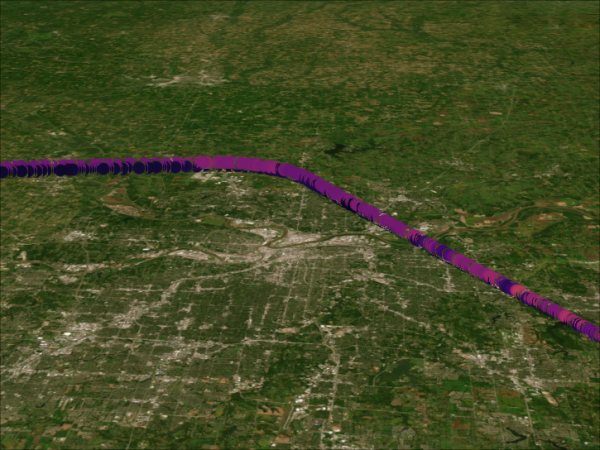
DC3 Flightpaths
DC3 Ozone Data
NO Data from DC3 above Kansas City

DC3

Deep Convective Clouds and Chemistry Project

Data Centers

ASDC

The Deep Convective Clouds and Chemistry (DC3) field campaign sought to understand the dynamical, physical, and lightning processes of deep, mid-latitude continental convective clouds and to define the impact of these clouds on upper tropospheric composition and chemistry. 

DC3 was conducted from May to June 2012 with a base location of Salina, Kansas. Observations were conducted in northeastern Colorado, west Texas to central Oklahoma, and northern Alabama in order to provide a wide geographic sample of storm types and boundary layer compositions, as well as to sample convection.

DC3 had two primary science objectives. The first was to investigate storm dynamics and physics, lightning and its production of nitrogen oxides, cloud hydrometeor effects on wet deposition of species, surface emission variability, and chemistry in anvil clouds. Observations related to this objective focused on the early stages of active convection. The second objective was to investigate changes in upper tropospheric chemistry and composition after active convection. Observations related to this objective focused on the 12-48 hours following convection. This objective also served to explore seasonal change of upper tropospheric chemistry.

In addition to using the NSF/NCAR Gulfstream-V (GV) aircraft, the NASA DC-8 was used during DC3 to provide in-situ measurements of the convective storm inflow and remotely-sensed measurements used for flight planning and column characterization. DC3 utilized ground-based radar networks spread across its observation area to measure the physical and kinematic characteristics of storms. 

Additional sampling strategies relied on lightning mapping arrays, radiosondes, and precipitation collection. Lastly, DC3 used data collected from various satellite instruments to achieve its goals, focusing on measurements from CALIOP onboard CALIPSO and CPL onboard CloudSat.

In addition to providing an extensive set of data related to deep, mid-latitude continental convective clouds and analyzing their impacts on upper tropospheric composition and chemistry, DC3 improved models used to predict convective transport. DC3 improved knowledge of convection and chemistry, and provided information necessary to understanding the processes relating to ozone in the upper troposphere.

DC3 field campaign data available at ASDC includes data collected onboard the DC-8 aircraft.

DC3 Project Page

  • Investigate storm dynamics and physics, lightning and its production of nitrogen oxides, cloud hydrometeor effects on wet deposition of species, surface emission variability, and chemistry in anvil clouds
  • Investigate changes in upper tropospheric chemistry and composition after active convection
  • Explore seasonal change of upper tropospheric chemistry
PlatformsInstruments
Douglas DC-83-Wavelength Particle Soot Absorption Photometer Manufactured by Radiance Research (PSAP)
Air Pressure Sensor (AS)
TSI Condensation Particle Counter 3010 Manufactured by TSI Inc.
Scanning Mobility Particle Sizer (SMPS)
Ultra-High Sensitivity Aerosol Spectrometer (UHSAS)
LASER SPECTROMETER
AEROSOL MASS SPECTROMETER (AMS)
Single Particle Soot Photometer Manufactured by Droplet Measurement Technologies (DMT SP2)
Particle Analysis by Laser Mass Spectrometry (PALMS)
Polarized Imaging Nephelometer (PI-NEPH)
Differential Aerosol Sizing and Hygroscopicity Spectrometer Probe (DASH-SP)
Liquid Waveguide Capillary Cells (LWCC)
CCN Counter
Differential Absorption Lidar (DIAL)
2D-STEREO PARTICLE PROBE (2DS)
CCD-based Actinic Flux Spectroradiometer (CAFS)
Meteorological Measurement System (MMS)
Diode Laser Hygrometer developed by NASA LaRC (DLH)
Global Positioning System (GPS)
HYGROMETERS
PRESSURE TRANSDUCERS
HUMIDITY SENSORS
TEMPERATURE SENSORS
Solar Spectral Flux Radiometers (SSFR)
RADIOMETERS
Gas Chromatograph/Mass Spectrometry (GC-MS)
Thermal Dissociation Laser Induced Fluorescents developed by University of California, Berkley (TD-LIF)
Differential Absorption CO, CH4, N2O Measurements (DACOM)
Liquid Waveguide Capillary Cells (LWCC)
Chemical Ionization Time-of-Flight Mass Spectrometer (CIT-ToF-CIMS)
CHEMILUMINESCENCE
Proton Transfer Mass Spectrometer (PTR-MS)
Difference Frequency Generation Absorption Spectrometer developed by University of Colorado, Boulder (DFGAS)
LI-6252 Differential Mid-Infrared Absorption of CO2 Sensor Manufactured by LI-COR Biosciences (AVOCET)
NSF/NCAR Gulfstream GV HIAPERComputer
Scanning Mobility Particle Sizer (SMPS)
Ultra-High Sensitivity Aerosol Spectrometer (UHSAS)
Cloud Particle Counter (CPC)
Global Positioning System (GPS)
HYGROMETERS
Ultra-High Sensitivity Aerosol Spectrometer (UHSAS)
Cloud Particle Counter (CPC)
Vertical Cavity Surface Emitting Laser Hygrometer
Total Water Instrument: Closed-path Laser Hygrometer 2 (CLH 2)
Trace Organic Gas Analyzer (TOGA)
Cavity Ring-Down Spectroscopy (CRDS)
Compact Atmospheric Multispecies Spectrometer (CAMS)
Chemical Ionization Time-of-Flight Mass Spectrometer (CIT-ToF-CIMS)
Chemical Ionization Mass Spectrometer (IMS)
CHEMILUMINESCENCE
DLR-FalconCloud Particle Counter (CPC)
Single Particle Soot Photometer Manufactured by Droplet Measurement Technologies (DMT SP2)
Optical Plankton Counter (OPC)
Global Positioning System (GPS)
HYGROMETERS
PRESSURE SENSORS
TEMPERATURE SENSORS
HUMIDITY SENSORS
Chemical Ionization Time-of-Flight Mass Spectrometer (CIT-ToF-CIMS)
Cavity Ring-Down Spectroscopy (CRDS)
GAS SENSORS
CHEMILUMINESCENCE
OZONE SENSOR
GAS CHROMATOGRAPHS