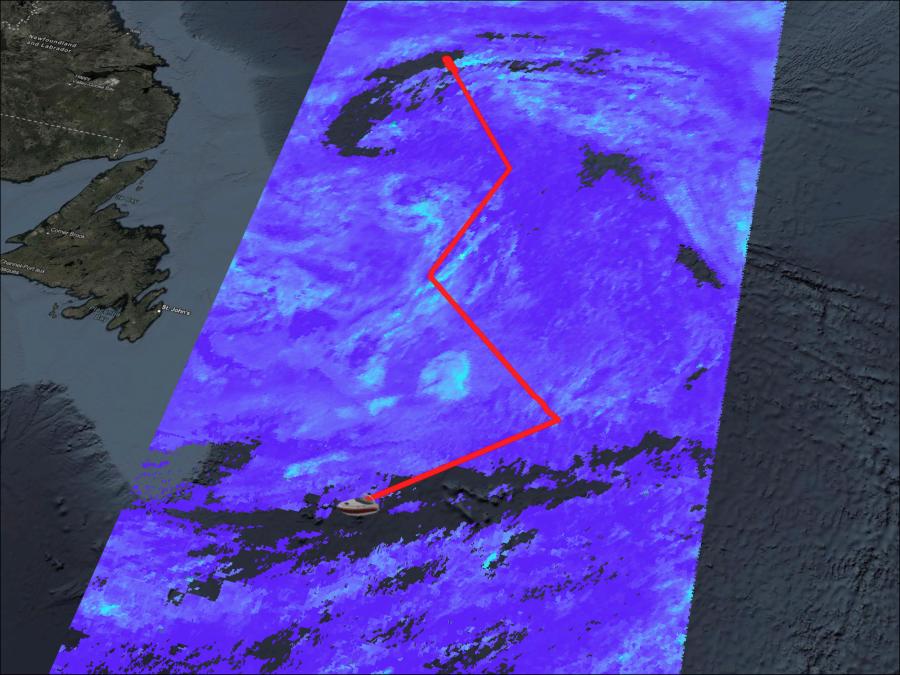
GIS Image of a ship track in red along a satellite image of cloud droplet particle count in blue and purple over satellite imagery with an image of a ship at the southern end of the ship track
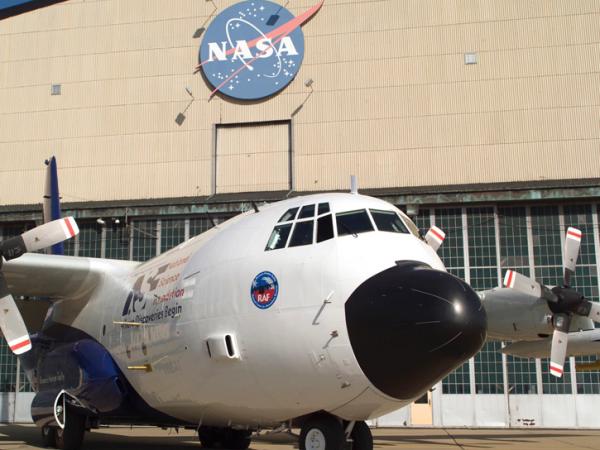
Image of the NASA/NSF C-130 aircraft on the ramp at the hangar
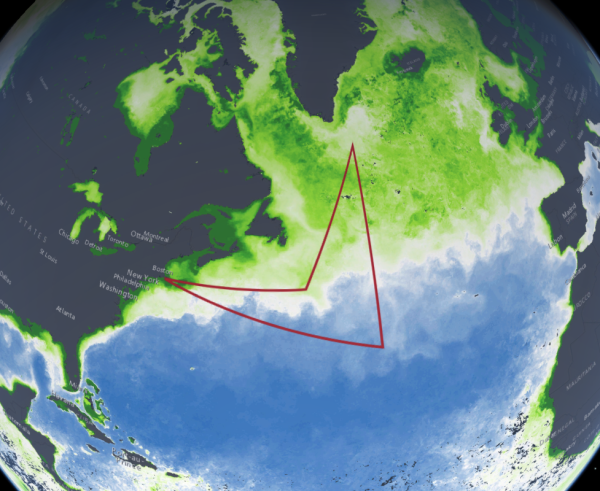
Image of a flight path from the NAAMES campaign with the green highlighting plankton blooms

NAAMES

North Atlantic Aerosols and Marine Ecosystems Study

Principal Investigator

Michael Behrenfeld

Data Centers

ASDC

Funding Programs

Earth Venture Suborbital-2 (EVS-2)

The NASA North Atlantic Aerosols and Marine Ecosystems Study (NAAMES) project was the first NASA Earth Venture – Suborbital mission focused on studying the coupled ocean ecosystem and atmosphere. 

NAAMES utilizes a combination of ship-based, airborne, autonomous sensor, and remote sensing measurements that directly link ocean ecosystem processes, emissions of ocean-generated aerosols and precursor gases, and subsequent atmospheric evolution and processing. 

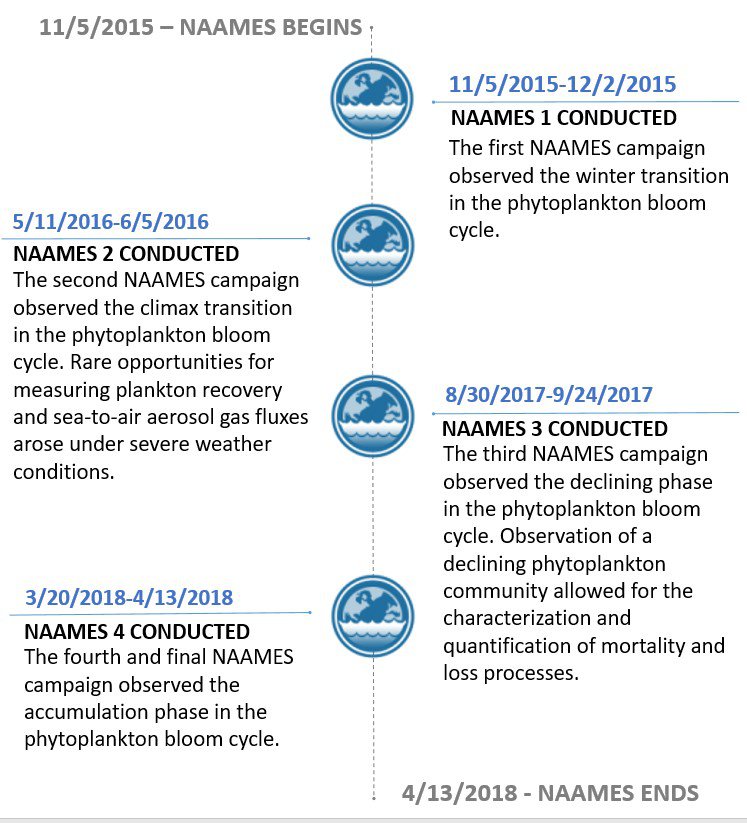
Four deployments coincide with the seasonal cycle of phytoplankton in the North Atlantic Ocean: the Winter Transition (November 5 – December 2, 2015), the Bloom Climax (May 11 – June 5, 2016), the Deceleration Phase (August 30 – September 24, 2017), and the Acceleration Phase (March 20 – April 13, 2018). Ship-based measurements were conducted from the Woods Hole Oceanographic Institution Research Vessel Atlantis in the middle of the North Atlantic Ocean, while airborne measurements were conducted on a NASA Wallops Flight Facility C-130 Hercules that was based at St. John's International Airport, Newfoundland, Canada. 

Data products in the ASDC archive focus on the NAAMES atmospheric aerosol, cloud, and trace gas data from the ship and aircraft, as well as related satellite and model data subsets. While a few ocean-remote sensing data products (e.g., from the high-spectral resolution lidar) are also included in the ASDC archive, most ocean data products reside in a companion archive at SeaBass.
The following objectives span across all four deployments:
Winter Transition: November 5 - December 2, 2015
Bloom Climax: May 11 - June 5, 2016
Deceleration Phase: August 30 - September 24, 2017
Acceleration Phase: March 20 - April 13, 2018

  • Define key processes impacting phytoplankton communities to understand their structure and function.
  • Define interactions between ocean ecosystems and biogenic aerosols to understand marine aerosol-cloud-climate interactions. 
PlatformInstruments
C-130 Hercules3-Wavelength Particle Soot Absorption Photometer Manufactured by Radiance Research (PSAP)
Aerosol Mass Spectrometer (AMS)
Aerodynamic Particle Sizer (APS)
Cloud Condensation Nuclei Counter (CCN)
Laser Spectrometer
TSI-3563 Nephelometer
Scanning Mobility Particle Sizer (SMPS)
Single Particle Soot Photometer Manufactured by Droplet Measurement Technologies (DMT SP2)
Ultra-High Sensitivity Aerosol Spectrometer Manufactured by Droplet Measurement Technologies (DMT UHSAS)
Research Scanning Polarimeter (RSP)
Spectrometers for Sky-Scanning, Sun-Tracking Atmospheric Research (4STAR)
High Spectral Resolution Lidar (HSRL)
Cloud Droplet Probe (CDP)
Cloud Imaging Probe (CIP)
Hygrometers
Pitot-Static System
Geostationary Coastal and Air Pollution Event (GEO-CAPE) Airborne Simulator (GCAS)
Los Gatos Research CO/CO2/H2O Analyzer (LGR)
Proton Transfer Mass Spectrometer (PTR-MS)
Research Vessel (R/V) AtlantisMass Spectrometers
Ion Chromatographs
TSI Condensation Particle Counter 3010 Manufactured by TSI Inc. (TSI CPC-3010)
TSI Condensation Particle Counter 3025 Manufactured by TSI Inc. (TSI CPC-3025)
Cloud Condensation Nuclei Counter (CCN)
3-Wavelength Particle Soot Absorption Photometer Manufactured by Radiance Research (PSAP)
TSI-3563 Nephelometer
Aerodynamic Particle Sizer (APS)
Cloud Particle Counter (CPC)
Fourier Transform Infrared Spectrometer
Optical Sensor (OPS)
Single Particle Soot Photometer Manufactured by Droplet Measurement Technologies (DMT SP2)
Aerosol Mass Spectrometer (AMS)
Thermosalinographs
Ozone and Carbon Sensors
BalloonsRadiosondes
Image

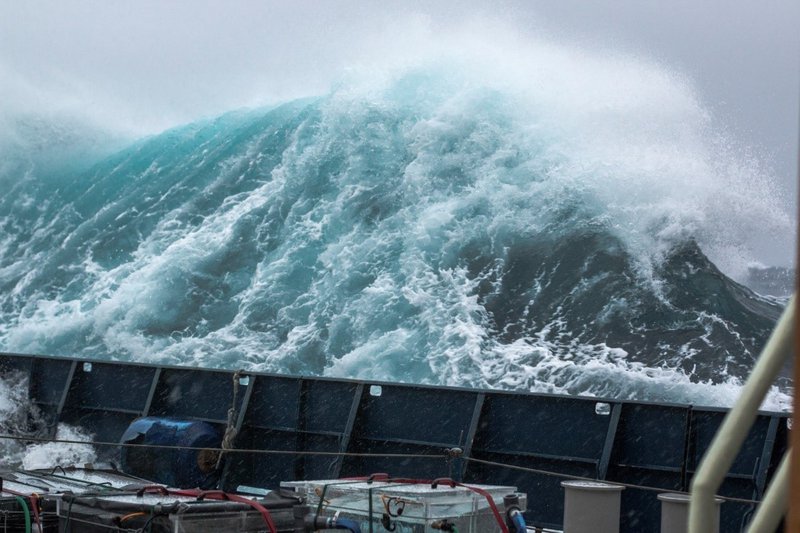
After mostly favorable weather conditions through the second field campaign of the North Atlantic Aerosols and Marine Ecosystems Study (NAAMES), an extreme weather system on May 30, 2016 provided a unique opportunity for scientists to measure atmospheric phenomena at sea. The high wind speeds and large waves – in some cases up to 30 feet – prevented those aboard the Research Vessel Atlantis (R/V Atlantis) from accessing the deck of the ship. Some instruments on the deck of the R/V Atlantis were damaged, shifted, or lost during the storm. Despite posing hazardous conditions, the storm provided researchers with a unique opportunity to enhance their research by measuring sea-to-air aerosol gas fluxes in a severe weather event. The measurement of sea-to-air aerosol gas fluxes quantifies aerosols as they move from the ocean into the air, and these aerosol gas fluxes can be impacted by environmental disturbances such as a severe weather event. Aerosols play an important role in cloud formation in marine environments. Understanding the forces that form marine aerosols may inform future hypotheses and/or conclusions about the interactions between the ocean and atmosphere.

Image
Image Caption

The storm produced strong waves similar to this one, which were sometimes up to thirty feet. Photo Credits: NASA/Christien Laber

The NAAMES campaign challenged competing views surrounding the seasonality of the phytoplankton bloom cycle. The data collected from the NAAMES campaign helped characterize the temporal patterns of phytoplankton blooms in the North Atlantic region in the exploration of these competing views. During NAAMES, scientists were able to observe the disturbance recovery hypothesis, when a phytoplankton population accumulated in response to population loss resulting from a severe weather system. Additionally, scientists collected important measurements of sea-to-air aerosol gas fluxes in another severe weather event. NAAMES has led to new research in the application of satellite data in oceanography. The vast and unique dataset of NAAMES continues to be explored and NAAMES-related publications appear rapidly in the scientific community.