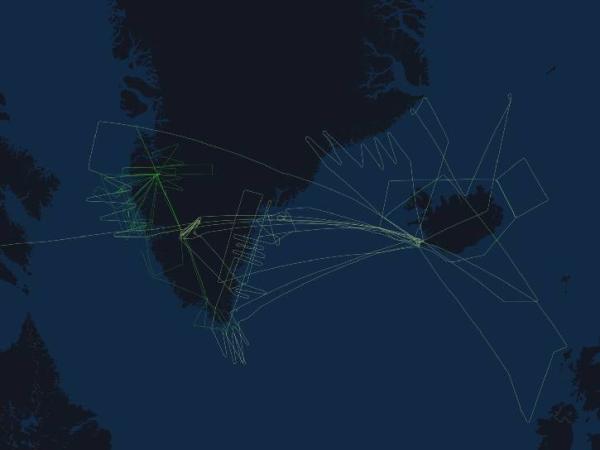
Beginning in the fall of 2014, NASA sponsored the Polar Winds airborne campaigns, which were designed to fly the Doppler Aerosol WiNd (DAWN) lidar and other instruments to take airborne wind measurements of the Arctic atmosphere, specifically over and off the coasts of Greenland. The primary objective of the Polar Winds campaigns were to take airborne wind and aerosol measurements of the Arctic atmosphere and Planetary Boundary Layer (PBL).
Polar Winds conducted a series of science flights focusing on the measurement and analyses of lower tropospheric winds and aerosols associated with coastal katabatic flows, barrier winds, the Greenland Tip Jet, boundary layer circulations such as rolls and OLEs (Organized Large Eddies), and near surface winds over open water, transitional ice zones and the Greenland Ice Cap. Polar Winds also focused on satellite calibration and validation (cal/val) by conducting underflights of existing remote sensing instruments, along with practicing underflying the future Aeolus Airborne Demonstrator for the Direct-Detection Doppler Wind Lidar (ALADIN) that was launched on 22 August 2018.
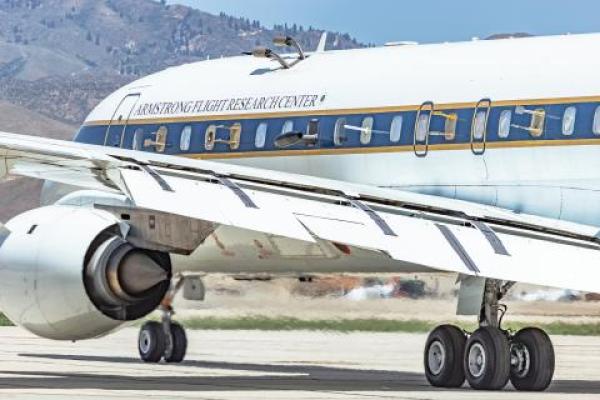
Polar Winds II was based in Keflavik, Iceland and utilized the NASA DC-8 aircraft to fly DAWN and the Yankee Environmental Services (YES) High Definition Sounding System (HDSS)/eXpendable Digital Dropsondes (XDD) over the Arctic from May 11-25, 2015. Almost 100 dropsondes were launched during the campaign. Comparisons between the dropsondes and wind profiles collected by DAWN showed very good agreement and low bias. During Polar Winds II, NASA flew seven flights in coordination with the German Aerospace Research Establishment Deutsches Zentrum für Luftund Raumfahrt (DLR) Falcon aircraft. The DLR aircraft was equipped with a coherent detection airborne wind lidar and a direct detection wind lidar that was an Aeolus simulator. Ten science flights were completed by the DC-8, four of which were conducted to support Aeolus cal/val.
After Polar Winds II, DAWN was modified to help improve the sensitivity of the instrument as it faced backscatter sensitivity issues, particularly in low aerosol conditions. The improved DAWN instrument was later flown during other NASA field campaigns.