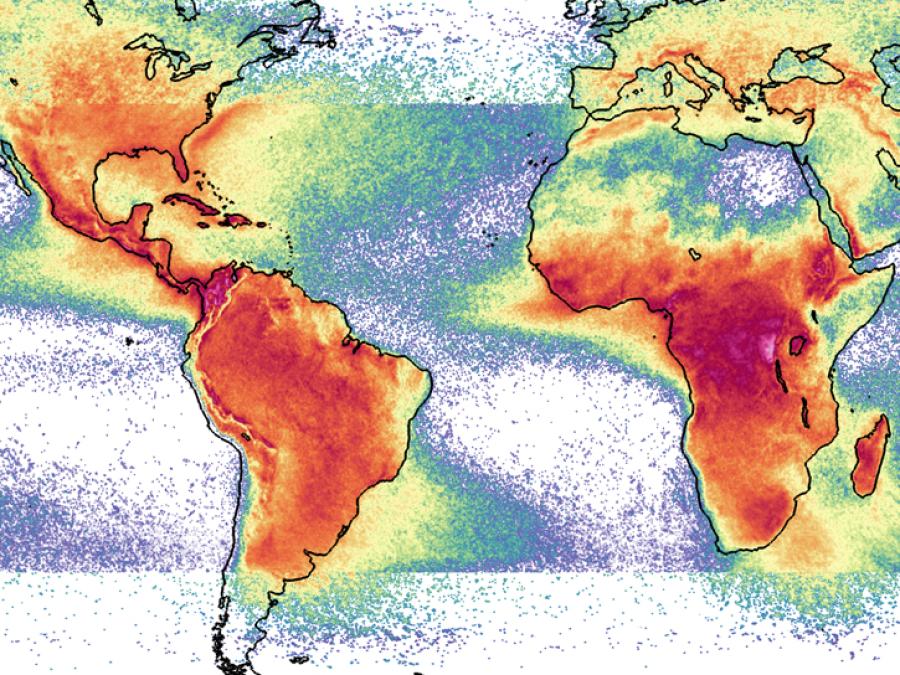
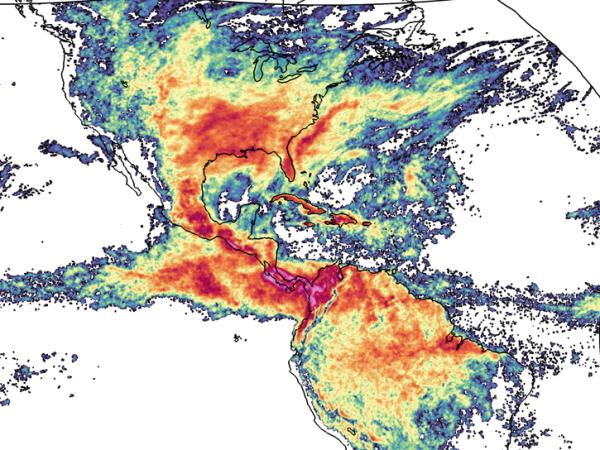
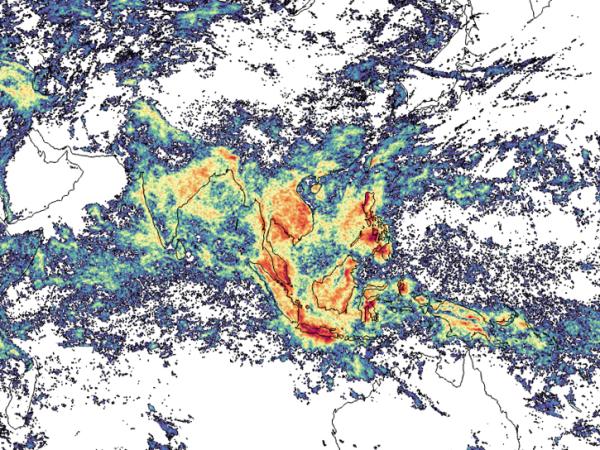
This WMO program aims to create a core set of global observations that enables the study of long term weather patterns and trends. To do so, these essential variables need to provide global observations, be well understood and available to the user community (both public and commercial), and have a sufficient period of record (typically at least 30 years).
Lightning observations have achieved all three of these goals. For this reason, lightning became one of the 55 essential variables in 2018. Lightning has long been recognized as a diagnostic for thunderstorm intensity, which is impacted by large-scale atmospheric patterns. Lightning serves as a diagnostic metric of global “storminess,” with the state of convection being otherwise hard to capture worldwide due to a lack of observations, particularly over the oceans.
This project uses “thunder hours” in order to create a global dataset from the varied lightning detection systems. Many of the limitations in lightning detection — from uneven sampling from the location of ground sensors to coverage issues from satellites — mostly impact how these networks detect individual lightning flashes. When the question becomes “Has lightning occurred over a particular hour in a particular grid?” the individual lightning instruments work very effectively to create a homogenous dataset that can be used interchangeably between observation platforms.
The thunder hour serves as an effective measure of global “storminess” to help monitor global convection. It is calculated by dividing the globe into a 0.05 degree latitude by 0.05 degree longitude grid. Every grid point that had at least two lightning pulses in an hour within 15 km of the grid point was set to “true” for having detected lightning. Therefore, the product can show how many hours per month lightning occurred.