
During 1983-2001, NASA conducted a collection of field campaigns as part of the Global Tropospheric Experiment (GTE) to quantify atmospheric trace gases’ sources, sinks, and distribution. Among those were the Transport and Atmospheric Chemistry near the Equator (TRACE) campaigns, which included two missions: TRACE-Atlantic (TRACE-A) and TRACE-Pacific (TRACE-P).
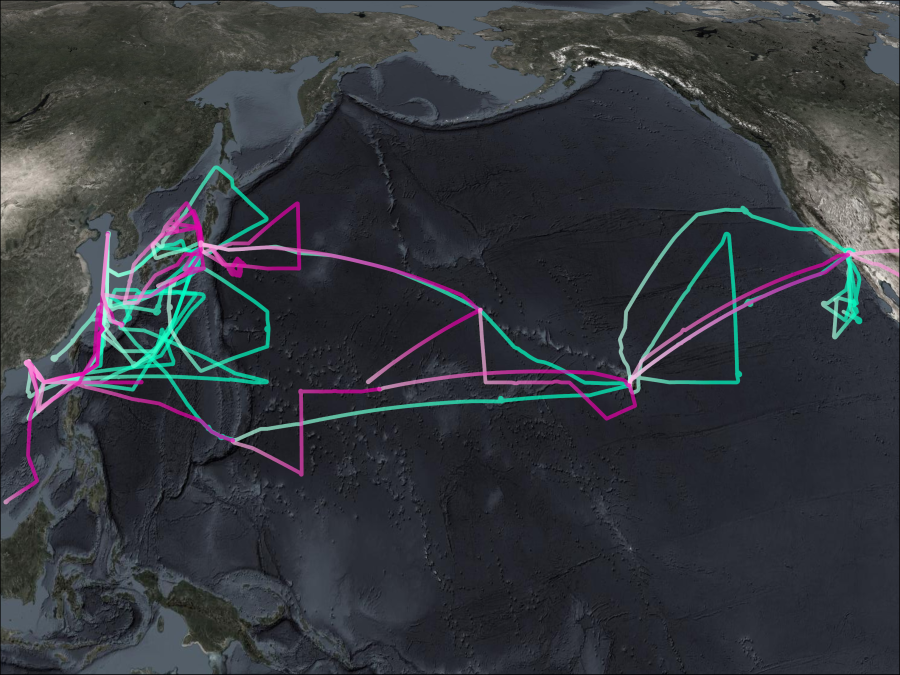
TRACE-P was conducted from February to April 2001 over the northwestern Pacific, which coincides with the strongest Asian outflow and southeast Asia biomass burning season. The primary goal of TRACE-P was to expand upon the work done by the Pacific Exploratory Mission-West (PEM-West) campaign in providing a quantitative understanding of the outflow, its origin, and its evolution.
To accomplish its objectives, the TRACE-P science team deployed the high-altitude NASA DC-8 and the low-altitude P-3B aircraft operating out of Hong Kong and Yokota Air Force Base near Tokyo, Japan. Deploying both aircraft allowed for maximum geographical coverage of Asian outflow, with the DC-8 supporting a higher ceiling (12 km), greater range, and greater payload capacity.
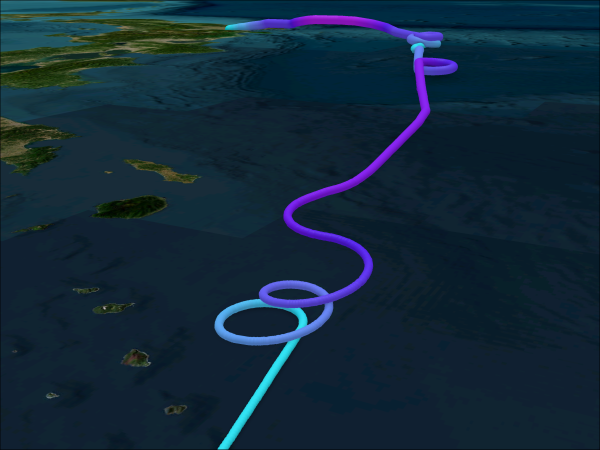
While the P-3B was the platform of choice for sampling the lower troposphere, the DC-8 also provided frequent vertical profile information down to 0.15 km. Both aircraft included in-situ measurements of ozone and aerosol precursors and oxidants, e.g., NOx, VOCs, oxygenated species, as well as greenhouse gases and tracers. The DC-8 aircraft also included a Differential Absorption Lidar (DIAL), which was used for remote sensing of ozone and aerosols by measuring peroxides, carbonyls, and other oxygenated organics. The P-3B included a more extensive payload for aerosol microphysics and a fast 3D air motion sensing system, which enabled surface flux studies.
With many overlapping measurements between the P-3B and DC-8, intercomparisons were conducted to evaluate the measurement consistency between the two aircraft. The aircraft transit flights collected data across the Pacific. Seventeen research flights were flown by the DC-8 while 21 were flown by the P-3B. Ozonesondes were also launched 1-3 times a week from ground sites to collect ancillary measurements on both sides of the Pacific. The second half of the TRACE-P mission overlapped with the Asian Pacific Regional Aerosol Characterization Experiment (ACE-ASIA), a National Science Foundation (NSF) mission with a primary focus on aerosol particles.
TRACE-P data can be utilized to evaluate the impact of many years of rapid economic development in Asia and serve as a benchmark for later suborbital missions, such as KORUS-AQ and ASIA-AQ. Detailed descriptions related to the motivation, implementation, and instrument payloads are available in the TRACE-P overview paper. A collection of the publications based on TRACE P observation are available in the Journal of Geophysical Research special issues, “NASA Global Tropospheric Experiment Transport and Chemical Evolution Over the Pacific (TRACE-P): Measurements and Analysis."