The Visible Infrared Imaging Radiometer Suite (VIIRS) flies aboard the joint NASA/NOAA Suomi National Polar-orbiting Partnership (Suomi NPP) and NOAA Joint Polar Satellite System platforms (NOAA-20 and NOAA-21). VIIRS collects visible and infrared imagery along with global observations of Earth's land, atmosphere, cryosphere, and ocean.

VIIRS extends observational records collected by similar instruments aboard previously-launched satellites, such as NASA's Moderate Resolution Imaging Spectroradiometer (MODIS) and NOAA's Advanced Very High Resolution Radiometer (AVHRR). VIIRS snow cover and sea ice algorithms are specifically designed for compatibility with MODIS snow cover and sea ice datasets, which ensures continuity between MODIS and VIIRS data products and supports comparison of snow and sea ice data over the lives of MODIS, VIIRS, and beyond to facilitate long-term climate data records.

Near Real-Time Data

Near real-time VIIRS data are available through NASA's Land, Atmosphere Near real-time Capability for Earth observation (LANCE).

VIIRS data are available at the following levels:

  • Level 0: comprises raw instrument data packets that are used to generate calibrated and geolocated Level 1 products
  • Level 1: reconstructed, unprocessed instrument data at full resolution, time-referenced, and annotated with ancillary information
  • Level 2: derived geophysical variables at the same resolution and location as Level 1 source data (swath products)
  • Level 2G: Level 2 data mapped on a uniform space-time grid scale (Sinusoidal)
  • Level 3: gridded variables in derived spatial and/or temporal resolutions
  • Level 4: model output or results from analyses of lower-level data

Several of NASA's distributed active archive centers (DAACs) archive VIIRS data, and each has its own naming conventions. Details for each DAAC are included below.

LP DAAC

VIIRS Filenames

VIIRS filenames (i.e., the local granule ID) follow a naming convention which gives useful information regarding the specific product. Product short name designations are as follows: VNP for Suomi NPP VIIRS, VJ1 for NOAA-20 VIIRS, VJ2 for NOAA-21 VIIRS, and VCD for combined Suomi NPP and NOAA-20 VIIRS.

In this example of a VNP swath product, the filename VNP14.A2026173.0742.002.2026173151111.hdf indicates:

  • VNP14 - Product Short Name
  • A2026173 - Julian Date of Acquisition (AYYYYDDD)
  • 0742 - Hours and Minutes of Acquisition (HHMM)
  • 002 - Collection Version
  • 2026173151111 - Julian Date of Production (YYYYDDDHHMMSS)
  • .hdf - Data Format (HDF-EOS)

In this example of a VJ1 tiled product, the filename VJ113A2.A2026153.h00v10.002.2026169081704.hdf indicates:

  • VJ113A2 - Product Short Name
  • A2026153 - Julian Date of Acquisition (AYYYYDDD)
  • h00v10 - Tile Identifier (horizontalXXverticalYY)
  • 002 - Collection Version
  • 2026169081704 - Julian Date of Production (YYYYDDDHHMMSS)
  • .hdf - Data Format (HDF-EOS)

In this example of a VJ2 Climate Modeling Grid (CMG) product, the filename VJ209CMG.A2026168.002.2026173010747.hdf indicates:

  • VJ209CMG - Product Short Name
  • A2026168 - Julian Date of Acquisition (AYYYYDDD)
  • 002 - Collection Version
  • 2026173010747 - Julian Date of Production (YYYYDDDHHMMSS)
  • .hdf - Data Format (HDF-EOS)

In this example of a VCD CMG product, the filename VCD19A3.A2026163.h00v08.002.2026169141645.hdf indicates:

  • VCD19A3 - Product Short Name
  • A2026163 - Julian Date of Acquisition (AYYYYDDD)
  • h00v10 - Tile Identifier (horizontalXXverticalYY)
  • 002 - Collection Version
  • 2026169141645 - Julian Date of Production (YYYYDDDHHMMSS)
  • .hdf - Data Format (HDF-EOS)

VIIRS Product Long Name

The VIIRS Product Long Name (i.e., Collection-Level) naming convention provides useful information regarding the product and indicates if the associated files for the dataset are swath, Sinusoidal tile grid, Rotated Sinusoidal Grid (RSIN), also known as Zonal Sinusoidal Projection (ZSP), or CMG. Swath products are produced in 6-minute temporal increments of satellite acquisition.

In this example of a swath dataset, all products belonging to the VIIRS/NPP Thermal Anomalies/Fire 6-Min L2 Swath 750m V002 collection have the following characteristics:

  • VIIRS/NPP - Instrument/Satellite
  • Thermal Anomalies/Fire - Geophysical Parameter
  • 6-Min - Temporal Resolution
  • L2 - Processing Level
  • Swath - Swath
  • 750m - Spatial Resolution
  • V002 - Collection Version

In this example of a Sinusoidal tiled dataset, all products belonging to the VIIRS/JPSS1 Land Aerosol Optical Thickness L2G Daily Global 1km SIN Grid V002 collection have the following characteristics:

  • VIIRS/JPSS1 - Instrument/Satellite
  • Land Aerosol Optical Thickness - Geophysical Parameter
  • L2G - Processing Level
  • Daily - Temporal Resolution
  • Global - Global Coverage
  • 1 km - Spatial Resolution
  • SIN Grid - Sinusoidal Grid
  • V002 - Collection Version

In this example of an RSIN/VSP dataset, all products belonging to the VIIRS/NPP+JPSS1 BRDF Model Parameters Daily L3 Global 750m RSIN Grid V002 collection have the following characteristics:

  • VIIRS/NPP+JPSS1 - Instrument/Satellite
  • BRDF Model Parameters - Geophysical Parameter
  • Daily - Temporal Resolution
  • L3 - Processing Level
  • Global - Global Coverage
  • 750m - Spatial Resolution
  • RSIN Grid - Rotated Sinusoidal Grid
  • V002 - Collection Version

In this example of a CMG dataset, all products belonging to the VIIRS/JPSS2 Surface Reflectance Daily L3 Global 0.05Deg CMG V002 collection have the following characteristics:

  • VIIRS/JPSS2- Instrument/Satellite
  • Surface Reflectance - Geophysical Parameter
  • Daily - Temporal Resolution
  • L3 - Processing Level
  • Global - Global Coverage
  • 0.05 Deg - Spatial Resolution
  • CMG - Climate Modeling Grid
  • V002 - Collection Version

VIIRS Sinusoidal Tile Grid

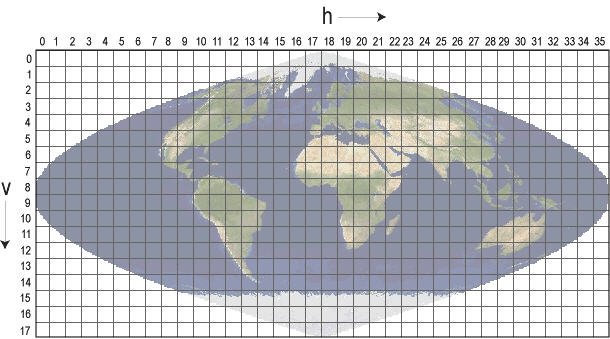
The VIIRS Sinusoidal Tile Grid that applies to most VIIRS products is the same as the MODIS Sinusoidal Tile Grid. Please see below for information about the tiling system for VIIRS MAIAC specific products.

Image

Level 2G, Level 3, and Level 4 Suomi NPP NASA VIIRS land products use this Sinusoidal grid tiling system. Tiles are 10 degrees by 10 degrees at the equator. The tile coordinate system starts at (0,0) (horizontal tile number, vertical tile number) in the upper left corner and proceeds right (horizontal) and downward (vertical). The tile in the bottom right corner is (35,17).

VIIRS Zonal Sinusoidal Projection (ZSP)

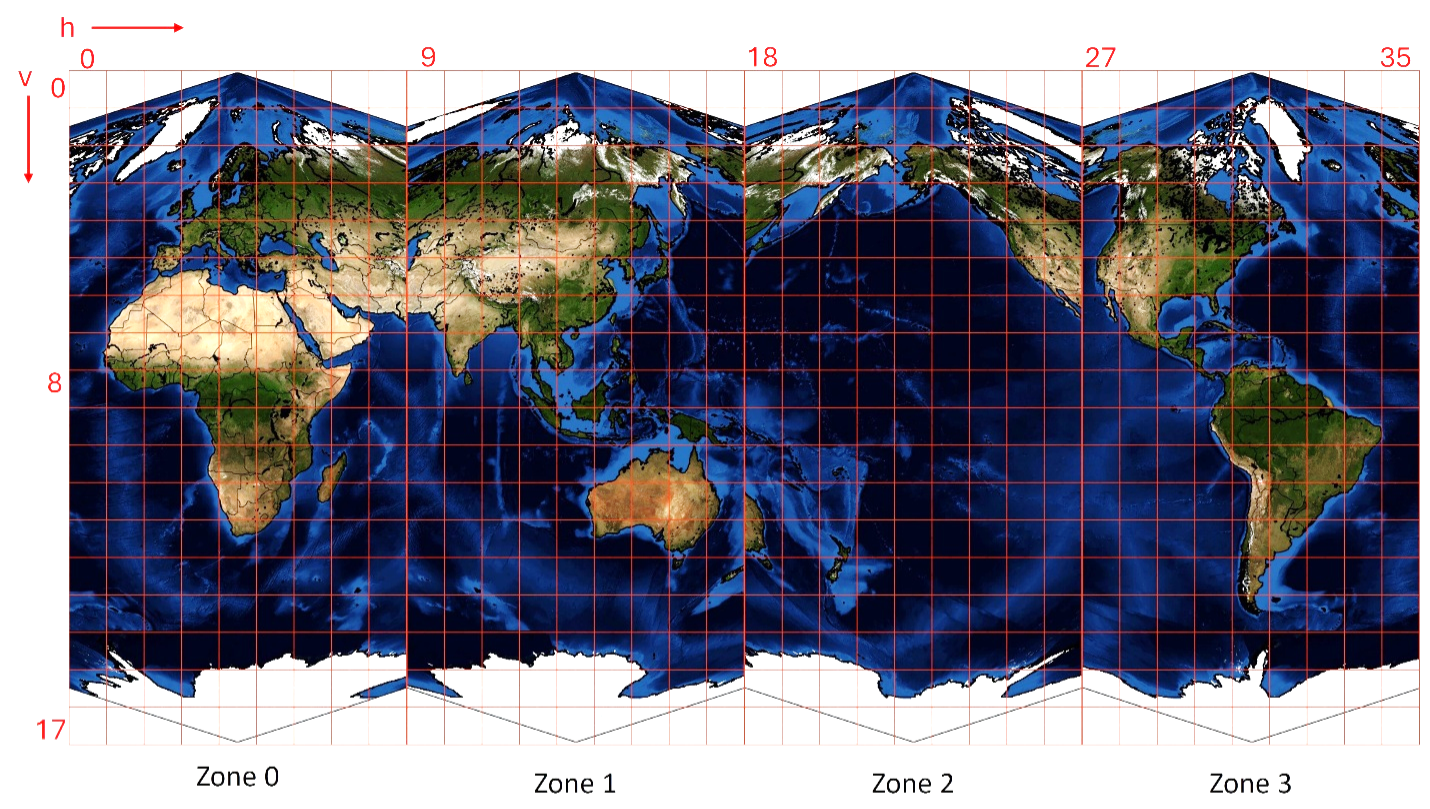
The Global Sinusoidal Projection has significant spatial distortions off the Greenwich meridian and towards the poles. These distortions are mitigated in the Zonal Sinusoidal Projection (ZSP), which was originally named as Rotated Sinusoidal (RSIN) projection. Each of the four zones has the standard Sinusoidal projection rotated 90°. This projection retains an equal area property, reduces geographic distortions, and can be easily re-projected to any standard projection without loss of information. It also keeps the same total number of pixels by filling in the significant empty space in the global Sinusoidal projection. There is a certain overlap between tiles towards the poles. The user can select the tile providing minimal distortion as the one with the shortest distance from its center to the pixel. 

The MAIAC global grid tiling system divides Earth's surface into 648 tiles arranged in a 36 × 18 grid, with each tile covering 1,200 × 1,200 km². Tile coordinates begin at (0, 0) in the upper-left corner, with horizontal tile numbers (0–35) increasing eastward and vertical tile numbers (0–17) increasing southward. Tiles are grouped into four horizontal zones based on their center meridians: Zone 0 (tiles 0–8, centered at 20°E), Zone 1 (tiles 9–17, centered at 110°E), Zone 2 (tiles 18–26, centered at 160°W), and Zone 3 (tiles 27–35, centered at 70°W). A list of the corner coordinates are provided for every tile within the Zonal Sinusoidal Projection.


Image

VIIRS Climate Modeling Grid (CMG)

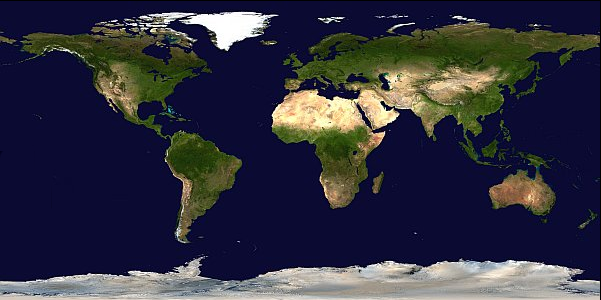
The VIIRS CMG is the same as the MODIS CMG. The CMG datasets provide global coverage in a Geographic Latitude and Longitude projection at a resolution of 0.05 degrees. The geographic coordinates of the upper left corner of the upper left pixel of a VIIRS CMG image are -180.00 degrees longitude, 90.00 degrees latitude. The geographic coordinates of the lower right corner of the lower right pixel are 180.00 degrees longitude, -90.00 degrees latitude.

Image

VIIRS products have two sources of metadata: the embedded HDF-EOS5 metadata, and the external Earth Observing System Data and Information System (EOSDIS) metadata, known as the EOSDIS Core System (ECS) metadata. The HDF-EOS5 metadata contains valuable information including global attributes and dataset specific attributes pertaining to the granule. An external metadata file is provided in XML format (.xml) and is provided along with the VIIRS product. This file provides a subset of the HDF-EOS5 metadata. Some key features of VIIRS HDF-EOS5 metadata attributes may include the following:

  • The Xdim and Ydim represent the rows and columns of the data, respectively.
  • The Projection and ProjParams identify the projection and its corresponding projection parameters.
  • The Sinusoidal Projection is used for most of the gridded VIIRS land products and has a unique sphere measuring 6371007.181 meters.
  • The UpperLeftPointMtrs is in projection coordinates and identifies the very upper left corner of the upper left pixel of the image data.
  • The LowerRightMtrs identifies the very lower right corner of the lower right pixel of the image data. These projection coordinates are the only metadata that accurately reflect the extreme corners of the gridded image.
  • Coordinate fields named EastBoundingCoord, WestBoundingCoord, NorthBoundingCoord, and SouthBoundingCoord represent the latitude and longitude coordinates of the geographic tile corresponding to the data.

The dataset attributes contain specific Science Dataset (SDS) information such as the data range and applicable scaling factors for the data. Information for each NASA VIIRS land data product can be found on the respective dataset landing pages.

Remote video URL

Animation of the NOAA/STAR GHRSST L3U Sea Surface Temperature v2.80 data derived from VIIRS aboard Suomi-NPP satellites covering the period of Feb. 1, 2012, to present. Credit: PO.DAAC

Instrument Type

Spectrometers/Radiometers

Instrument Subtype

Imaging Spectrometers/Radiometers

Specifications

Resolution

Platforms

Related Data Centers/Projects

Frequently Asked Questions

Earthdata Forum

Our online forum provides a space for users to browse thousands of FAQs about research needs, data, and data applications. You can also submit new questions for our experts to answer.

Submit Questions to Earthdata Forumand View Expert Responses

Earthdata
Forum