Access a range of datasets and data tools to further your research on sea level changes
Researchers have long been interested in precisely measuring sea level, given its importance to global circulation and weather. Tide gauges — digital or mechanical sensors used to record sea level height over time in an individual location — have been used for more than 200 years.
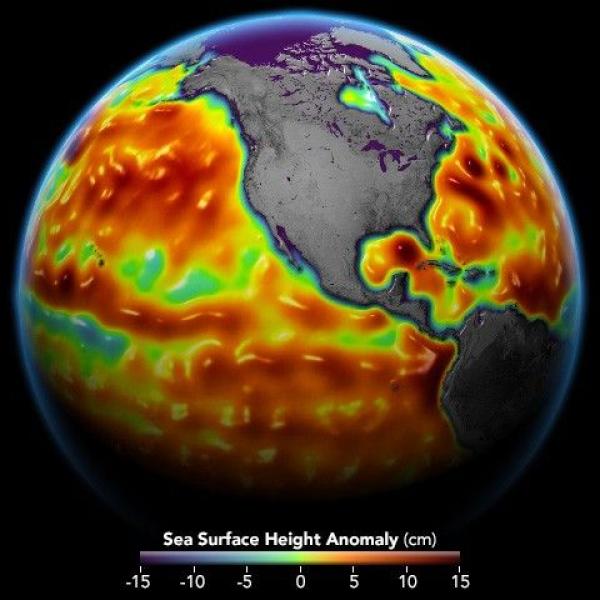
In the 1990s, researchers began using satellites to study sea level on a global scale with a unified standard. This practice, known as altimetry, works by bouncing radar signals off the surface of the ocean and measuring the time they take to return to the satellite. Altimetry has revolutionized the study of our oceans by identifying ocean patterns and dynamics with remarkable scale and precision.
The Surface Water and Ocean Topography (SWOT) mission, for example, can detect variations in ocean surface height on a scale of a few centimeters, and its 15-km resolution helps us study marine currents too small to detect with older satellites.
Both land- and space-based instruments have shown that global sea level rise is accelerating each year. Imagery from missions like Landsat and the Moderate Resolution Imaging Spectroradiometer (MODIS) provide direct observations of changing shorelines, and the flooding and extreme tides that can result. The Gravity Recovery and Climate Experiment (GRACE) and GRACE Follow-On (GRACE-FO) satellites track minuscule variations in gravitational force at Earth's surface, giving us another way to measure ocean mass changes across the globe.
These observations let us build an observational record of global sea levels and inform mathematical models to predict how coastlines might change in the decades to come. These data are also important for understanding how coastal ecosystems and shorelines might change, and for helping coastal communities create infrastructure that will stand up to changing tides and floods.
Learn How to Use Sea Level Changes Data
Join Our Community of NASA Data Users
While NASA data are openly available without restriction, an Earthdata Login is required to download data and to use some tools with full functionality.
Learn About the Benefits of Earthdata LoginFrequently Asked Questions
Earthdata Forum
Our online forum provides a space for users to browse thousands of FAQs about research needs, data, and data applications. You can also submit new questions for our experts to answer.
Submit Questions to Earthdata Forumand View Expert Responses