Access a range of datasets and data tools to further your aquifer research.
Aquifers are underground water-bearing rock layers that store the fresh water humans access through wells and springs. We have long depended on aquifers as sources of fresh water for drinking, irrigation, and sanitation. As global populations grow and societies strive to improve infrastructure and food security, our need for clean groundwater continues to increase.
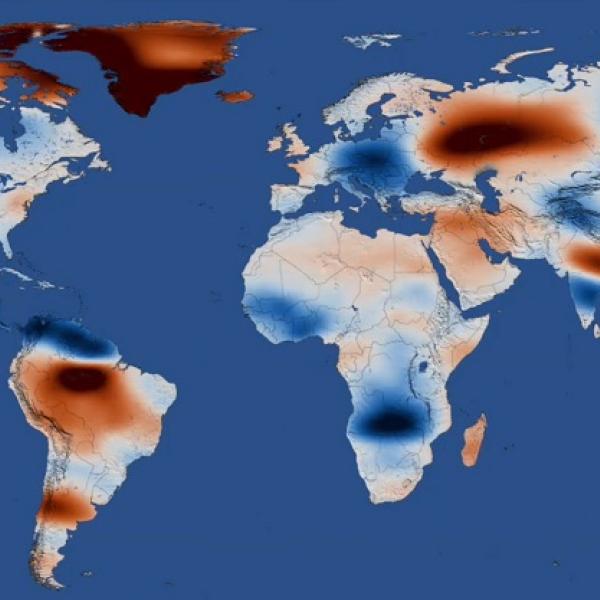
The Gravity Recovery and Climate Experiment (GRACE) and GRACE Follow-on (GRACE-FO) missions measure changes in groundwater due to consumption and recharging. These data help researchers and resource managers track the water levels and internal dynamics of aquifers.
Each of the GRACE missions consist of a pair of satellites that orbit in tandem and track each other with microwave signals. By tracking minuscule differences in the speed and distance between the two satellites, scientists can detect tiny fluctuations in Earth's gravitational field. These minor changes in gravity reflect changes in the masses of water beneath the planet's surface, so researchers use GRACE and GRACE-FO data to derive maps of groundwater stored in aquifers. NASA shares these findings as monthly mass grids and land water content maps.
Learn How to Use Aquifers Data
Join Our Community of NASA Data Users
While NASA data are openly available without restriction, an Earthdata Login is required to download data and to use some tools with full functionality.
Learn About the Benefits of Earthdata LoginFrequently Asked Questions
Earthdata Forum
Our online forum provides a space for users to browse thousands of FAQs about research needs, data, and data applications. You can also submit new questions for our experts to answer.
Submit Questions to Earthdata Forumand View Expert Responses