The Sentinels are a fleet of European Space Agency (ESA) satellites designed to acquire measurements from multiple sensor types that will provide information necessary to meet Europe's Copernicus Programme objectives. 

The first mission in the series, the Sentinel-1 constellation, includes twin satellites that each carry C-band synthetic aperture radar (SAR) and together provide all-weather, day-and-night imagery of Earth's surface. Sentinel-1A was launched on April 3, 2014, and Sentinel-1B on 25 April 2016. They orbit 180° apart, together imaging the Earth every six days.

The Sentinel-1 constellation benefits numerous services, such as monitoring of Arctic sea-ice extent, routine sea-ice mapping, and surveillance of the marine environment. Applications include oil-spill monitoring and ship detection for maritime security; monitoring land-surface for motion risks; mapping for forest, water, and soil management; and mapping to support humanitarian aid and crisis situations.

In December 2021, an anomaly in the power supply of Sentinel-1B caused the SAR sensor to stop working. Attempts to restore power to the sensor failed, and the mission officially ended on August 3, 2022.

Sentinel-1C was launched in December 2024, reestablishing a twin satellite constellation with extensive worldwide coverage and, in most areas, six-day repeat-pass observations.

All products from the Sentinel-1 mission are available to download from NASA's Alaska Satellite Facility Distributed Active Archive Center (ASF DAAC) through the Vertex search application, programmatically using asf_search and SearchAPI, and through Earthdata Search.

Type

Earth Observation Satellite

Data Center

ASF DAAC

Launch

Sentinel-1A - April 3, 2014
Sentinel-1B - April 25, 2016
Sentinel-1C - Dec. 5, 2024

Objective

Land and Ocean Monitoring

Properties of Sentinel-1 acquisition modes 


PropertyStrip Map (SM) modeInterferometric Wide (IW) mode1Extra Wide (EW) mode2Wave (WV) mode
Temporal Coverage12 Days12 Days12 Days12 Days
Spatial CoverageGlobalGlobalGlobalGlobal
Primary UseHigh-resolution imagingLandMaritime/Sea iceOpen ocean
Center FrequencyC-band at 5.405 GHzC-band at 5.405 GHzC-band at 5.405 GHzC-band at 5.405 GHz
PolarizationSingle Polarization (HH or VV)
Dual Polarization (HH+HV or VV+VH)
Single Polarization (HH or VV)
Dual Polarization (HH+HV or VV+VH)
Single Polarization (HH or VV)
Dual Polarization (HH+HV or VV+VH)
Single Polarization (HH or VV)
Dual Polarization (HH+HV or VV+VH)
Spatial Resolution5 x 5 m5 x 20 m20 x 40 m5 x 5 m
Swath Width80 km250 km410 km100 km
Off-Nadir Angle18.3° to 46.8°29.1° to 46.0°18.9° to 47.0°21.6° to 45.1° and 34.8° to 38.0°
File formatSAFESAFESAFESAFE
ProviderEuropean Space AgencyEuropean Space AgencyEuropean Space AgencyEuropean Space Agency
Date published:2014201420142014

1 Interferometric Wide Swath (IW)

  • Acquired with TOPSAR
  • Three sub-swaths
  • 250 km swath width
  • 5 m x 20 m ground resolution

2 Extra Wide Swath (EW)

  • Acquired with TOPSAR
  • Five sub-swaths
  • 410 km swath width
  • 20 m x 40 m ground resolution


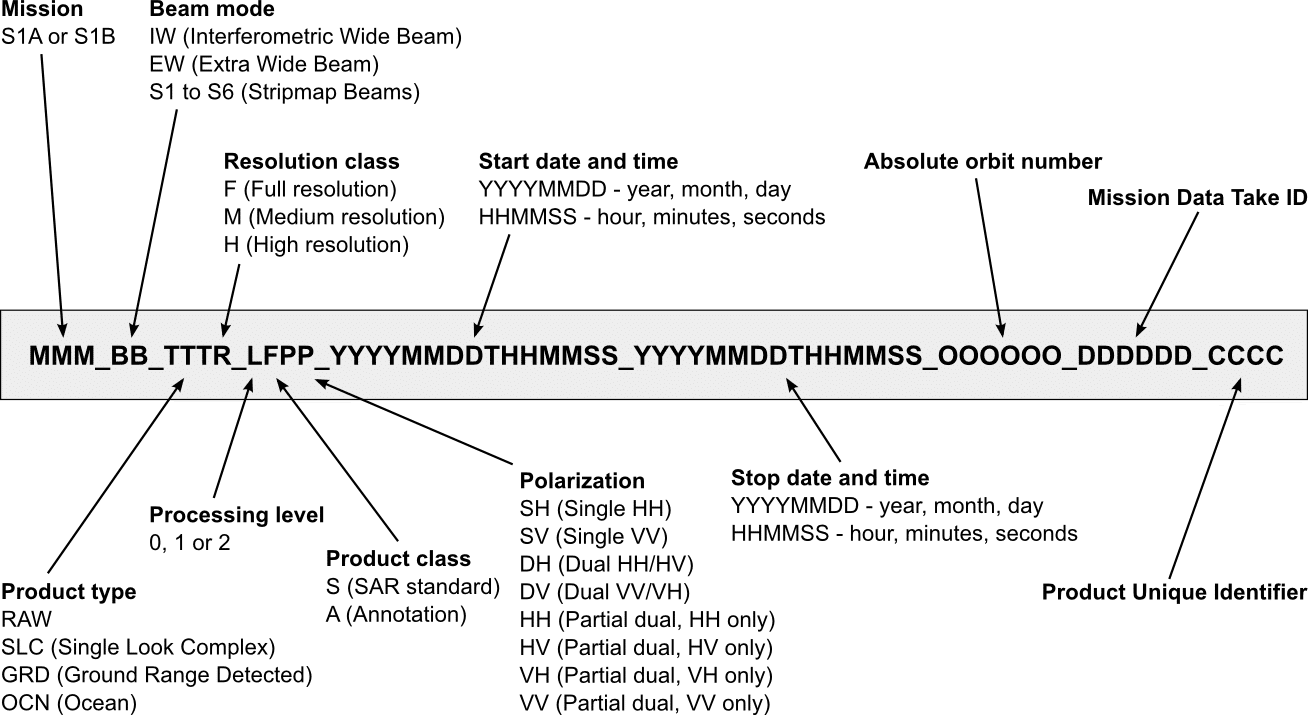
The naming convention used for a Sentinel-1 product file is diagrammed in Figure 1. For more information, see the SentiWiki S1 SAR Products Overview.


Image
Image Caption

Fig. 1 Sentinel-1 product file naming convention.


Sentinel-1 Cumulative Acquisition Maps

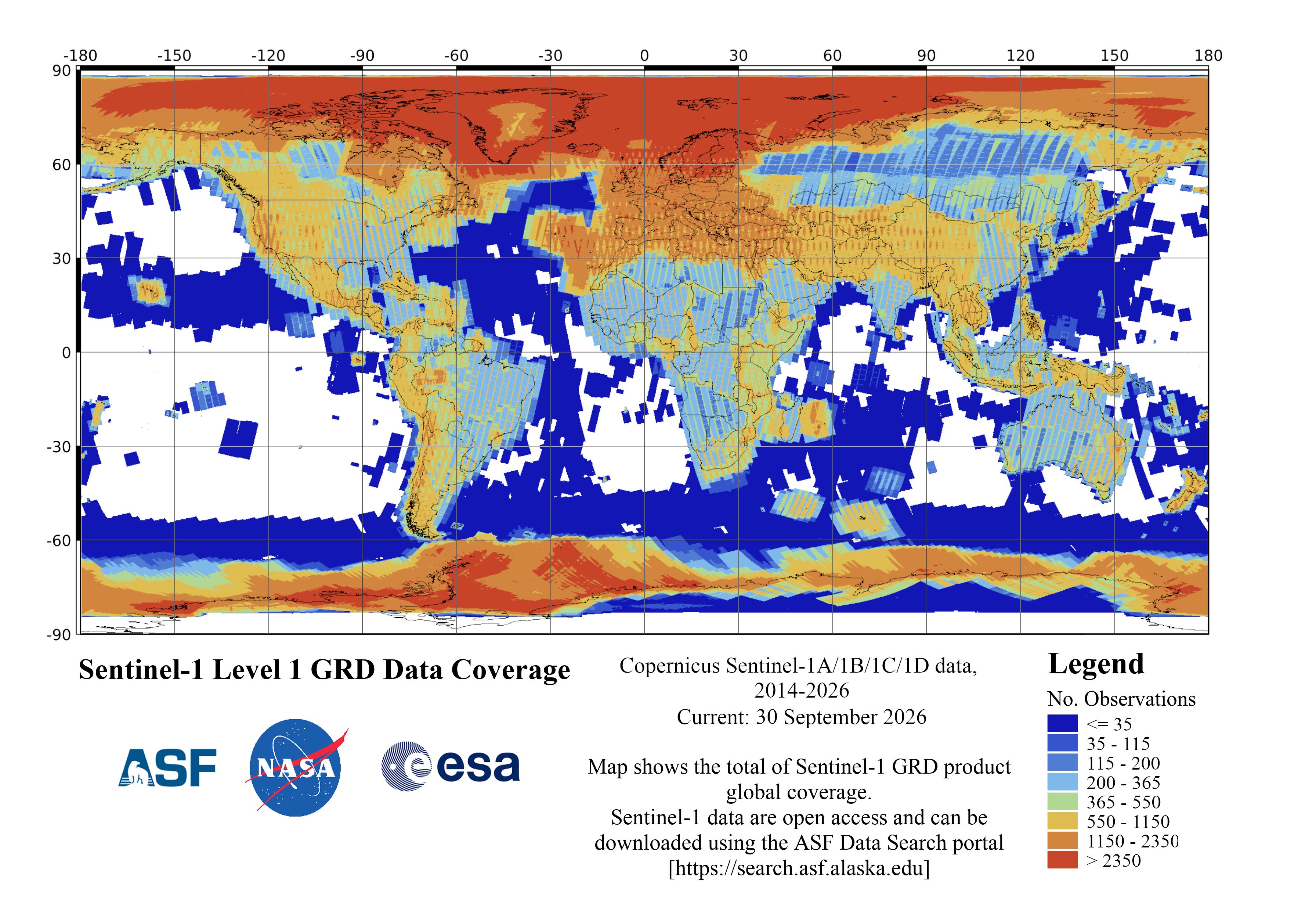
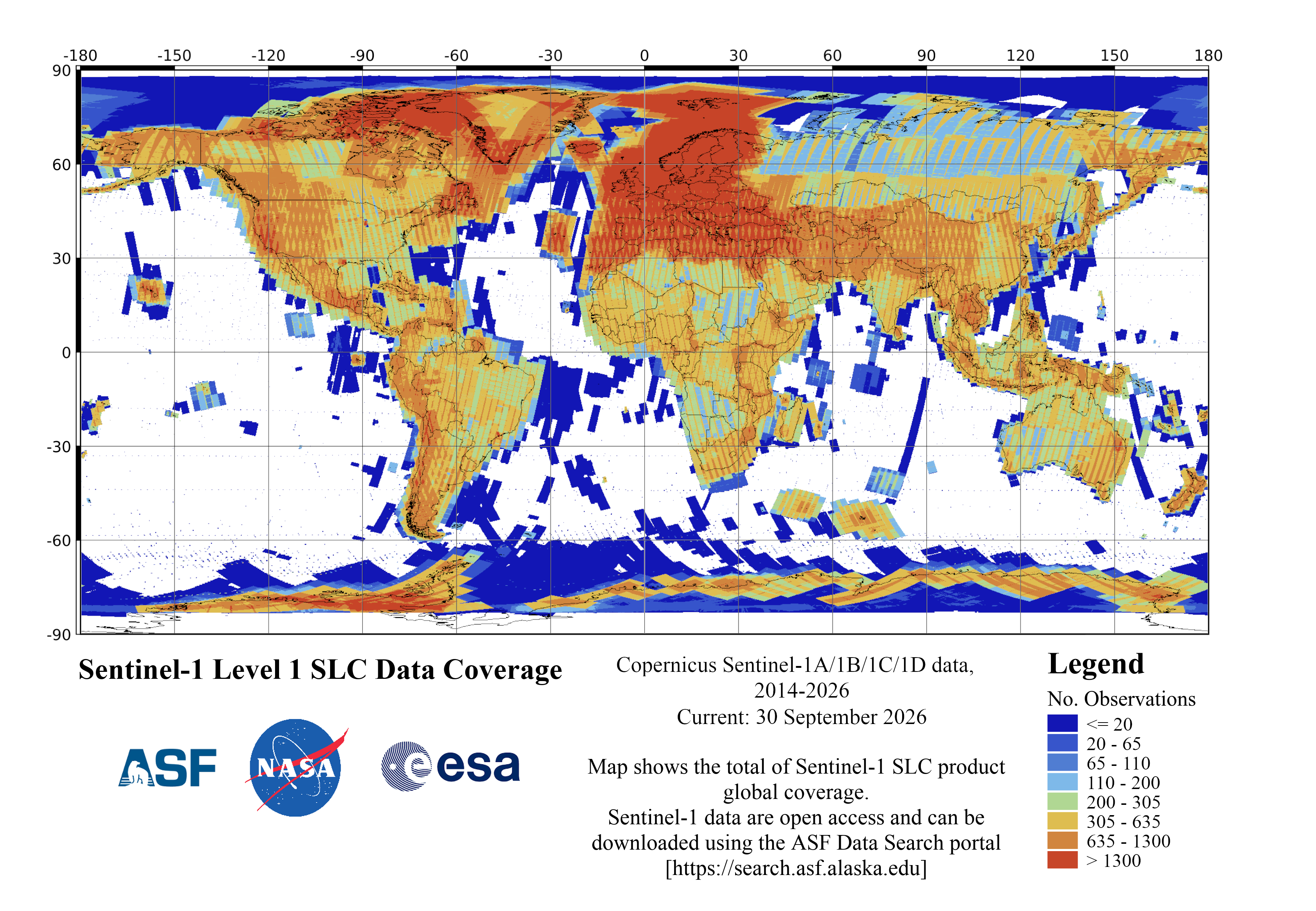
Two Cumulative Heat maps are updated monthly as new data are processed. One map displays the total coverage of Sentinel-1 Ground Range Detected (GRD) product data over the globe from 2014 to the last updated month in the current year, while the other map displays the total coverage of Sentinel-1 Single Look Complex (SLC) product data over the globe for the same time period. A color ramp indicates the number of times an area has been observed.

Current Cumulative: March 31, 2026

Image
Image Caption

Sentinel-1 Level 1 GRD data coverage - cumulative through March 31, 2026

Sentinel-1 Monthly Acquisition Map

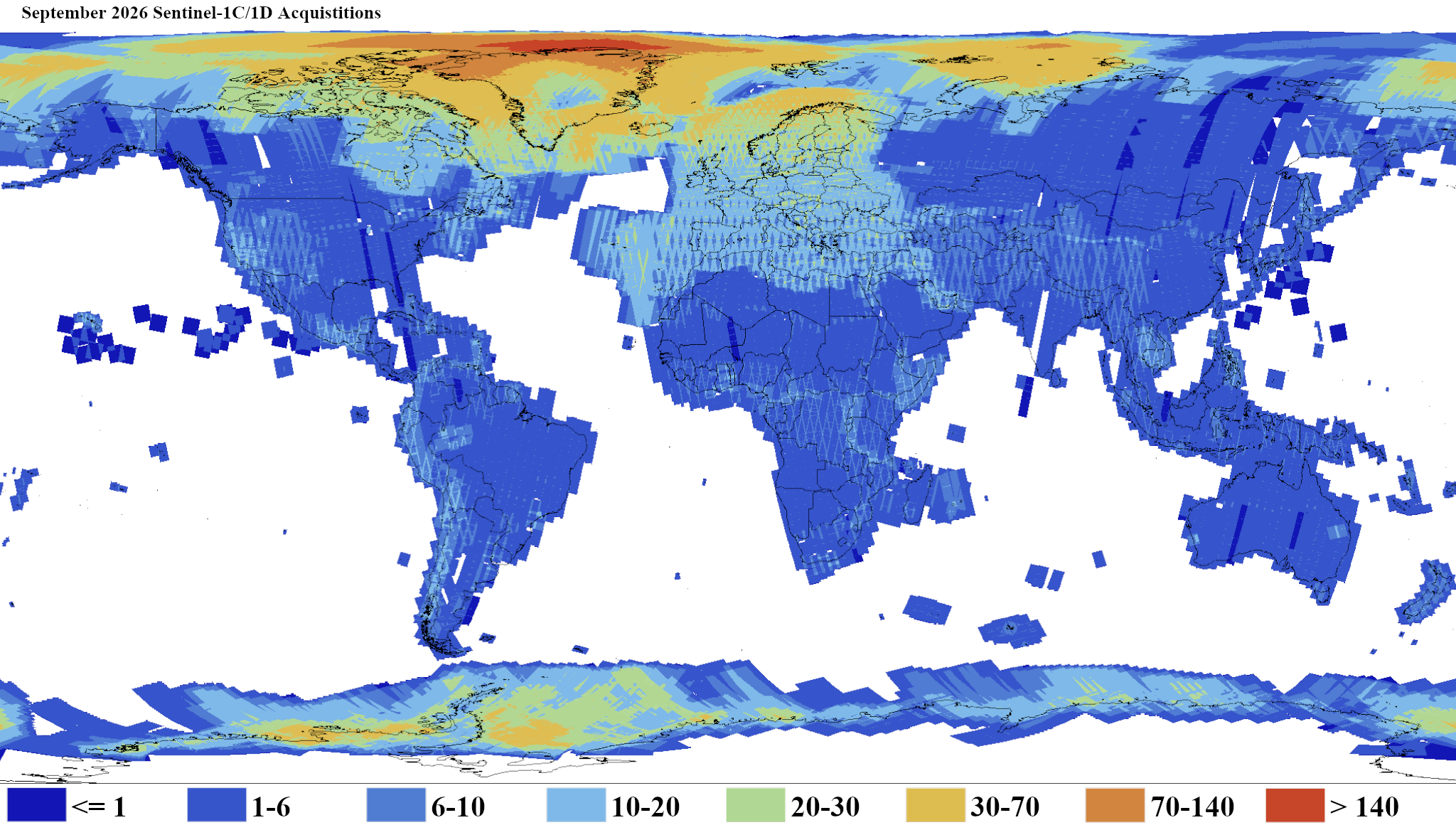
The monthly acquisition map shows the distribution of Sentinel-1 GRD products generated in the previous month. The number of products over an area is indicated by a color ramp.

Image
Image Caption

Sentinel-1A and 1C Level 1 GRD data coverage - March 2026

Image
Image Caption

Sentinel-1 Level 1 SLC data coverage - cumulative through March 31, 2026


Orbit and Auxiliary Data Files


The Precise Orbit Determination (POD) service for Sentinel-1 provides orbit ephemerides files in the form of Precise Orbit Ephemerides files (available 20 days after data acquisition) and Restituted Orbit files (available a few hours after data acquisition). Flight Operation Segment (FOS) Predicted Orbit files (available seven days before data acquisition), Instrument Processing Facility (IPF) auxiliary files, L1 Processor Parameters, L2 Processor Parameters, Instrument, Calibration, and Simulated Cross Spectra Auxiliary Data are also available.

Access to Sentinel-1 ephemeris files and documentation:

Guide to the ASF POD service catalogue

Directory NameDirectory Content
mpl_orbpreFOS Predicted Orbit files
aux_poeorbPOD Precise Orbit Ephemerides files
aux_resorbPOD Restituted Orbit files
aux_resattPOD Restitude Attitude files
aux_pp1L1 Processor Parameters
aux_calCalibration Auxiliary Data
aux_insInstrument Auxiliary Data
aux_pp2L2 Processor Parameters


Instruments Aboard Sentinel-1

Instrument Name Operational Date(s) Spectral Resolution Type of Instrument
Sentinel-1 C-band Synthetic Aperture Radar (Sentinel-1 C-SAR)

1 nm-180nm

Imaging Radars

Related Platforms

Frequently Asked Questions

Earthdata Forum

Our online forum provides a space for users to browse thousands of FAQs about research needs, data, and data applications. You can also submit new questions for our experts to answer.

Submit Questions to Earthdata Forumand View Expert Responses

Earthdata
Forum