Introduction
The Arctic Ocean is one of the most important and challenging regions to observe because it experiences the largest changes from climate warming while at the same time is one of the most difficult to sample because of sea ice and extreme cold temperatures. Additionally, changes in river discharge reflect both changes in ice coverage, as well as precipitation in the Arctic. Both of these are related to the region’s changing climate.
Rivers discharge freshwater into the ocean and thus impact areas of discharge by freshening coastal ocean waters. This impacts coastal ecosystems and changes in biodiversity.
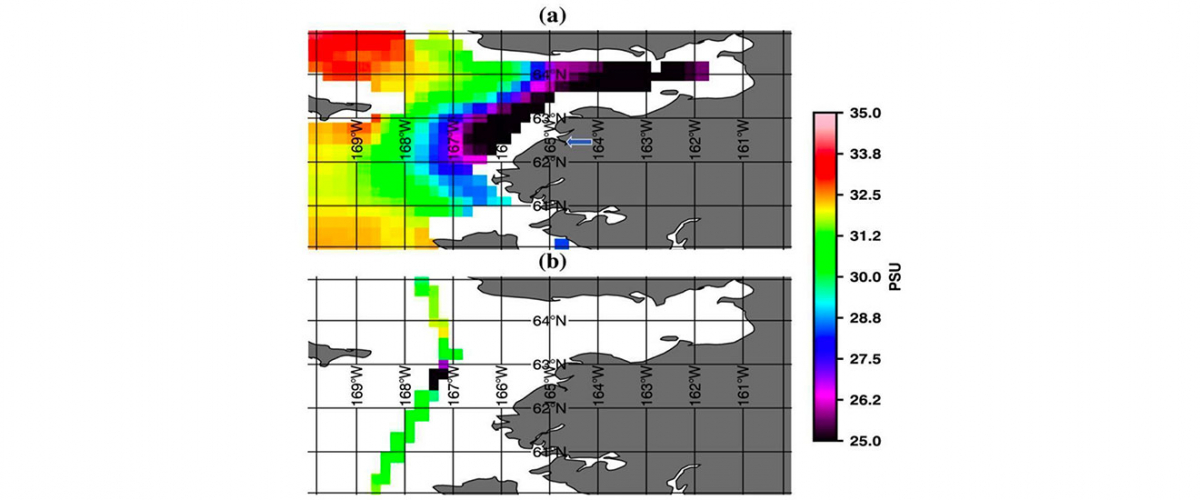
Measuring Yukon Delta Salinity With Saildrones and SMAP
Here we first compare satellite derived surface salinity and models with two deployments of the autonomous saildrone uncrewed vehicle. We then zoom in on the area of the Yukon delta. Results show that satellites can be used to monitor changes in critical areas of the world’s oceans. The figure clearly shows both the saildrone and satellites are resolving the freshening associated with the delta.
Two NASA-sponsored deployments of the saildrone vehicle provided a unique opportunity for validating sea surface salinity (SSS) derived from three separate products that use data from NASA’s Soil Moisture Active Passive (SMAP) satellite. Results were also compared directly with the Estimating the Circulation and Climate of the Ocean (ECCO) model.
Major Findings
The results indicate that the three SMAP products resolve the runoff signal associated with the Yukon River, with high correlation between SMAP products and saildrone SSS. Based on these encouraging results, future research should focus on improving derivations of satellite-derived SSS in the Arctic Ocean and integrating model results to complement remote sensing observations.
Results from the recent saildrone in-situ campaign also indicated that satellites and models present a valuable tool for monitoring this critical region of the world’s oceans. The saildrone allows for a spatial comparison of features directly with remote sensing data. Integrating models will provide information on stratification that cannot be resolved by remote sensing data alone.
Results from this study provide critical motivation for understanding the impacts of changes in sea ice concentration in the Arctic. The NASA-funded Salinity and Stratification at the Sea Ice Edge (SASSIE) aims to build on these studies by comparing near surface salinity measurements directly with satellite derived measurements. This will directly link ocean water measurements of salinity with those derived from satellites. As a result, improved understanding of ice melt in the arctic and how it is changing will increase our understanding of sea ice melt and how the ocean stratification is changing.
Related Links
References
- Vazquez-Cuervo, J.; Gentemann, C.; Tang, W.; Carroll, D.; Zhang, H.; Menemenlis, D.; Gomez-Valdes, J.; Bouali, M.; Steele, M. Using Saildrones to Validate Arctic Sea-Surface Salinity from the SMAP Satellite and from Ocean Models. Remote Sens. 2021, 13, 831. doi:10.3390/rs13050831
- ECCO LLC270 Ocean-Ice State Estimate