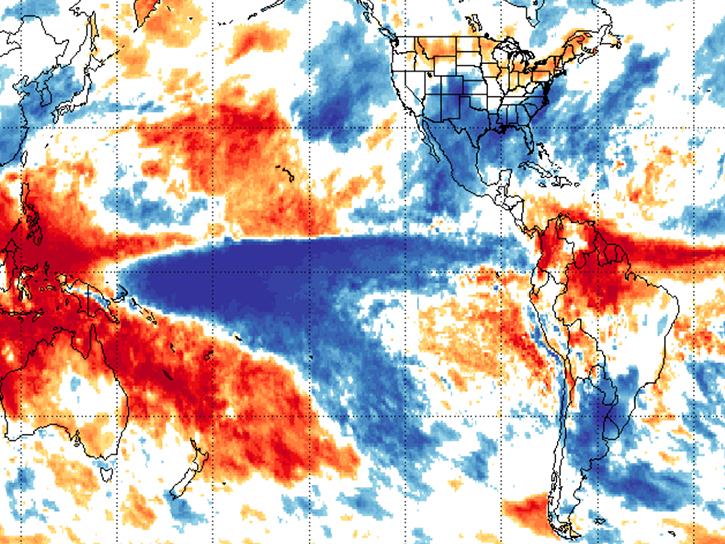
N: 90 S: -90 E: 180 W: -180
Description
Version 07B is the current version of the IMERG data sets. Older versions will no longer be available and have been superseded by Version 07.
The Integrated Multi-satellitE Retrievals for GPM (IMERG) is the unified U.S. algorithm that provides the multi-satellite precipitation product for the U.S. GPM team.
The precipitation estimates from the various precipitation-relevant satellite passive microwave (PMW) sensors comprising the GPM constellation are computed using the 2021 version of the Goddard Profiling Algorithm (GPROF2021), then gridded, intercalibrated to the GPM Combined Ku Radar-Radiometer Algorithm (CORRA) product, and merged into half-hourly 0.1°x0.1° (roughly 10x10 km) fields. Note that CORRA is adjusted to the monthly Global Precipitation Climatology Project (GPCP) Satellite-Gauge (SG) product over high-latitude ocean to correct known biases.
The half-hourly intercalibrated merged PMW estimates are then input to both a Morphing-Kalman Filter (KF) Lagrangian time interpolation scheme based on work by the Climate Prediction Center (CPC) and the Precipitation Estimation from Remotely Sensed Information using Artificial Neural Networks (PERSIANN) Dynamic Infrared–Rain Rate (PDIR) re-calibration scheme. In parallel, CPC assembles the zenith-angle-corrected, intercalibrated merged geo-IR fields and forwards them to PPS for input to the PERSIANN-CCS algorithm (supported by an asynchronous re-calibration cycle) which are then input to the KF morphing (quasi-Lagrangian time interpolation) scheme.
The KF morphing (supported by an asynchronous KF weights updating cycle) uses the PMW and IR estimates to create half-hourly estimates. Motion vectors for the morphing are computed by maximizing the pattern correlation of successive hours within each of the precipitation (PRECTOT), total precipitable liquid water (TQL), and vertically integrated vapor (TQV) data fields provided by the Modern-Era Retrospective Analysis for Research and Applications, Version 2 (MERRA-2) and Goddard Earth Observing System model Version 5 (GEOS-5) Forward Processing (FP) for the post-real-time (Final) Run and the near-real-time (Early and Late) Runs, respectively. The vectors from PRECTOT are chosen if available, else from TQL, if available, else from TQV. The KF uses the morphed data as the “forecast” and the IR estimates as the “observations”, with weighting that depends on the time interval(s) away from the microwave overpass time. The IR becomes important after about ±90 minutes away from the overpass time. Variable averaging in the KF is accounted for in a routine (Scheme for Histogram Adjustment with Ranked Precipitation Estimates in the Neighborhood, or SHARPEN) that compares the local histogram of KF morphed precipitation to the local histogram of forward- and backward-morphed microwave data and the IR.
The IMERG system is run twice in near-real time:
"Early" multi-satellite product ~4 hr after observation time using only forward morphing and
"Late" multi-satellite product ~14 hr after observation time, using both forward and backward morphing
and once after the monthly gauge analysis is received:
"Final", satellite-gauge product ~4 months after the observation month, using both forward and backward morphing and including monthly gauge analyses.
In V07, the near-real-time Early and Late half-hourly estimates have a monthly climatological concluding calibration based on averaging the concluding calibrations computed in the Final, while in the post-real-time Final Run the multi-satellite half-hourly estimates are adjusted so that they sum to the Final Run monthly satellite-gauge combination. In all cases the output contains multiple fields that provide information on the input data, selected intermediate fields, and estimation quality. In general, the complete calibrated precipitation, precipitation, is the data field of choice for most users.
Briefly describing the Final Run, the input precipitation estimates computed from the various satellite passive microwave sensors are intercalibrated to the CORRA product (because it is presumed to be the best snapshot TRMM/GPM estimate after adjustment to the monthly GPCP SG), then "forward/backward morphed" and combined with microwave precipitation-calibrated geo-IR fields, and adjusted with seasonal GPCP SG surface precipitation data to provide half-hourly and monthly precipitation estimates on a 0.1°x0.1° (roughly 10x10 km) grid over the globe. Precipitation phase is a diagnostic variable computed using analyses of surface temperature, humidity, and pressure. The current period of record is June 2000 to the present (delayed by about 4 months).
Product Summary
Citation
Citation is critically important for dataset documentation and discovery. This dataset is openly shared, without restriction, in accordance with the EOSDIS Data Use and Citation Guidance.
Copy Citation
Documents
READ-ME
PI DOCUMENTATION
ANOMALIES
IMPORTANT NOTICE
Publications Citing This Dataset
| Title | Year Sort ascending | Author | Topic |
|---|---|---|---|
| Hydrological Analysis of the Middle and Lower Paraguay Basin Based on Water Balance and Storage Using Imerg, GLDAS, and Grace Products (2003-2023) | Villalba, Rossana, Ferral, Anabella, BaezGiven, Julian, Kurita, Jorge, Bonansea, Matias, Bertoni, Juan Carlos | Surface Pressure, Heat Flux, Longwave Radiation, Shortwave Radiation, Surface Temperature, Humidity, Evapotranspiration, Surface Winds, Rain, Precipitation Rate, Snow, Soil Moisture/Water Content, Soil Temperature, Land Surface Temperature, Snow Water Equivalent, Runoff, Ground Water, Precipitation, Precipitation Amount | |
| Downscaling of soil moisture in the Wujiang River Basin based on integrated decision tree-based machine learning | Qu, Pengfei, Yuan, Yongyi, Lu, Hanyu | Precipitation, Rain, Precipitation Amount, Precipitation Rate, Snow | |
| On the dynamic link between summer inner-continental warming and the outer-continental weakened precipitation extreme ascent in East Asia | Cho, Jae-Hee, Kim, Hak-Sung | Precipitation, Rain, Precipitation Amount, Precipitation Rate, Snow | |
| Global retrieval of harmonized microwave land surface emissivity | Hu, Jiheng, Li, Rui, Zhang, Peng, Wang, Yu, Wu, Shengli, Letu, Husi, Weng, Fuzhong | Precipitation, Rain, Precipitation Amount, Precipitation Rate, Snow, Atmospheric Water Vapor, Land Use/Land Cover Classification, Vegetation Index, Normalized Difference Vegetation Index (NDVI), Enhanced Vegetation Index (EVI), Brightness Temperature, Snow Cover | |
| Global risk pooling mitigates financial risk from drought in hydropower-dependent countries | Cuppari, Rosa Isabella, Pavelsky, Tamlin M., Characklis, Gregory W. | Snow Cover, Vegetation Index, Normalized Difference Vegetation Index (NDVI), Enhanced Vegetation Index (EVI), Emissivity, Land Surface Temperature, Precipitation, Precipitation Amount, Precipitation Rate, Snow, Rain | |
| Bayesian Model Averaging Method for Merging Multiple Precipitation Products over the Arid Region of Northwest China | Yang, Yong, Chen, Rensheng, Lu, Xinyu, Mao, Weiyi, Liu, Zhangwen, Wang, Xueliang | Surface Pressure, Heat Flux, Longwave Radiation, Shortwave Radiation, Surface Temperature, Humidity, Evapotranspiration, Surface Winds, Rain, Precipitation Rate, Snow, Soil Moisture/Water Content, Soil Temperature, Land Surface Temperature, Snow Water Equivalent, Runoff, Air Temperature, Specific Humidity, Wind Speed, Snow Cover, Snow Depth, Skin Temperature, Water Vapor, Snow/Ice, Evaporation, Latent Heat Flux, Latent Heat Flux, Sensible Heat Flux, Diffusion, Surface Winds, U/V Wind Components, Wind Stress, Wind Stress, Surface Roughness, Planetary Boundary Layer Height, Ice Fraction, Precipitation, Precipitation Amount, Total Surface Precipitation Rate | |
| Assessing the Impacts of Long-Term Weather Variability and Urban Development on Crop Production to Analyze Food Security in Iran | Garajeh, Mohammad Kazemi, Kamran, Khalil Valizadeh, Feizizadeh, Bakhtiar, Khorrami, Behnam | Land Use/Land Cover Classification, Evapotranspiration, Photosynthesis, Primary Production, Latent Heat Flux, Precipitation, Rain, Precipitation Amount, Precipitation Rate, Snow | |
| Moisture Transport from Tropical Oceans Drives Summertime Rainfall Variability over Southwest North America | Zhao, Siyu, Zhang, Honghai, He, Jie | Precipitation, Rain, Precipitation Amount, Precipitation Rate, Snow | |
| Role of Arabian Sea warm pool and atmospheric instability in triggering a monsoonal MCC over Peninsular India | Jose, Subin, Jayachandran, V., Pradeep, Nandana S | Precipitation, Precipitation Amount, Precipitation Rate, Snow, Rain | |
| Seasonal dynamics of Sulfur dioxide and Sulfate aerosols over India: Insights from Sentinel-5P and MERRA-2 datasets | J S, Priya, V, Krishnakumar, Rahim, Sabna | Precipitation, Rain, Precipitation Amount, Precipitation Rate, Snow, Aerosols, Aerosol Extinction, Aerosol Optical Depth/Thickness, Angstrom Exponent, Aerosol Particle Properties, Carbonaceous Aerosols, Dust/Ash/Smoke, Organic Particles, Sulfate Particles, Sulfur Oxides, Sulfur Compounds, Sulfate, Sulfur Dioxide, Sulfur Oxides, Particulate Matter, Dimethyl Sulfide, Black Carbon, Sea Salt, PARTICULATE MATTER (PM 2.5), PARTICULATE MATTER (PM 10), PARTICULATE MATTER (PM 1.0) | |
| A theoretical index for understanding distinct land relative humidity trends in observations, reanalyses, and models | Zhou, Wenyu, Leung, L. Ruby, Harrop, Bryce E., Chen, Ziming, Chang, Chuan-Chieh | Precipitation, Rain, Precipitation Amount, Precipitation Rate, Snow | |
| Widespread forest disturbance from windthrow in central African rainforests | Negron-Juarez, Robinson, Feng, Yanlei, Sheil, Douglas, Keller, Michael, Ordway, Elsa M., Magnabosco Marra, Daniel, Urquiza-Munoz, Jose D. | Precipitation, Rain, Precipitation Amount, Precipitation Rate, Snow | |
| Coupled tropospheric and stratospheric dynamics of Kelvin waves over | Szkolka, Wojciech, Baranowski, Dariusz B., Flatau, Maria K., Flatau, Piotr J., Marzuki, Shimomai, Toyoshi, Hashiguchi, Hiroyuki | Precipitation, Precipitation Amount, Precipitation Rate, Snow, Rain | |
| Defining the Agricultural Wet Season in Africa Using Soil Moisture From | Chalmers, Christopher, Zhang, Yan, Xiao, Jingfeng, Li, Xing, Rigden, Angela | Brightness Temperature, Surface Soil Moisture, Soil Classification, Soil Depth, Soil Porosity, Soil Texture, Terrain Elevation, Precipitation, Precipitation Amount, Precipitation Rate, Snow, Rain | |
| Evaluating the performance of ANN and ANFIS models for spatial | Husrevoglu, Mustafa, Gundogdu, Ismail Bulent | Surface Pressure, Heat Flux, Longwave Radiation, Shortwave Radiation, Air Temperature, Specific Humidity, Evapotranspiration, Wind Speed, Rain, Snow, Soil Moisture/Water Content, Soil Temperature, Land Surface Temperature, Snow Cover, Snow Depth, Snow Water Equivalent, Runoff, Precipitation, Precipitation Amount, Precipitation Rate | |
| Evaluation of hourly summer precipitation products over the Tibetan | Jia, Jingjing, He, Yongli, Zhang, Boyuan, Huo, Zixin, Tang, Zhen, Wang, Shanshan, Yu, Haipeng, Guan, Xiaodan | Precipitation, Precipitation Amount, Precipitation Rate, Snow, Rain | |
| Impact of Dynamic Downscaling on the Simulation of Tropical Easterly | DeLaune, Connor, Misra, Vasubandhu, Jayasankar, C. B. | Precipitation, Precipitation Amount, Precipitation Rate, Snow, Rain | |
| Hydrological drivers of maize productivity: A new analytical framework | Zhang, Qichen, Shen, Xiaofang, Dong, Weihong, Su, Xiaosi, Wan, Yuyu, Lyu, Hang, Song, Tiejun | Precipitation, Rain, Precipitation Amount, Precipitation Rate, Snow, Land Use/Land Cover Classification, Evapotranspiration, Photosynthesis, Primary Production, Latent Heat Flux, Vegetation Productivity | |
| Gridded precipitation and temperature products performance over Afghanistan: from simple bias correction to advanced data fusion | Nasimi, Mohammad Najim, Bauer-Gottwein, Peter, Boyce, Scott E., Huang, Jingshui, Disse, Markus | Precipitation, Precipitation Amount, Precipitation Rate, Snow, Rain | |
| GRACE/GFO and Swarm Observation Analysis of the 2023-2024 Extreme | Zhou, Jun, Cui, Lilu, Li, Yu, Yao, Chaolong, Meng, Jiacheng, Zou, Zhengbo, Lu, Yuheng | Precipitation, Precipitation Amount, Precipitation Rate, Snow, Rain | |
| Impacts of Northerly Low-Level Jets on Mesoscale Convective Systems East | Mu, Ye, Jones, Charles, Carvalho, Leila M. V., Kukulies, Julia, Prein, Andreas F., Xue, Lulin, Liu, Changhai | Precipitation, Brightness Temperature, Precipitation Amount, Precipitation Rate, Snow, Rain | |
| Impacts of resolution on heavyprecipitating storms in climate model hindcasts | Wu, WenYing, Ma, HsiYen | Precipitation, Precipitation Amount, Precipitation Rate, Snow, Rain | |
| Impacts of the Madden-Julian Oscillation on Widespread Heavy Rainfall | LopezBravo, Clemente, Vincent, Claire L., Huang, Yi, Lane, Todd P. | Precipitation, Precipitation Amount, Precipitation Rate, Snow, Rain | |
| Indian Institute of Tropical Meteorology (IITM) High-Resolution Global Forecast Model version 1: an attempt to resolve monsoon prediction deadlock | Krishna, R. Phani Murali, Kumar, Siddharth, Prajeesh, A. Gopinathan, Bechtold, Peter, Wedi, Nils, Roy, Kumar, Ganai, Malay, Reddy, B. Revanth, Tirkey, Snehlata, Goswami, Tanmoy, Kanase, Radhika, Sarkar, Sahadat, Deshpande, Medha, Mukhopadhyay, Parthasarathi | Precipitation, Precipitation Amount, Precipitation Rate, Snow, Rain | |
| A dataset of tracked mesoscale precipitation systems in the tropics | Russell, James, Rajagopal, Manikandan, Veals, Peter, Skok, Gregor, Zipser, Edward, TinocoMorales, Michell | Precipitation, Precipitation Amount, Precipitation Rate, Snow, Rain |
Variables
The table below lists the variables contained within a single granule for this dataset. Variables often contain observed or derived geophysical measurements collected from a variety of sources, including remote sensing instruments on satellite and airborne platforms, field campaigns, in situ measurements, and model outputs. The terms variable, parameter, scientific data set, layer, and band have been used across NASA’s Earth science disciplines; however, variable is the designated nomenclature in NASA’s Common Metadata Repository (CMR). Variable metadata attributes such as Name, Description, Units, Data Type, Fill Value, Valid Range, and Scale Factor allow users to efficiently process and analyze the data. The full range of attributes may not be applicable to all variables. Additional information on variable attributes is typically available in the data, user guide, and/or other product documentation.
For questions on a specific variable, please use the Earthdata Forum.
| Name Sort descending | Description | Units | Data Type | Fill Value | Valid Range | Scale Factor | Offset |
|---|---|---|---|---|---|---|---|
| Grid/gaugeRelativeWeighting | Grid/gaugeRelativeWeighting | percent | int16 | -9999 | N/A | N/A | N/A |
| Grid/lat | Grid/lat | degrees_north | float32 | N/A | N/A | N/A | N/A |
| Grid/lat_bnds | Grid/lat_bnds | degrees_north | float32 | N/A | N/A | N/A | N/A |
| Grid/lon | Grid/lon | degrees_east | float32 | N/A | N/A | N/A | N/A |
| Grid/lon_bnds | Grid/lon_bnds | degrees_east | float32 | N/A | N/A | N/A | N/A |
| Grid/precipitation | Grid/precipitation | mm/hr | float32 | -9999.900390625 | N/A | N/A | N/A |
| Grid/precipitationQualityIndex | Grid/precipitationQualityIndex | N/A | float32 | -9999.900390625 | N/A | N/A | N/A |
| Grid/probabilityLiquidPrecipitation | Grid/probabilityLiquidPrecipitation | percent | int16 | -9999 | N/A | N/A | N/A |
| Grid/randomError | Grid/randomError | mm/hr | float32 | -9999.900390625 | N/A | N/A | N/A |
| Grid/time | Grid/time | seconds since 1980-01-06 00:00:00 UTC | int32 | N/A | N/A | N/A | N/A |
| Grid/time_bnds | Grid/time_bnds | seconds since 1980-01-06 00:00:00 UTC | int32 | N/A | N/A | N/A | N/A |