N: 90 S: -90 E: 180 W: -180
Description
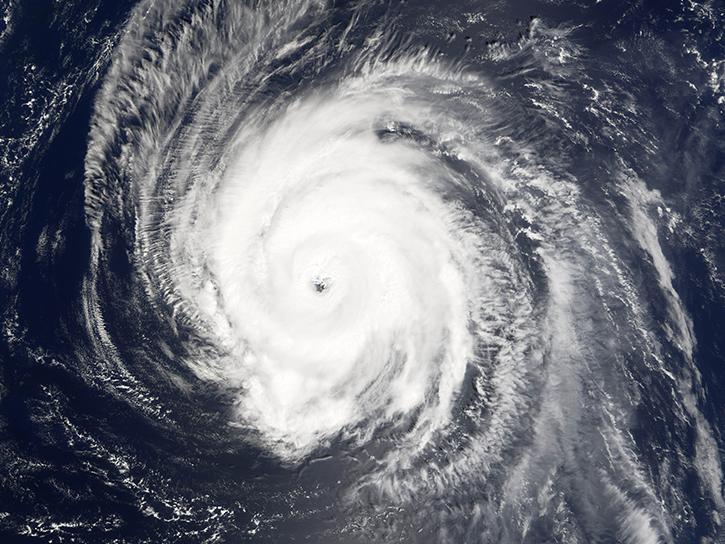
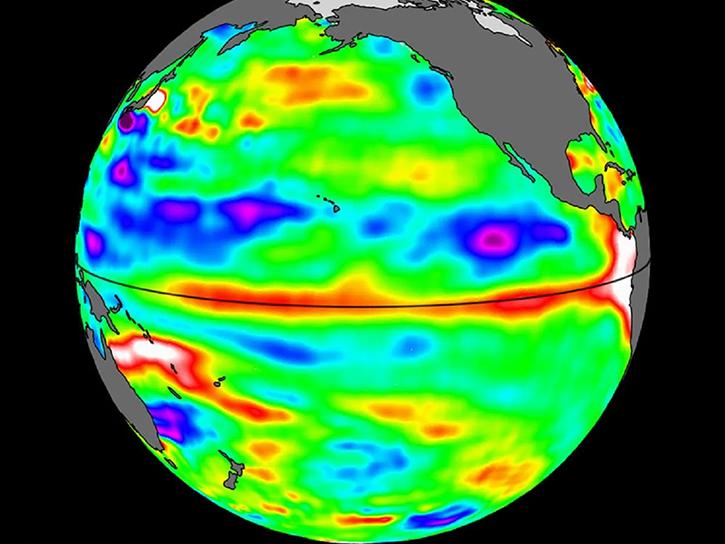
A Group for High Resolution Sea Surface Temperature (GHRSST) Level 4 sea surface temperature analysis produced as a retrospective dataset at the JPL Physical Oceanography DAAC using wavelets as basis functions in an optimal interpolation approach on a global 0.25 degree grid. The version 4 Multiscale Ultrahigh Resolution (MUR) L4 analysis is based upon nighttime GHRSST L2P skin and subskin SST observations from several instruments including the NASA Advanced Microwave Scanning Radiometer-EOS (AMSR-E), the JAXA Advanced Microwave Scanning Radiometer 2 on GCOM-W1, the Moderate Resolution Imaging Spectroradiometers (MODIS) on the NASA Aqua and Terra platforms, the US Navy microwave WindSat radiometer, the Advanced Very High Resolution Radiometer (AVHRR) on several NOAA satellites, and in situ SST observations from the NOAA iQuam project. The ice concentration data are from the archives at the EUMETSAT Ocean and Sea Ice Satellite Application Facility (OSI SAF) High Latitude Processing Center and are also used for an improved SST parameterization for the high-latitudes. The dataset also contains an additional SST anomaly variable derived from a MUR climatology (average between 2003 and 2014). This dataset was originally funded by the NASA MEaSUREs program (http://earthdata.nasa.gov/our-community/community-data-system-programs/measures-projects ) and the NASA CEOS COVERAGE project and created by a team led by Dr. Toshio M. Chin from JPL. It adheres to the GHRSST Data Processing Specification (GDS) version 2 format specifications.
Product Summary
Citation
Citation is critically important for dataset documentation and discovery. This dataset is openly shared, without restriction, in accordance with the EOSDIS Data Use and Citation Guidance.
Copy Citation
Documents
DATA CITATION GUIDELINES
GENERAL DOCUMENTATION
PUBLICATIONS
Dataset Resources
Publications Citing This Dataset
| Title | Year Sort ascending | Author | Topic |
|---|---|---|---|
| Retrieving cloud-base height and geometric thickness using the oxygen | Nagao, Takashi M., Suzuki, Kentaroh, Kuji, Makoto | Atmospheric Ozone, Sea Level Pressure, Surface Pressure, U/V Wind Components, U/V Wind Components, Potential Vorticity, Vertical Wind Velocity/Speed, Vertical Profiles, Upper Air Temperature, Air Temperature, Relative Humidity, Specific Humidity, Atmospheric Water Vapor, Cloud Liquid Water/Ice, Altitude, Geopotential Height, Ozone Profiles, Surface Temperature, Skin Temperature, Atmospheric Winds, Surface Winds, Atmospheric Pressure, Total Precipitable Water, Oxygen Compounds, Boundary Layer Winds, Terrain Elevation, Digital Elevation/Terrain Model (DEM), Topographical Relief Maps, Sea Surface Temperature | |
| Assessing the accuracy of MUR high resolution satellite sea surface temperature data | St. Amand, Frankie M., Maasch, Kirk A., Sandweiss, Daniel H. | Sea Surface Temperature | |
| Predicting species distributions in the open ocean with convolutional neural networks | Morand, Gaetan, Joly, Alexis, Rouyer, Tristan, Lorieul, Titouan, Barde, Julien | Sea Surface Temperature | |
| Learning Sea Surface Height Interpolation From Multi-Variate Simulated | Archambault, Theo, Filoche, Arthur, Charantonis, Anastase, Bereziat, Dominique, Thiria, Sylvie | Sea Surface Temperature | |
| Trends and Interannual Variability of the Hydroxyl Radical in the Remote | Anderson, Daniel C., Duncan, Bryan N., Liu, Junhua, Nicely, Julie M., Strode, Sarah A., FolletteCook, Melanie B., Souri, Amir H., Ziemke, Jerry R., GonzalezAbad, Gonzalo, Ayazpour, Zolal | Tropopause, Surface Pressure, Air Temperature, Upper Air Temperature, Total Precipitable Water, Water Vapor, Cloud Height, Cloud Top Pressure, Cloud Top Temperature, Cloud Vertical Distribution, Emissivity, Sea Surface Temperature, Skin Temperature, Carbon Monoxide, Geopotential Height, Humidity, Water Vapor Profiles, Cloud Liquid Water/Ice, Outgoing Longwave Radiation, Methane, Atmospheric Ozone, Reflectance, Nitrogen Dioxide, Sea Surface Temperature, Aerosol Backscatter, Aerosol Extinction, Aerosol Optical Depth/Thickness, Angstrom Exponent, Aerosol Particle Properties, Aerosol Radiance, Carbonaceous Aerosols, Cloud Condensation Nuclei, Dust/Ash/Smoke, Nitrate Particles, Organic Particles, Particulate Matter, Sulfate Particles, Trace Gases/Trace Species, Atmospheric Emitted Radiation, Emissivity, Optical Depth/Thickness, Radiative Flux, Transmittance, Atmospheric Stability, Cloud Condensation Nuclei, Cloud Droplet Concentration/Size, Cloud Optical Depth/Thickness, Cloud Asymmetry, Cloud Ceiling, Cloud Frequency, Cloud Emissivity, Cloud Radiative Forcing, Cloud Reflectance, Rain Storms | |
| Internal solitary waves within the cold tongue of the equatorial pacific generated by buoyant gravity currents | Santos-Ferreira, A. M., Silva, J. C. B. da, St-Denis, B., Bourgault, D., Maas, L. R. M. | Sea Surface Temperature | |
| Constraining the hydroxyl (OH) radical in the tropics with satellite observations of its driversfirst steps toward assessing the feasibility of a global observation ... | Anderson, Daniel C., Duncan, Bryan N., Nicely, Julie M., Liu, Junhua, Strode, Sarah A., Follette-Cook, Melanie B. | Sea Surface Temperature, Atmospheric Ozone, Reflectance, Carbon Monoxide, Geopotential Height, Tropopause, Methane, Surface Pressure, Outgoing Longwave Radiation, Air Temperature, Upper Air Temperature, Humidity, Total Precipitable Water, Water Vapor, Water Vapor Profiles, Cloud Liquid Water/Ice, Cloud Height, Cloud Top Pressure, Cloud Top Temperature, Cloud Vertical Distribution, Emissivity, Skin Temperature, Sea Surface Temperature, Nitrogen Dioxide, Carbon And Hydrocarbon Compounds, Aerosol Backscatter, Aerosol Extinction, Aerosol Optical Depth/Thickness, Angstrom Exponent, Aerosol Particle Properties, Aerosol Radiance, Carbonaceous Aerosols, Cloud Condensation Nuclei, Dust/Ash/Smoke, Nitrate Particles, Organic Particles, Particulate Matter, Sulfate Particles, Trace Gases/Trace Species, Atmospheric Emitted Radiation, Emissivity, Optical Depth/Thickness, Radiative Flux, Transmittance, Atmospheric Stability, Cloud Condensation Nuclei, Cloud Droplet Concentration/Size, Cloud Optical Depth/Thickness, Cloud Asymmetry, Cloud Ceiling, Cloud Frequency, Cloud Emissivity, Cloud Radiative Forcing, Cloud Reflectance, Rain Storms, Atmospheric Nitric Acid, Nitric Oxide, Nitrogen Oxides, Nitrous Oxide, Biomass Burning, Halocarbons And Halogens, Sulfur Compounds, Air Quality, Atmospheric Carbon Monoxide, Non-methane Hydrocarbons/Volatile Organic Compounds, Fossil Fuel Burning, Industrial Emissions, Atmospheric Carbon Dioxide | |
| Predicting sea surface temperatures with coupled reservoir computers | Walleshauser, Benjamin, Bollt, Erik | Sea Surface Temperature | |
| Substratum and bioregion specificity of lithobiontic communities in the rocky intertidal zone of the British Isles | Wyness, Adam J., Orostica, Mauricio H., Monsinjon, Jonathan, McQuaid, Christopher D. | Sea Surface Temperature | |
| Super typhoons Hato (1713) and Mangkhut (1822), partII: challenges in | Choy, Chun Wing, Lau, Dick Shum, He, Yuheng | Sea Surface Temperature |
Variables
The table below lists the variables contained within a single granule for this dataset. Variables often contain observed or derived geophysical measurements collected from a variety of sources, including remote sensing instruments on satellite and airborne platforms, field campaigns, in situ measurements, and model outputs. The terms variable, parameter, scientific data set, layer, and band have been used across NASA’s Earth science disciplines; however, variable is the designated nomenclature in NASA’s Common Metadata Repository (CMR). Variable metadata attributes such as Name, Description, Units, Data Type, Fill Value, Valid Range, and Scale Factor allow users to efficiently process and analyze the data. The full range of attributes may not be applicable to all variables. Additional information on variable attributes is typically available in the data, user guide, and/or other product documentation.
For questions on a specific variable, please use the Earthdata Forum.
| Name Sort descending | Description | Units | Data Type | Fill Value | Valid Range | Scale Factor | Offset |
|---|---|---|---|---|---|---|---|
| analysed_sst | "Final" version using Multi-Resolution Variational Analysis (MRVA) method for interpolation | kelvin | short | -32768 | -32767 to 32767 | 0.001 | 298.15 |
| analysis_error | uncertainty in "analysed_sst" | kelvin | short | -32768 | 0 to 32767 | 0.01 | N/A |
| lat | geolocations inherited from the input data without correction | degrees_north | float | N/A | -90 to 90 | 1 | N/A |
| lon | geolocations inherited from the input data without correction | degrees_east | float | N/A | -180 to 180 | 1 | N/A |
| mask | flag interpretation as integer values: 1=water, 2=land, 5=lake, 9=water with ice in the grid, 13=lake with ice in the grid, 17=river | N/A | byte | -128 | 1 to 31 | 1 | N/A |
| sea_ice_fraction | ice fraction is a dimensionless quantity between 0 and 1; it has been interpolated by a nearest neighbor approach. | N/A | byte | -128 | 0 to 100 | 0.01 | N/A |
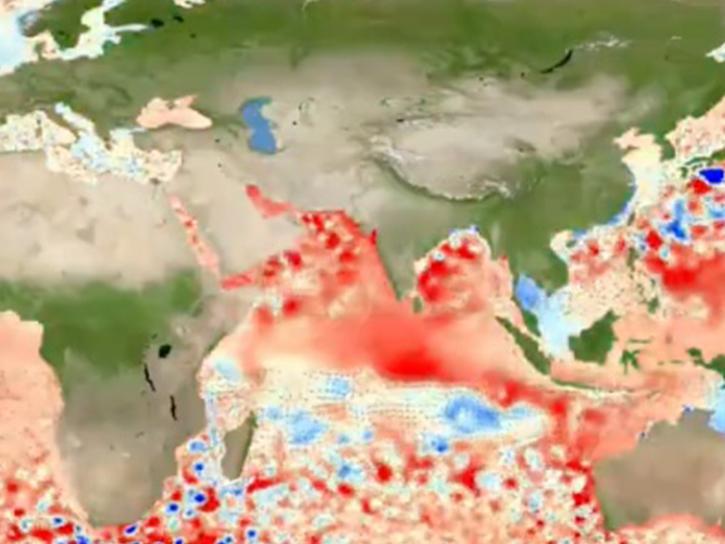
| sst_anomaly | anomaly reference to the day-of-year average between 2003 and 2014 | kelvin | short | -32768 | -32767 to 32767 | 0.001 | N/A |
| time | Nominal time of analyzed fields | seconds since 1981-01-01 00:00:00 UTC | int | N/A | N/A | 1 | N/A |